








Anglo-Saxon Royal Arch: One Degree, Several Traditions
Anglo-Saxon Royal Arch occupies a singular place within Freemasonry. Both a continuation of the Master Mason degree and, depending on the jurisdiction, a system in its own right, it does not fit easily into the usual categories and often unsettles Freemasons formed within a continental framework. What does Anglo-Saxon Royal Arch truly encompass, beyond approximate labels and misleading equivalences? Why does this degree, so central in the Anglo-Saxon world, remain marginal and frequently misunderstood in continental Europe?
Anglo-Saxon Royal Arch cannot be reduced to a simple additional degree. It follows its own internal logic, shaped by history, practice, and the institutional compromises of the various Grand Lodges. Beneath an apparent unity, Anglo-Saxon Royal Arch reveals a plurality of forms, narratives, and structures, reflecting not divergence, but a living development.
To understand Anglo-Saxon Royal Arch is therefore to move beyond a strictly linear reading of degrees and to enter a more nuanced landscape, where a single symbolic core unfolds through distinct traditions without ever losing its deeper coherence.
- 1. Anglo-Saxon Royal Arch: what are we really dealing with?
- 2. Anglo-Saxon Royal Arch: what are its historical origins?
- 3. Anglo-Saxon Royal Arch: a degree… or something else?
- 4. Anglo-Saxon Royal Arch: one narrative, multiple interpretations
- 5. Anglo-Saxon Royal Arch: why do its forms diverge?
- 6. Anglo-Saxon Royal Arch in England and Scotland
- 7. Anglo-Saxon Royal Arch in Ireland: an earlier tradition?
- 8. Anglo-Saxon Royal Arch in America: synthesis or recomposition?
- Conclusion – Anglo-Saxon Royal Arch: unity or diversity?
- FAQ – Anglo-Saxon Royal Arch: understanding a distinct system
- Podcast – Anglo-Saxon Royal Arch: one degree, several traditions
1. Anglo-Saxon Royal Arch: what are we really dealing with?
Anglo-Saxon Royal Arch refers to a set of Masonic practices specific to British jurisdictions and those derived from them. It is neither a simple higher degree nor a uniform extension of the Master Mason degree, but a more complex reality, whose form varies from one country to another while retaining a common core.
In Anglo-Saxon Freemasonry, Royal Arch is generally regarded as the completion of the Master Mason’s journey, without being considered an additional degree in the strict sense. This ambiguity, inherited from its history, largely explains the difficulties it raises within continental Freemasonry, where the initiatic progression is conceived in a more linear way.
A first common confusion lies in equating Anglo-Saxon Royal Arch with the 13th degree of the Ancient Accepted Scottish Rite, known as Royal Arch of Solomon or Royal Arch of Enoch. Although these two systems share historical roots, they now belong to distinct constructions, both in their structure and in their initiatic function.
Another ambiguity should be clarified, namely that surrounding the Royal Ark Mariner, translated into French as Nautonier de l’Arche Royale. Despite the apparent similarity of the terms, they do not refer to the same symbolic framework. In this case, the ark refers to the biblical account of Noah, whereas Anglo-Saxon Royal Arch belongs to an entirely different context, centred on the Temple of Jerusalem and what is associated with it.
2. Anglo-Saxon Royal Arch: what are its historical origins?
The origins of Anglo-Saxon Royal Arch are difficult to establish with any certainty. While some traditions associate it with early practices linked to the Lodge of York, the first clear documentary evidence appears in Ireland in the 1740s. From there, Royal Arch spread and became firmly established in England by the mid-eighteenth century.
Various theories have been put forward regarding its more distant origins. Some authors have suggested a French influence, connected with the chivalric developments set out in Ramsay’s Oration of 1736. This cannot be demonstrated conclusively, but it does highlight the circulation of early higher degrees between France, Ireland, and England along channels that remain only partly understood.

Royal Arch Chapter in the English tradition.
In England, Royal Arch was first adopted by the “Ancients”, whose ranks included many Irish Masons. The “Moderns”, by contrast, initially resisted it, rejecting anything that might be perceived as going beyond the Master Mason degree. This divergence reflects differences in practice and organisation rather than a fundamental doctrinal disagreement.
The situation gradually evolved, culminating in the union of the two Grand Lodges in 1813, which led to the formation of the United Grand Lodge of England. The incorporation of Royal Arch into the new structure required a compromise that has since become well known: so-called “pure and ancient” Freemasonry was defined as consisting of three degrees, “including” the Supreme Order of the Holy Royal Arch. This formulation, both inclusive and ambiguous, has had a lasting impact on the particular status of Royal Arch within English Freemasonry.
3. Anglo-Saxon Royal Arch: a degree… or something else?
The definition adopted in 1813 by the United Grand Lodge of England still shapes the way Anglo-Saxon Royal Arch is understood, while preserving a certain ambiguity. To state that “pure and ancient” Freemasonry consists of three degrees, “including” the Supreme Order of the Holy Royal Arch, is to incorporate it without fully recognising it as a distinct degree.
This formulation is not an oversight, but a compromise. It preserves the principle of a three-degree system while acknowledging the importance of Anglo-Saxon Royal Arch in the completion of the Master Mason’s journey. What emerges is a typically British construction, where coherence rests less on a strictly hierarchical system than on a pragmatic balance between established practices.
In practice, however, Anglo-Saxon Royal Arch operates as an autonomous body. It has its own structures, its own officers, its own Chapters, and its own modes of admission. It is not part of the Craft Lodge, even though it remains closely connected to it. This dual nature — symbolic integration on one hand, institutional autonomy on the other — contributes to its singular character.
Anglo-Saxon Royal Arch thus appears as a continuation of the Master Mason degree, without being an additional degree in the strict sense. It does not extend the initiatic progression in a linear way, but rather deepens it, according to a logic that partly escapes the usual categories of continental Freemasonry.
4. Anglo-Saxon Royal Arch: one narrative, multiple interpretations
Despite the diversity of its forms, Anglo-Saxon Royal Arch rests on a remarkably stable symbolic core. At the heart of the degree lies the discovery of a hidden vault beneath the Temple of Jerusalem, within which a sacred Name is brought to light, carrying a particular significance for the candidate.
This motif of discovery is not that of a sudden revelation, but of a rediscovery. It unfolds within a long temporal horizon, marked by loss, forgetting, and restoration. Anglo-Saxon Royal Arch does not present new knowledge; it brings to light what had been concealed, preserved, yet inaccessible.
In the English, Scottish, and American forms, this narrative is set in the context of the rebuilding of the Temple after the Babylonian exile. The figures of Zerubbabel, the High Priest Joshua, and the prophet Haggai embody this moment of return and reconstruction, alongside other characters drawn from the books of Ezra and Nehemiah. Anglo-Saxon Royal Arch thus establishes a direct link between rebuilding and recovering.
The Irish tradition, by contrast, places the action in an earlier moment of biblical history, during the restoration of the Temple under King Josiah. This shift in narrative setting does not alter the fundamental structure of the degree, but it changes its emphasis: it is no longer a matter of rebuilding after destruction, but of restoring an existing order that has been altered.
Across these variations, Anglo-Saxon Royal Arch maintains a deep coherence. The hidden place, the descent, the discovery, and the transmission remain constant elements, expressed differently across traditions without losing their meaning.
5. Anglo-Saxon Royal Arch: why do its forms diverge?
While Anglo-Saxon Royal Arch displays a clear symbolic unity, its ritual and organisational forms vary significantly from one country to another. This diversity is not the result of disorder, but can be explained by the concrete conditions of its transmission and development during the eighteenth century.
Anglo-Saxon Royal Arch did not emerge as a single, unified system, nor from a single centre. It circulated between Ireland, England, and Scotland, carried by Lodges, Chapters, and Masons who adapted practices to their own context. This movement encouraged the emergence of local variants, which gradually stabilised without ever being fully unified.
Ireland appears to have played a decisive role in this process. The earliest attested forms of Anglo-Saxon Royal Arch are found there, before being introduced into England, particularly through Irish Masons. This origin helps explain certain enduring differences, both in the narratives and in the regalia and practices.
England, by incorporating Anglo-Saxon Royal Arch into its system after 1813, gave it a distinctive institutional framework, shaped by the compromise already mentioned. Scotland, while adopting a closely related form, retained certain specific requirements, particularly in connection with the Mark Master degree.
As for America, it received these multiple influences and reorganised them within the York Rite, integrating Anglo-Saxon Royal Arch into a structured sequence of degrees. This reconfiguration does not represent a break, but an adaptation to a different context.
The divergences observed in Anglo-Saxon Royal Arch therefore do not reflect fundamental oppositions, but rather the traces of a living history, shaped by movement, adjustment, and successive transmission.
6. Anglo-Saxon Royal Arch in England and Scotland
In its English and Scottish forms, Anglo-Saxon Royal Arch presents a largely comparable structure, both in organisation and in narrative. In both cases, it is a single degree, conferred upon Master Masons within a framework distinct from the Craft Lodge, namely the Chapter.
The Three Principals occupy a central role. They represent Zerubbabel, the High Priest Joshua, and the prophet Haggai, figures associated with the rebuilding of the Temple. This triad structures the entire degree and provides its narrative coherence.

Zerubbabel, Joshua and Haggai during the rebuilding of the Temple of Jerusalem.
A notable difference appears, however, in the conditions of admission. In Scotland, the candidate must hold the Mark Master degree, usually conferred within the Craft Lodge as a complement to the Fellowcraft degree. This requirement is not expressed in the same way in England, where Anglo-Saxon Royal Arch follows more directly from the Master Mason degree.
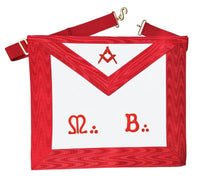
The regalia also shows certain variations. The borders of aprons and the sashes feature alternating triangles, with a slight difference in tone according to jurisdiction: red in England, crimson in Scotland. These distinctions, discreet yet consistent, contribute to the visual identity of each tradition.
Despite these variations, Anglo-Saxon Royal Arch retains a strong degree of uniformity in both countries. It appears as a structured continuation of the Master Mason degree, within a stable framework where the differences reflect usage rather than any fundamental divergence.
7. Anglo-Saxon Royal Arch in Ireland: an earlier tradition?
In Ireland, Anglo-Saxon Royal Arch is distinguished by a different narrative framework, placing it in an earlier period of biblical history. The story is no longer set during the rebuilding of the Temple after the exile, but during its restoration under King Josiah, as recorded in the Second Book of Kings.
The Three Principals represent figures distinct from those found in the English and Scottish traditions. The First Principal represents King Josiah, the Second the High Priest Hilkiah, and the Third the scribe Shaphan. This configuration alters the balance of the narrative, placing the emphasis on rediscovery and restoration within an already existing Temple.
The regalia also differs more markedly. Sashes and apron borders are red, without the alternating triangles seen in the English and Scottish forms. Here, red reflects an older usage, widely attested in eighteenth-century higher degrees, particularly in systems of French origin, where it is often described as the “true Scottish colour”.
As in Scotland, admission to Anglo-Saxon Royal Arch in Ireland requires the candidate to hold the Mark Master degree. This requirement confirms the close relationship between these two degrees, while also reflecting the internal coherence of the insular Masonic systems.
Through its narrative framework, its regalia, and its conditions of admission, Irish Anglo-Saxon Royal Arch retains specific features that may be understood as preserving an earlier form, prior to the developments that became established in England and Scotland.
8. Anglo-Saxon Royal Arch in America: synthesis or recomposition?
As practised in America, Anglo-Saxon Royal Arch operates within a framework that differs significantly from that of the British Isles. It is no longer an isolated degree, but forms part of a structured system, the York Rite, within which it occupies a central position.
In this context, the Royal Arch Chapter governs a sequence of degrees, including Mark Master, Virtual Past Master, Most Excellent Master, and finally Royal Arch Mason. Anglo-Saxon Royal Arch is therefore not only an endpoint, but the culmination of an organised progression.
The narrative, as in England and Scotland, is set within the rebuilding of the Temple. The figures of Zerubbabel, the High Priest Joshua, and the prophet Haggai are present, but their distribution differs. Zerubbabel here assumes the role of Second Principal, while the First Principal is the High Priest Joshua, with Haggai remaining as Third Principal.
The regalia, for its part, is red and closely resembles that of the Irish tradition. This convergence, combined with a degree structure shaped by multiple influences, gives American Anglo-Saxon Royal Arch a composite character.
It may thus be understood as a form of synthesis, without being a simple juxtaposition. Elements drawn from England, Ireland, and Scotland are reorganised into a coherent whole, adapted to the American Masonic context, while still suggesting the existence of earlier traditions whose precise forms are no longer directly accessible.
Conclusion – Anglo-Saxon Royal Arch: unity or diversity?
Anglo-Saxon Royal Arch does not lend itself to a single definition. Through its various forms, it reveals a constant tension between unity and diversity, between symbolic stability and historical variation. What may appear as dispersion in fact reflects a deeper coherence, grounded in the continuity of a shared core transmitted through distinct forms.
From one country to another, Anglo-Saxon Royal Arch adapts without losing itself. The differences observed in narrative, regalia, and structure do not indicate rupture, but rather inflection, shaped by the contexts in which it developed. Far from weakening the degree, this plurality highlights its vitality.
Anglo-Saxon Royal Arch thus invites us to move beyond a strictly linear reading of degrees. It does not simply follow the Master Mason degree; it sheds light on certain of its dimensions, according to a logic that partly escapes the usual categories of continental Freemasonry.
To understand Anglo-Saxon Royal Arch is therefore to recognise that a single initiatic structure can take different forms without losing its unity. This may well be the source of its singular character.
By Ion Rajolescu, Editor-in-Chief of Nos Colonnes — serving a Masonic voice that is just, rigorous, and alive
Explore our collection of English Royal Arch regalia and extend your understanding of the Royal Arch through pieces crafted in accordance with Chapter practice.

1 What is Anglo-Saxon Royal Arch in Freemasonry?
Anglo-Saxon Royal Arch refers to a Masonic system specific to British jurisdictions and those derived from them. It is considered a continuation of the Master Mason degree, without being a separate degree in the strict sense, and is practised within Chapters distinct from Craft Lodges.
2 Is Anglo-Saxon Royal Arch part of the Ancient Accepted Scottish Rite?
No. Anglo-Saxon Royal Arch should not be confused with the 13th degree of the Ancient Accepted Scottish Rite, called Royal Arch of Solomon or Royal Arch of Enoch. Although they share historical roots, they belong to different systems and structures.
3 Why is Royal Arch not considered a separate degree in England?
Since the Act of Union in 1813, English Freemasonry states that it consists of three degrees “including” the Royal Arch. This formulation allows its integration without formally recognising it as an additional degree.
4 What are the main differences between English, Scottish and Irish forms?
The differences mainly concern the narrative framework, the principal figures and certain regalia elements. English and Scottish forms are set during the rebuilding of the Temple, whereas the Irish version refers to an earlier period. Access conditions also vary.
5 What is the role of the York Rite in American Royal Arch?
In the United States, Royal Arch is integrated into the York Rite, where it forms the culmination of a sequence of degrees governed by a Chapter. It is therefore part of a structured progression rather than a standalone grade.
6 What is discovered in the Royal Arch ritual?
The central theme is the discovery of a hidden vault beneath the Temple of Jerusalem, associated with a sacred Name. This reflects a process of rediscovery and restoration rather than a new revelation.
7 Is Anglo-Saxon Royal Arch practised in continental Europe?
It is far less widespread in continental Europe, where it is often practised outside jurisdictions recognised by the United Grand Lodge of England and is sometimes misunderstood or confused with other Masonic degrees.
Read the full transcript of the podcast here for those who prefer reading or want more detail.
Podcast – Anglo-Saxon Royal Arch: one degree, several traditions
Anglo-Saxon Royal Arch holds a singular place within Freemasonry. It often unsettles expectations. Quite simply, it does not fit the categories familiar to Freemasons formed within continental systems.
So, what are we really dealing with?
Anglo-Saxon Royal Arch is not merely an additional degree. It is better understood as a continuation of the Master Mason degree, without extending it in a linear way. That distinction is essential. It explains many of the misunderstandings.
In England, since the Act of Union of eighteen thirteen, so-called “pure and ancient” Freemasonry consists of three degrees. And yet, it also includes Royal Arch. That “including” is not incidental. It reflects a compromise. A way of maintaining balance between principle and practice, between structure and usage.
At first glance, this may seem inconsistent. In reality, it follows a different logic.
Within Anglo-Saxon Freemasonry, there is no imperative to force everything into a perfectly coherent system. A structure may be both integrated and distinct at the same time. Royal Arch operates in that space. It is connected to the Craft, yet it has its own Chapters. It extends the Master Mason degree, yet it does not sit above it as a simple continuation.
This shift in perspective is key to understanding Anglo-Saxon Royal Arch.
But the complexity does not end there.
Behind this apparent unity, Royal Arch exists in several forms. England, Scotland, Ireland, the United States: each tradition preserves a common core, while expressing it differently.
That core deserves attention.
At the heart of the grade lies a single motif: discovery. A descent into a hidden place. A vault concealed beneath the Temple of Jerusalem. Within that space, the recovery of a sacred Name.
This is not a sudden revelation.
It is a rediscovery.
Something has been lost. Forgotten. Then found again. That nuance changes everything. Royal Arch does not present new knowledge. It brings back into light what was already there, but had become inaccessible.
In the English, Scottish and American forms, this narrative is set during the rebuilding of the Temple after the Babylonian exile. Figures such as Zerubbabel, the High Priest Joshua and the prophet Haggai embody that moment of return and restoration.
In Ireland, however, the setting is different.
The narrative is placed in an earlier period, under King Josiah. The focus shifts. The Temple is not rebuilt after destruction, but restored after decline. The structure remains. Something within it has been altered.
This shift is subtle, yet it changes the interpretation.
It is now worth considering the differences between the traditions.
In England and Scotland, Royal Arch takes a largely similar form. It is a single grade, conferred upon Master Masons within a Chapter distinct from the Craft Lodge. The Three Principals represent Zerubbabel, Joshua and Haggai. The structure is stable and recognisable.
Scotland introduces an additional requirement: the Mark Master degree. This detail is significant. It reflects a close relationship between these stages of the Masonic journey.
In Ireland, the distinctions are more pronounced.
The Three Principals differ. King Josiah, the High Priest Hilkiah and the scribe Shaphan replace the figures associated with the rebuilding of the Temple. The regalia also differs. Red predominates. A colour widely attested in many eighteenth-century high degrees.
In the United States, Royal Arch is integrated into a broader system: the York Rite.
It is no longer an isolated grade, but the culmination of a sequence. Mark Master, Past Master, Most Excellent Master, and finally Royal Arch Mason. The structure is organised and progressive.
And yet, the core remains.
The same narrative. The same symbolic framework. But arranged differently. With, at times, a distribution of roles that does not entirely match the British models.
How should this diversity be understood?
Does it reflect contradictions?
Probably not.
Anglo-Saxon Royal Arch shows something else. A way of transmitting a shared content without fixing it into a single form. A capacity to adapt without losing what matters.
Unity does not depend on uniformity.
It depends on fidelity to a core.
And this may be the true singularity of Anglo-Saxon Royal Arch.
It invites a change of perspective. To accept that a single structure can exist in several forms, without losing coherence.
And perhaps, more fundamentally, to recognise that a tradition is not preserved by repeating it identically, but by transmitting it as something living.


I WANT TO RECEIVE NEWS AND EXCLUSIVES!
Keep up to date with new blog posts, news and Nos Colonnes promotions.
