









The Mysterious Chevalier de Ramsay: Life, Thought, and Influence in Freemasonry
The Chevalier de Ramsay occupies a unique place in the history of Freemasonry. His name is inseparable from a famous speech often credited with originating the chivalric tradition of the higher degrees. Yet behind this reputation lies a much more complex character. Who was the Chevalier de Ramsay really? A philosopher, a mystic, a Jacobite loyal to the Stuarts, a visionary Freemason, or a bit of all of these at once? The more one takes an interest in the Chevalier de Ramsay, the more certainties fade away. His birth, his lineage, his career and even certain aspects of his life's journey remain surrounded by questions that continue to intrigue historians and Freemasons nearly three centuries after his death.
- 1. The mysterious origins of the Chevalier de Ramsay
- 2. From Scotland to France: Ramsay's spiritual quest
- 3. Jacobite, knight and courtier
- 4. Ramsay the Freemason
- 5. Ramsay's speeches and their influence
- Conclusion – The Chevalier de Ramsay, between history and legend
- FAQ – The mysterious Chevalier de Ramsay
- Podcast – The mysterious Chevalier de Ramsay
1. The mysterious origins of Chevalier de Ramsay
The life of Chevalier de Ramsay begins with an enigma. Here was a man who frequented the highest political, religious and intellectual circles of his time, who was knighted, appointed tutor to the grandson of James II Stuart and admitted to the Royal Society, but whose exact origins continue to fuel debate among historians.
A birth surrounded by uncertainties
For a long time, biographies asserted that Andrew Michael Ramsay was born in Ayr, in south-west Scotland, in 1686. His father was said to have worked as a baker, which would make Ramsay a man from a relatively modest background. This version was widely accepted for nearly three centuries. Yet the discovery and publication of a letter from Ramsay in 2018 led several researchers to re-examine this question.
According to this document, Ramsay was born in 1693 in Abbotshall, in the county of Fife, on the eastern coast of Scotland. Even more surprisingly, his father was reportedly not a baker but a minister. This hypothesis would better explain the intellectual journey of the young Ramsay, who undertook theology studies at the University of Edinburgh and obtained the degree of Master of Arts in 1707.
However, this new version itself raises difficulties. If Ramsay was indeed born in 1693, he would have completed his university studies at just fourteen years old. Such precocity is not entirely impossible in the context of the era, but it remains exceptional and calls for caution. Thus, the discovery intended to solve a historical enigma ended up creating a new one.
Was Ramsay noble?
The uncertainty does not stop at his date of birth. Another question, even more important for the remainder of his career, concerns his ancestry. Ramsay claimed to be descended from the Ramsays of Dalhousie and the Erskines of Mar, two prestigious lines of Scottish nobility. This lineage appears notably in the patent granted to him in 1723 by James Francis Stuart, the Jacobite claimant to the British throne. If this ancestry were authentic, it would partly explain the many honours bestowed upon him during his lifetime.
However, the evidence remains fragile. No decisive document has made it possible to establish with certainty that Ramsay genuinely belonged to these aristocratic families. Some historians consider that it was a sincere recognition of ancient rights. Others view it rather as a political favour granted to a loyal supporter of the Jacobite cause. In a Europe where titles, alliances, and dynastic loyalties played an essential role, such a distinction could serve political interests as much as genealogical realities.
These grey areas should not obscure a reality. Whatever his social background, Ramsay possessed a solid intellectual background and a remarkable ability to build relationships with influential figures. His career demonstrates that he knew early on how to navigate cultured circles and gain the trust of leading figures. The mysteries surrounding his birth and family are therefore not merely biographical curiosities. They form the first piece of a puzzle that would accompany him throughout his life.
For the further one advances in the life of the Chevalier de Ramsay, the more an impression takes hold: that of a man whose destiny seems constantly to oscillate between historical reality and legend.
2. From Scotland to France: Ramsay’s spiritual quest
Beyond the uncertainties surrounding his origins, one thing appears clearly: Ramsay was driven from an early age by a profound intellectual and spiritual search. This quest was to lead him far beyond the Scotland of his youth and permanently shape his worldview.
After his studies at the University of Edinburgh, he worked for a time as a tutor to the children of the Earl of Wemyss. This occupation was common among educated young men of his time, but Ramsay clearly aspired to more than a simple teaching career. His interest in religious and philosophical questions led him to leave Scotland in 1709 to go to the United Provinces.
The meeting with Pierre Poiret and Fénelon
This journey was no ordinary trip. Ramsay wished to meet Pierre Poiret, a French Calvinist theologian and pastor who had taken refuge in the Netherlands following the revocation of the Edict of Nantes. The two men were already corresponding, a sign that the young Scot had long been interested in spiritual matters. Poiret held a special place in the religious landscape of his time. Whilst remaining Protestant, he had drawn closer to a form of Christian mysticism that placed the emphasis on inner experience rather than doctrinal controversy.
This meeting proved decisive. Shortly afterwards, Ramsay continued his journey to France and reached Cambrai, where François de Salignac de La Mothe-Fénelon, better known simply as Fénelon, was living at the time. A former tutor to the Duke of Burgundy and Archbishop of Cambrai, Fénelon was amongst the most prestigious intellectual figures in the Kingdom of France.
It was under his guidance that Ramsay completed his religious evolution. While he had until then seemed close to deism, he converted to Catholicism. This conversion should not be understood as a mere change of denominational allegiance. It was part of a much deeper search, focused on inner life and spiritual transformation.
The lasting influence of Madame Guyon
Fénelon then introduced Ramsay to Jeanne-Marie Bouvier de La Motte Guyon, known as Madame Guyon. The latter exerted a considerable influence on him. One of the most famous French mystics of her time, she was the main representative of Quietism, a spiritual movement that insisted on trusting surrender to God, inner silence and the soul's openness to divine action.
Quietism was strongly challenged by ecclesiastical authorities. Its opponents accused it of minimising the role of external religious practices in favour of inner experience. Yet, despite official condemnations, its influence extended well beyond the disappearance of its main representatives.

Madame Guyon (1648-1717), French mystic and major figure of Quietism, whose influence deeply marked the spiritual thought of the Chevalier de Ramsay.
In 1714, Ramsay became Madame Guyon's secretary. This role allowed him to spend time daily with the woman who had deeply marked his thinking. When she died in 1717, he was still in her circle. The years spent with Fénelon and Madame Guyon left a lasting imprint on his thought.
This influence would later be reflected in his writings and right up to his conception of Freemasonry. Ramsay developed a vision of Christianity broadly open to different religious traditions, favouring spiritual brotherhood rather than denominational oppositions. In his eyes, what united human beings mattered more than what separated them.
This sensitivity largely explains the originality of his work. When Ramsay later spoke of a universal tradition symbolically going back to the origins of humanity, or when he presented Freemasonry as a meeting place for men of different faiths, he was in fact extending a line of thought begun long before his entry into the Order.
Before being a famous Freemason, before even being a knight or a Jacobite, Ramsay was first and foremost a spiritual seeker. It is in this inner quest that the deepest roots of his thought lie.
3. Jacobite, knight and courtier
Spiritual seeking never turned Ramsay away from the major political questions of his time. Like many Scots of his generation, he remained deeply attached to the Stuart dynasty, driven from the throne of England, Scotland and Ireland during the Glorious Revolution of 1688. This loyalty was to guide much of his life.
The Jacobite commitment of 1715
In 1715, Stuart supporters attempted to restore James Francis Stuart, son of the deposed King James II. This insurrection, known as the Jacobite rising of 1715, mobilised many Scots who remained loyal to their former dynasty. Ramsay then joined a Jacobite regiment and took part in the campaign.
The enterprise ended in failure. The Jacobite forces were defeated at the Battle of Preston in November 1715. Like many of the vanquished, Ramsay was captured. Sentenced to transportation to the Caribbean, he embarked with other prisoners on a ship bound for their place of exile.
What followed reads almost like an adventure novel. A mutiny broke out on board and the ship changed destination. Instead of reaching the colonies, it ended up docking in France in September 1716. Ramsay thus returned to the country where he had stayed a few years earlier and where there was a large Jacobite community in exile.
After the death of Madame Guyon in 1717, he entered the service of a noble family close to her circle. He served as tutor to the younger son until 1722. This period enabled him to consolidate his relationships in French aristocratic circles while remaining active in networks supporting the Stuarts.
When he settled in Paris in 1722, Ramsay was already fully integrated into Jacobite circles. His intelligence, culture and loyalty to the cause quickly earned him the esteem of James Francis Stuart, whom his supporters continued to regard as the legitimate sovereign of the British kingdoms.
The Order of Saint Lazarus and the question of nobility
This confidence was to be rewarded in spectacular fashion. In 1723, James Stuart recommended Ramsay to the Regent of the Kingdom of France, Philippe d’Orléans, to be admitted into the Order of Saint Lazarus. The knighting ceremony took place on 20 May 1723. Ramsay could henceforth bear the title of knight which would make him famous throughout Europe.
The event nevertheless raises several questions. The Order of Saint Lazarus normally required proof of nobility for the admission of its members. However, Ramsay was received as a Knight of Justice, without his aristocratic lineage being clearly established at the time. Even more surprisingly, just three days after the ceremony, James Francis Stuart issued him letters patent recognising his descent from the Ramsays of Dalhousie and the Erskines of Mar.
A simple administrative coincidence or an intervention intended to regularise a delicate situation? Historians still hesitate. This succession of events contributes to strengthening the impression of mystery surrounding Ramsay's career.
Tutor to young Charles Edward Stuart
Distinctions nevertheless continued to accumulate. In 1724, James Stuart appointed him tutor to his son Charles Edward Stuart, the future “Bonnie Prince Charlie”, who was then three and a half years old. This appointment was an exceptional testimony of trust. Few men could be entrusted with the education of the man whom the Jacobites hoped would one day ascend the British throne.
Tensions within the Jacobite court in Rome nevertheless limited this experience. Ramsay quickly returned to France, where he pursued a remarkable intellectual career. Between 1729 and 1730, he stayed in England to promote his works. He was admitted to the Royal Society, one of Europe's most prestigious learned institutions, on the same day as Montesquieu.
On his return to France, he attempted unsuccessfully to join the Académie française. The failure was no doubt disappointing, but it did not diminish his reputation in cultured circles. In 1735, he married Mary Nairne, daughter of the Under-Secretary to James Stuart. That same year, he received the hereditary title of Baronet of Scotland, a further mark of recognition from the Jacobite cause.
Through these successive honours, a singular character emerges. Whether he genuinely belonged to the ancient Scottish nobility or enjoyed the favour of the Stuarts, Ramsay managed to win the trust of sovereigns, prelates, scholars, and aristocrats. Few men of his era could boast such an astonishing career path. Yet behind this remarkable rise, many questions remain, as though each distinction received added a new veil to the mystery rather than clarifying it.
A man without a face?
One final detail contributes to the strangeness of the character. No authenticated portrait of Ramsay is known today. This absence is surprising for a man who frequented princely courts, aristocratic salons, and learned societies of his time.

Portrait traditionally attributed to the Chevalier de Ramsay. However, no authenticated portrait of Ramsay is known with certainty.
In 1921, Arthur Edward Waite published an illustration presented as depicting Ramsay in his New Encyclopaedia of Freemasonry. In reality, it was a knight of the Order of Saint Lazarus based on an engraving from Father Hélyot's monumental work on religious and military orders. There is no evidence to suggest that it is truly the face of Ramsay. Three centuries after his death, the man who was to leave a lasting mark on the history of Freemasonry remains, right down to his features, an elusive figure.
4. Ramsay the Freemason
The Masonic career of the Chevalier de Ramsay is paradoxically less well known than his political, religious, or intellectual career. The man whose name was to become essential in the history of speculative Freemasonry appears relatively little in the Masonic archives of his time.
An initiation shrouded in mystery
According to the traditionally accepted version, Ramsay was made a Freemason in 1730 at the Horn Tavern Lodge in Westminster, during his stay in England from 1729 to 1730. This date is generally accepted by historians, even if certain evidence calls for caution.
Indeed, Ramsay had long frequented the Jacobite circles established in France. Now, these circles already included many Freemasons, and several Lodges were active in their midst. It is therefore possible that Ramsay had become acquainted with Freemasonry prior to his time in Westminster. Some authors have even put forward the hypothesis of an initiation in a French Jacobite Lodge several years earlier. However, there is no formal proof to confirm this.
Grand Orator of the first Grand Lodge of France
Whatever the exact date of his initiation, Ramsay seems to have quickly gained an important place in young French Freemasonry. In 1736, he served as Grand Orator of the first Grand Lodge of France under the Grand Mastership of Charles Radcliffe, Lord Derwentwater. Like Ramsay, the latter was a convinced Jacobite, deeply committed to the Stuart cause.
The office of Grand Orator was a perfect match for Ramsay's talents. A recognised writer, appreciated speaker, and a man of broad culture, he possessed the necessary qualities to deliver addresses during ceremonies and important meetings. His taste for history, philosophy, and spiritual traditions was soon to find a lasting expression in a text destined to go far beyond the boundaries of his era.
The speech that was to secure his posterity
It was in 1736 that Ramsay delivered before St Thomas Lodge No. 1 in Paris what was to become his famous speech. This Lodge was largely made up of British Brethren living in France. The text aimed, in particular, to present Freemasonry as a respectable institution, heir to a long moral and spiritual tradition.
The following year, Ramsay prepared a new, more expanded version of his speech, this time intended to be delivered before the Grand Lodge. Before delivering it, however, he chose to seek the opinion of Cardinal de Fleury, chief minister to Louis XV and a long-time patron.

First page of the manuscript of the 1736 speech, a founding text of the Masonic thought of the Knight de Ramsay.
The Cardinal's reaction was negative. The French authorities were viewing Freemasonry with a certain mistrust at the time, and Fleury deemed it wiser to avoid an address that might draw attention to the Order. Ramsay therefore abandoned his plan, and the 1737 speech was never delivered publicly.
After this episode, traces of his Masonic activity became scarce. Everything points to his gradual retirement from Lodge life. When he died in 1743, his reputation as a thinker, writer, and Stuart supporter was already well established. Yet it was above all as a Freemason that he was to enter posterity.
For while the Masonic career of Ramsay remained relatively modest, the ideas he formulated in his discourses were to exert a considerable influence. They contributed to shaping the imagination of French Freemasonry for a long time to come, and explain why his name continues to be evoked nearly three centuries after his passing.
5. Ramsay's discourses and their influence
If the name of the Chevalier de Ramsay has remained famous in Freemasonry, it owes it mainly to his two discourses of 1736 and 1737. However, these texts should not be reduced to their references to the Crusades or chivalry, for their ambition is far broader.
A universalist vision of Freemasonry
Deeply influenced by Fénelon, Madame Guyon and the Quietist tradition, Ramsay developed a largely universalist vision of spirituality. He presented Freemasonry as a meeting point for men of different religions and nations, united by the pursuit of virtue and wisdom.
This conception relies on an idea that occupies an important place in his thought: the existence of a spiritual tradition common to all humanity. Ramsay was thus particularly sensitive to the figure of Noah, whom he considered to be the symbol of a heritage preceding the religious divisions that arose throughout history. It is, moreover, remarkable that the allusion to Noachism in his 1736 discourse predates by two years the explicit introduction of this notion in Anderson's Constitutions of 1738. Some historians have therefore wondered whether Anderson himself had been influenced by Ramsay.
Crusades and chivalric imagination
The question of the Crusades is the one that posterity has remembered the most. Present in the 1736 discourse, it occupies a more significant place in that of 1737. Ramsay established a link between Freemasonry and the chivalric orders engaged in the Holy Land. This interpretation was to meet with considerable success in 18th-century French Freemasonry.
However, it would be an overstatement to see Ramsay as the inventor of the chivalric higher degrees. These appeared after him and developed under the influence of numerous authors. On the other hand, his discourses undoubtedly contributed to creating a climate favourable to their emergence by offering Freemasonry a chivalric imagination particularly appealing to the French nobility.
Thus, Ramsay's legacy is limited neither to the Crusades nor to the higher degrees. It lies just as much in his vision of a universal brotherhood rooted in a spiritual heritage common to all humanity.
Conclusion – The Chevalier de Ramsay, between history and legend
The Chevalier de Ramsay remains one of the most fascinating figures in Masonic history. A Scot of debated origins, converted to Catholicism under Fénelon and Madame Guyon, a loyal supporter of the Stuarts and an influential Freemason, he lived through his era leaving behind more questions than certainties.
His reputation today rests mainly on his orations of 1736 and 1737. These helped to spread a universalist vision of Freemasonry while paving the way for a chivalric imagery that would leave a lasting mark on French Freemasonry. Yet, Ramsay's contribution is limited neither to the Crusades nor to the higher degrees. His work also bears witness to a desire to seek what brings human beings together beyond religious and national boundaries.
Nearly three centuries after his passing, the Chevalier de Ramsay thus remains at the crossroads of history and legend, which no doubt explains why his name continues to hold a special place in Masonic memory.
By Ion Rajolescu, editor-in-chief of Nos Colonnes — in the service of a fair, rigorous and living Masonic voice.
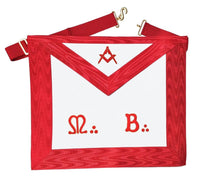
Discover our collection dedicated to the Inner Order of the Strict Templar Observance, heir to the chivalric imagery that deeply marked part of 18th-century European Freemasonry.

1 Who was the Chevalier de Ramsay?
The Chevalier de Ramsay, full name Andrew Michael Ramsay, was an 18th-century Scottish writer, philosopher, Jacobite, and Freemason. He is best known for his orations of 1736 and 1737, which exerted a lasting influence on French Freemasonry and on the development of chivalric symbolism in the higher degrees.
2 Why is the Chevalier de Ramsay famous in Freemasonry?
The Chevalier de Ramsay is primarily famous for his Masonic orations, in which he presents Freemasonry as a universal brotherhood and establishes a symbolic link between the Order and the Crusades. These texts deeply marked 18th-century Masonic thought.
3 Was the Chevalier de Ramsay really noble?
The question remains debated. Ramsay claimed descent from the Scottish families Ramsay of Dalhousie and Erskine of Mar, and this ancestry was recognised by James Francis Edward Stuart in 1723. However, historians do not possess sufficient evidence to definitively confirm this lineage.
4 When did the Chevalier de Ramsay become a Freemason?
The generally accepted date is 1730, when he was received at the Horn Tavern Lodge in Westminster. However, some researchers believe that he may have been initiated earlier in a Jacobite lodge in France, but there is no formal proof to confirm this hypothesis.
5 What link exists between the Chevalier de Ramsay and the higher degrees?
The Chevalier de Ramsay did not create higher Masonic degrees. On the other hand, his orations contributed to popularising the idea of a chivalric origin of Freemasonry. This interpretation exerted a significant influence on the emergence of numerous degrees and Masonic systems developed in France during the 18th century.
6 What place does Noah occupy in Ramsay's thought?
Ramsay considered Noah to be the symbol of a spiritual heritage common to all humanity. This universal vision, sometimes described as Noachic or Noachite, occupies an important place in his orations and contributes to his conception of a Freemasonry open to men of different beliefs.
7 Why does the Chevalier de Ramsay remain a mysterious figure?
Several aspects of his life remain uncertain, notably his date of birth, family origins, noble ancestry, and even his physical appearance, as no authenticated portrait is known. These areas of mystery still contribute today to the fascination he holds for historians and Freemasons.
Find here the full transcript of the podcast for those who prefer reading or wish to explore the discussions in more detail.
Podcast – The mysterious Knight of Ramsay
When a Freemason hears the name of the Knight of Ramsay mentioned, he usually thinks of a famous speech, the Crusades or even chivalric higher degrees. Yet, behind this reputation lies a character far more complex than the image often conveyed by Masonic tradition.
Andrew Michael Ramsay remains one of the most intriguing figures of the eighteenth century. His life seems to oscillate constantly between history and legend. His date of birth is debated. His social origins remain uncertain. His noble ancestry has never been established with certainty. And as if to add further to the mystery, no authenticated portrait of him has survived.
For a long time, it was claimed that he was born in Ayr, Scotland, in sixteen eighty-six, into a modest family. However, a letter published several centuries later suggests that he was born in sixteen ninety-three in Abbotshall and that his father was a minister. As is often the case with Ramsay, certainties are rare and several aspects of his origins remain debated.
One thing nevertheless appears clearly. Ramsay received a solid intellectual education at the University of Edinburgh. Very early on, he took an interest in religious and philosophical questions. This curiosity led him to leave Scotland for continental Europe.
In the United Provinces, he met the theologian Pierre Poiret, an important figure of mystical Protestantism. Shortly afterwards, he moved to France and made the acquaintance of Fénelon, one of the great Catholic thinkers of his time. Under his influence, Ramsay converted to Catholicism.
Fénelon also put him in touch with Madame Guyon, a famous representative of Quietism. This spiritual movement stressed inner experience, the silence of the soul and trustful abandonment to divine action. Ramsay was deeply marked by this teaching. He even became Madame Guyon's secretary and remained close to her until her death.
This period is essential to understanding his thought. Long before his Masonic involvement, Ramsay was already seeking to overcome religious divisions. He was more interested in what unites human beings than in what separates them. This aspiration for a universal brotherhood would later permeate all his work.
Alongside this spiritual quest, Ramsay remained deeply attached to the Jacobite cause. The Jacobites supported the Stuart dynasty, driven from the British throne at the end of the seventeenth century.
During the uprising of seventeen fifteen, Ramsay joined the forces loyal to James Francis Stuart. The rebellion failed. Captured, he was sentenced to transportation to the Caribbean. Destiny decided otherwise. A mutiny broke out aboard the ship carrying him, and it eventually reached France.
Back on the Continent, Ramsay continued his rise. Thanks to his intelligence, his culture and his connections, he gradually gained the trust of the Jacobite leaders.
In seventeen twenty-three, James Francis Stuart obtained his admission to the Order of Saint Lazarus for him. Ramsay then received the title of knight under which he would enter history. Here again, the mystery remains. He was admitted as a Knight of Justice even though his nobility was not clearly established. Only three days later, James Francis Stuart granted him letters patent recognizing his aristocratic ancestry.
The following year, Ramsay was entrusted with the education of young Charles Edward Stuart, the man history would remember as Bonnie Prince Charlie. He subsequently became a Fellow of the Royal Society and frequented some of the most prestigious intellectual circles in Europe.
However, it was in Freemasonry that his name would achieve its greatest legacy.
According to tradition, Ramsay was made a Freemason in Westminster in seventeen thirty. Some researchers believe that he may have already attended Jacobite lodges in France, but proof is lacking.
What is certain is that in seventeen thirty-six he held the office of Grand Orator of the first Grand Lodge of France. This responsibility suited his talents as a writer and speaker perfectly.
That same year, he delivered an oration before the Saint-Thomas Lodge in Paris that was destined to leave a lasting mark on Masonic history. A second version was drafted the following year. It was never delivered, as Cardinal de Fleury advised Ramsay to forgo speaking.
These two speeches are often associated with knighthood and the Crusades. Yet, their content is richer than is generally remembered.
Above all, Ramsay develops a universalist vision of Freemasonry. For him, the Order must unite men of different nations and religions around a shared pursuit of virtue and wisdom.
This conception is based on an important idea: the existence of a spiritual tradition common to all humanity. Ramsay thus accords a special place to the figure of Noah, a symbol of a heritage preceding denominational divisions. He imagines a primitive wisdom of which the various religious traditions would have preserved certain elements.
This vision is remarkable. It even precedes the explicit introduction of Noachism in the seventeen thirty-eight edition of Anderson's Constitutions. Some historians have wondered whether Anderson himself had been influenced by Ramsay.
The question of the Crusades also appears in his discourses. Ramsay established a symbolic link between Freemasonry and certain chivalric orders active in the Holy Land. This idea was to exert a considerable influence on the French Masonic imagination.
However, a common misconception must be avoided. Ramsay created no Masonic higher degrees. The chivalric systems that developed during the eighteenth century were the work of other authors. On the other hand, his discourses contributed to providing a historical and symbolic framework in which these degrees were to flourish.
It is no doubt for this reason that his name remained associated with the birth of chivalric Freemasonry. But reducing Ramsay to this dimension alone would be unfair.
Behind the Jacobite, behind the knight and behind the Freemason lay a man in search of unity. His entire life bears witness to an effort to bring together worlds that seemed opposed: Protestantism and Catholicism, politics and spirituality, religious traditions and universal ideals.
Nearly three centuries after his death, the Chevalier de Ramsay thus continues to occupy a special place in Masonic memory. Perhaps because he remains difficult to pin down. Perhaps also because the questions he raised continue to accompany us today.


I WANT TO RECEIVE NEWS AND EXCLUSIVE OFFERS!
Stay up to date with new blog articles, new products and Nos Colonnes promotions.
