



The Aprons of the Scottish Standard Rite
When visiting another Lodge, you may already have noticed Freemasons wearing an apron edged with tartan rather than a plain colour. This regalia often surprises Continental visitors, so far does it depart from the customs of most Masonic rites. It is associated with the Scottish Standard Rite, a ritual whose name is well known but whose origin and nature remain largely misunderstood. Why choose a tartan rather than a traditional colour? Does this choice reflect an ancient custom of Scottish Freemasonry, or a more recent creation? To answer these questions, we have to go back to the singular history of Freemasonry in Scotland and understand what the aprons of the Scottish Standard Rite really stand for. The aprons of the Scottish Standard Rite are indeed the product of a tradition more complex than it first appears, one in which historical heritage and contemporary adaptation meet. The aprons of the Scottish Standard Rite therefore tell a very different story from the one their simple appearance might suggest.
- 1. The aprons of the Scottish Standard Rite: why are they tartan?
- 2. Why is Freemasonry in Scotland different?
- 3. Does the Scottish Standard Rite really exist?
- 4. Why do the aprons of the Scottish Standard Rite use the Royal Stewart tartan?
- 5. Are the aprons of the Scottish Standard Rite faithful to Scottish tradition?
- Conclusion – The aprons of the Scottish Standard Rite
- FAQ – The aprons of the Scottish Standard Rite
- Podcast – The aprons of the Scottish Standard Rite
1. The aprons of the Scottish Standard Rite: why are they tartan?
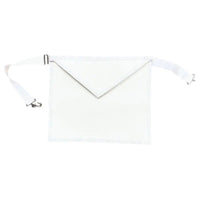
The aprons of the Scottish Standard Rite stand out at once for their tartan border, made in the famous Royal Stewart pattern. For Freemasons used to craft lodge aprons that are most often edged in blue or red, this choice may seem purely decorative. Yet it follows a very specific historical and symbolic logic.
Contrary to a widespread belief, the Scottish Standard Rite is not an old Scottish rite that has preserved immemorial customs. It is a ritual drawn up at the beginning of the twentieth century to offer a common form of Scottish Masonic practice, without calling into question the traditions specific to each of the Lodges of Scotland. The aprons now associated with it are therefore not the legacy of a single custom, but the result of a choice made to represent, outside Scotland, the Scottish Masonic tradition.
Why settle on a tartan rather than a colour? Because tartan is probably the element most immediately associated with Scotland’s identity. Where other rites are distinguished by a particular colour of regalia, the Scottish Standard Rite chose a textile pattern that evokes the history of clans, regions and Scottish traditions. This choice gives the aprons an instantly recognisable identity, while affirming their connection to a strong national culture.
This apparent simplicity, however, hides a far more nuanced reality. Freemasonry in Scotland has never known uniformity in its regalia. Quite the contrary: each Lodge has its own customs, inherited from its history. To understand why a tartan was eventually adopted as the emblem of the Scottish Standard Rite, we must first look at the very particular organisation of Freemasonry in Scotland itself.
2. Why is Freemasonry in Scotland different?
To understand the origin of the Scottish Standard Rite and its aprons, we must first look at the very particular structure of Freemasonry in Scotland. We will also avoid the adjective “écossais” (Scottish) here, since in French it is often a source of confusion: it also designates the various so-called “Scottish” rites developed on the European continent, which have no direct historical link with Scotland.
Freemasonry in Scotland presents a very different face from the English, Irish, American or Continental traditions. Although the Grand Lodge of Scotland was founded in 1736, after those of London and Ireland, it rests on a much older tradition. Scotland is indeed the only country where Lodges of masons existed without interruption from the end of the Middle Ages until the birth of speculative Freemasonry.
Before 1736, there was no Grand Lodge in the modern sense of the term. The Lodges were nonetheless united within what might be called the Order of the Masons of Scotland, placed under the hereditary protection of the Sinclair family, as confirmed by the charters of 1601 and 1628. These texts did not create that office; they renewed an institution that was already old.
The organisation rested above all on the relationships between Mother Lodges and Daughter Lodges. Certain Lodges, described as immemorial, held the old traditions and had founded new Lodges, which could in turn create others. Among the most famous are the Lodge of Kilwinning and the Lodge of Mary’s Chapel in Edinburgh. Freemasonry in Scotland thus grew like a vast family tree, in which each Lodge knew its origins while recognising the other branches of the same tradition.

Lodge Mary’s Chapel No. 1, in Edinburgh, is one of the oldest Masonic Lodges in Scotland and bears witness to the remarkable continuity of the Scottish tradition
The creation of the Grand Lodge of Scotland did not upset this balance. The old Lodges kept their privileges, their customs and their ritual practices. The main mission of the new institution was to ensure the cohesion of the whole, without imposing a uniformity that would have run counter to the traditions of the country.
This autonomy explains a little-known peculiarity: there is no single ritual in Scotland. Each Lodge received that of its Mother Lodge, sometimes adapted it over time, then passed it on to its own Daughter Lodges. With some 640 Lodges today, the Grand Lodge of Scotland thus recognises several hundred ritual variants, which can be grouped into a few broad families without ever being reduced to a single model.
Such diversity often surprises Freemasons from more centralised Obediences, where rituals and regalia are defined by a central authority. In Scotland, the age of the Lodges and their deep roots in society have led to an entirely different conception: unity rests not on uniformity, but on the recognition of a shared history and respect for the traditions specific to each lodge. It is precisely this reality that allows us to understand what the Scottish Standard Rite really is.
3. Does the Scottish Standard Rite really exist?
In the light of this extraordinary diversity, one question naturally arises: what, then, is the Scottish Standard Rite? If every Scottish Lodge has its own ritual, how can there be a “standard rite” common to all of them?
The answer is paradoxical. The Scottish Standard Rite does exist, but it is practised by no Lodge in Scotland.
This apparent contradiction is explained by the circumstances of its creation. Since the Grand Lodge of Scotland could not, and did not wish to, impose a single ritual on the Lodges under its authority, it decided at the turn of the twentieth century to draw up a Standard Ritual. It was published in 1901 to set down the lowest common denominator of Scottish Masonic practice. The aim was not to replace the traditional rituals of the Lodges, but to define a minimal framework respecting the essential principles of the Scottish tradition.
The Scottish Standard Rite is therefore not a new rite meant to take the place of existing practices. Rather, it is a synthesis of the most widely shared customs, leaving intact the particularities inherited from the Mother Lodges. Scottish lodges thus went on working according to their own rituals, handed down from generation to generation.
This Standard Ritual did, however, find an unexpected use outside Scotland. Lodges founded in several European countries, notably in France, wished to work according to the Scottish Masonic tradition without being historically attached to one of the old Mother Lodges. The ritual published in 1901 offered them a simple solution: to work from a text recognised by the Grand Lodge of Scotland, reflecting the fundamental customs of the Scottish Masonic tradition.
It was in this context that Lodges working the Scottish Standard Rite developed outside its country of origin. One practical question remained, however. Since Scottish Lodges used a wide variety of regalia, which aprons should these new Lodges adopt to express their attachment to the Masonic tradition of Scotland? It was this question that led to the choice of the famous Royal Stewart tartan.
4. Why do the aprons of the Scottish Standard Rite use the Royal Stewart tartan?
In Scotland, Masonic aprons do not follow a single model imposed on every Lodge. The general shape has a recognisable feature, with a rounded flap, but colours and borders vary widely from one lodge to another. Some Lodges use blue, green, red, yellow or orange borders; others have adopted a tartan linked to their region, their local history or a particular tradition.
This freedom directly reflects the organisation of Freemasonry in Scotland. Since each Lodge has its own ritual heritage, it was natural for the regalia themselves to express this diversity. The apron is therefore not merely an item of dress common to all Freemasons. It can also become the visible sign of a local allegiance, of a Lodge lineage, or of a custom handed down over time.
The European Lodges working the Scottish Standard Rite found themselves in a different situation. They practised a common ritual, published in 1901, but could not lay direct claim to the particular customs of a Scottish Mother Lodge. In a Continental Masonic culture used to identifying rites by relatively uniform regalia, a clear distinguishing mark had to be adopted.
Tartan was the natural choice, because it instantly evokes Scotland. But which tartan? A tartan is never a mere decorative pattern: it may refer to a clan, a family, a region, an institution or a restricted use. Wearing a particular tartan without any legitimate claim to it could therefore seem clumsy, or even inappropriate.
The Royal Stewart tartan offered an obvious solution. Associated with the House of Stuart, it has a strong Scottish resonance and great international visibility. It has also become, in the popular imagination, one of the most recognisable patterns of Scotland. Its adoption for the aprons of the Scottish Standard Rite thus gave the Lodges concerned an immediately legible identity, without artificially tying them to a specific clan or region.
This choice is not without ambiguity. The Royal Stewart is so widespread today that it can sometimes come across as an almost touristic image of Scotland. It gives the aprons undeniable visual impact, but it does not reflect the real diversity of Scottish Masonic customs. That is precisely what makes this regalia interesting: it expresses both a sincere attachment to the tradition of Scotland and a Continental adaptation of that tradition.
5. Are the aprons of the Scottish Standard Rite faithful to Scottish tradition?
The aprons of the Scottish Standard Rite are ultimately a perfect illustration of the paradox that defines this ritual. For many Freemasons they have become the very symbol of the Masonic tradition of Scotland. Yet that tradition was never built around uniformity.
For several centuries, Freemasonry in Scotland has rested on the autonomy of its Lodges. Each one keeps its own customs, its ritual particularities and, very often, its own regalia. This diversity is not an anomaly: on the contrary, it is one of the fundamental characteristics of the Scottish tradition. It is precisely to preserve this heritage that the Grand Lodge of Scotland has never sought to impose a single ritual on all the Lodges under its authority.
The adoption of a common apron for Lodges working the Scottish Standard Rite therefore follows a different logic. It reflects rather the habits of Continental Freemasonry, where each rite is generally associated with specific and easily identifiable regalia. The choice of the Royal Stewart tartan thus makes this ritual instantly identifiable, while affirming its Scottish inspiration.
These aprons should therefore not be seen as an exact reflection of the customs observed in the Lodges of Scotland. They are rather the expression of a Scottish tradition adapted to an international context. Their originality lies not only in their tartan border, but in the story they tell: that of an ancient Freemasonry, deeply attached to the freedom of its Lodges, and of a ritual designed to carry this heritage far beyond the borders of Scotland.
The aprons of the Scottish Standard Rite thus remind us that a living tradition can never be reduced to a uniform or a symbol. On the contrary, they invite us to discover the richness of a Freemasonry in which unity has always been built on respect for diversity.
Conclusion – The aprons of the Scottish Standard Rite
The aprons of the Scottish Standard Rite intrigue with their Royal Stewart tartan border, instantly associated with Scotland. Behind this singularity, however, lies a more nuanced reality. Contrary to what one might think, they do not reproduce a uniform custom of Scottish Lodges; instead they accompany a ritual drawn up at the beginning of the twentieth century to set out the essential principles of the Masonic tradition of Scotland.
In Scotland itself, each Lodge remains free to keep its own rituals and its own regalia, inherited from its history. The aprons of the Scottish Standard Rite thus bear witness less to loyalty to a single form than to a desire to keep alive, outside Scotland, a tradition founded on continuity, transmission and the autonomy of the Lodges. In the end, they illustrate an essential idea of Freemasonry in Scotland: unity can sit perfectly well alongside diversity of practice.
By Ion Rajolescu, editor-in-chief of Nos Colonnes — in the service of a Masonic voice that is accurate, rigorous and alive.

Why are the aprons of the Scottish Standard Rite edged with tartan?
The aprons of the Scottish Standard Rite are edged with the Royal Stewart tartan to affirm their connection to the Masonic tradition of Scotland. This choice does not correspond to a universal custom among Scottish Lodges, but to a visual identity adopted by Lodges working the Scottish Standard Rite outside its country of origin.
Is the Scottish Standard Rite practised in Scotland?
Paradoxically, no. The Scottish Standard Rite was published in 1901 by the Grand Lodge of Scotland as a reference ritual, but Scottish Lodges continue to work according to their own ritual traditions, inherited from their history and lineage.
What is the Royal Stewart tartan?
The Royal Stewart is one of the most famous tartans of Scotland. Historically associated with the House of Stuart, it has over time become the best-known Scottish pattern in the world. It is this renown that explains its adoption for the aprons of the Scottish Standard Rite.
Do all Scottish Lodges use the same apron?
No. Freemasonry in Scotland leaves its Lodges great freedom in matters of regalia. Apron borders may be in different colours or made from a variety of tartans, according to the customs of each lodge.
Why is it called the Scottish Standard Rite?
The term refers to a ritual published by the Grand Lodge of Scotland in 1901 to define the common principles of the Scottish Masonic tradition. It is not a historical rite in the Continental sense, but a “standard” intended to serve as a reference.
What is distinctive about Freemasonry in Scotland?
Freemasonry in Scotland stands out for the very great autonomy of its Lodges. Each lodge keeps its own ritual, handed down by its Mother Lodge, which explains the existence of many recognised ritual variants within the Grand Lodge of Scotland.
Why are the aprons of the Scottish Standard Rite so different from other Masonic aprons?
The aprons of the Scottish Standard Rite stand out for their tartan border rather than a plain colour. This choice reflects a wish to evoke Scotland and its cultural heritage at a glance, while giving the Lodges working this ritual a visual identity of their own.
Here you will find the full transcript of the podcast, for those who prefer reading or wish to explore the discussion further.
Podcast – The aprons of the Scottish Standard Rite
When visiting a Lodge, you may already have come across Brethren wearing an apron edged with tartan. For a Freemason used to craft lodge regalia bordered in blue or red, the effect is immediate. These aprons intrigue. They evoke Scotland, the Highlands, the clans, and a whole history that one senses is older than the simple choice of a fabric.
These aprons are associated with the Scottish Standard Rite, known in English as the Royal Standard of Scotland. Yet their story is subtler than it seems. The Royal Stewart tartan that edges them is not the legacy of a custom shared by all the Lodges of Scotland. Rather, it is a way of giving a strong visual identity to a ritual practised outside its country of origin.
To understand this, we must go back to Freemasonry in Scotland itself. It does not work like most Continental Obediences, where rituals are generally set by a central authority. In Scotland, Lodges enjoy a very great degree of autonomy. Some of them have roots in a very old history, predating the creation of the Grand Lodge of Scotland in seventeen thirty-six.
Before that date, Lodges were bound together by lineages, local traditions and relationships between Mother Lodges and Daughter Lodges. The Lodge of Kilwinning and that of Mary’s Chapel, in Edinburgh, are among the most famous of these old Lodges. Each passed on its customs, its ritual forms and its own spirit. The creation of the Grand Lodge of Scotland did not abolish this diversity. Rather, it organised and preserved it.
That is why there is no single Masonic ritual in Scotland imposed on every Lodge. Each lodge keeps its customs, some very old, some adapted over time. This diversity is naturally found in the regalia too. Aprons may be edged in different colours, or even in particular tartans, linked to a region, a local history or a Lodge tradition.
The Scottish Standard Rite was born in a different context. Published in nineteen hundred and one by the Grand Lodge of Scotland, it was not intended to replace the rituals of Scottish Lodges. Rather, it sought to set down a reference form, a standard, reflecting the fundamental customs of the Masonic tradition of Scotland. Paradoxically, this ritual is practised by no Lodge in Scotland, since the Lodges there keep their own rituals.
It was outside Scotland, notably in Continental Europe, that this text found a practical application. Lodges wishing to work in the spirit of the Scottish Masonic tradition could thus rely on a recognised ritual, without being historically attached to a Mother Lodge in Scotland.
A very practical question then remained: which aprons to adopt? In the Continental way of thinking, a rite is often associated with recognisable regalia. Tartan therefore became the almost natural choice, since it immediately evokes Scotland. But not all tartans are equal. Some refer to clans, families, regions or restricted uses.
The Royal Stewart offered an obvious solution. Associated with the House of Stuart, it has become one of the best-known tartans in the world. It gives the aprons of the Scottish Standard Rite an immediately legible identity. But this choice also carries a measure of paradox. It visually standardises a rite that claims to hand down the spirit of a tradition founded, precisely, on the diversity of customs.
The aprons of the Scottish Standard Rite should therefore not be understood as an exact reproduction of the customs of Scottish Lodges. They are rather the expression of a tradition adapted to an international context. They recall Scotland, but they also say something about the way Continental Freemasonry likes to identify its rites through distinctive regalia.
Behind a simple tartan border, then, lies a rich story: that of the old Lodges of Scotland, their autonomy, their lineages, and a ritual that has become, outside its country of origin, one of the most recognisable signs of this tradition. The aprons of the Scottish Standard Rite are therefore not merely original. They invite us to understand another way of living Masonic unity: a unity that comes not through uniformity, but through the recognition of a shared history.


I WANT TO RECEIVE NEWS AND EXCLUSIVES!
Keep up to date with new blog posts, news and Nos Colonnes promotions.
