





Why is the letter G at the centre of the Masonic Temple ?
1. The letter G in Freemasonry : a letter without words, yet full of meaning.
In the codified world of Freemasonry, where every word counts and every letter is hidden behind three dots, the letter G. It does not designate a sacred word, it is not followed by dots and it is not uniformly explained in the rituals. Standing alone at the centre of the symbolic edifice, it is a visible yet unresolved enigma.
Traditionally, abbreviated Masonic letters veil what they designate : J∴ and B∴ for the pillars, M∴ B∴ for the Master Mason word, and C∴ K∴ H∴ for 'Knight Kadosh'. They function as thresholds, remaining silent about what is to be uncovered. The letter G, however, conceals nothing. It reveals itself in all its graphic nakedness at the centre of the Delta or the Blazing Star, positioned between the square and compasses. Isn't that in itself a paradox?

The letter G in the Masonic Temple
Is it the initial of a divine name ? A cosmic principle ? A tool of Royal Art ? Or is it something quite different : a Masonic G symbol whose function is precisely to avoid being reduced to a single meaning ?
Perhaps the silence of the G is more eloquent than many a speech. What if this silent but luminous letter was not there to designate, but to provide orientation ? To provide an internal sense of direction rather than an external word ? Perhaps this is the true sacred geometry of Freemasonry : a silent letter that places.
2. God, Geometry, Gnosis, Genius : what does the Masonic G symbol really conceal ?
Freemasons have certainly not lacked imagination when it comes to interpreting the Masonic G symbol. Very early on, several hypotheses were circulated, often complementary and sometimes contradictory. In the Anglo-Saxon tradition, the first explanation was almost instinctive : G would be the initial of 'God'. This seemingly straightforward interpretation elevated G to the pinnacle of the symbolic system, serving as a reminder that all things begin and end with God.
For those with a more practical approach, it was obvious that G stood for 'geometry'. The art of building, tracing, measuring and thinking about the universe in terms of proportions — geometry is the science of the Great Architect of the Universe.

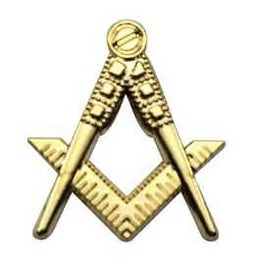
The letter G at the heart of the Square and Compasses
Others have seen Gnosis in it : that inner knowledge which we discover within ourselves, rather than receiving from a master. Further along the symbolic axis, some recognise Gravitation — the mysterious law that links the stars — or even Generation in its cosmogonic, sexual, or spiritual sense.
Finally, one interpretation suggests that it represents Genius : not a supernatural spirit, but humanity's creative force and its ability to transform, connect with and give form to the invisible.
Should we choose between all these hypotheses ? Can we decide ? Or should we accept this plurality as a richness? After all, the letter G in Freemasonry has never been defined in a single way. Like a mirror, it reflects the viewer's own perspective. What if this openness to interpretation is precisely its purpose ? To exist as an enigma of its own volition, a letter at the intersection of God, geometry, gnosis and genius, without ever merging ?
3. The G for Three : A Forgotten Value
In Freemasonry, the letter G is often interpreted according to modern languages, particularly French and English, in which it occupies seventh place in the alphabet. However, this seemingly minor detail has led to many misinterpretations. After all, why would the Fellowcraft, whose symbolic number is five, discover a letter linked to seven ? And why does the G not appear in the Master Mason Degree if its modern alphabetical position determines its use ? This inconsistency is only apparent. It becomes clear as soon as we leave behind contemporary conventions and return to ancient alphabets.
In the Greek alphabet, Gamma is the third letter. The same is true of the Hebrew Ghimel and their common ancestor, the Phoenician Gaml. In these traditions, the letter we call G had a numerical value of Three. This is where the symbol takes on new depth. In Freemasonry, Three is not a quantity ; it is a structure, a force and a presence. There are three pillars, three strokes and three degrees. Three represents balance in movement, the transition from duality to synthesis and is the number of the Fellowcraft, who learns to stand between verticality and horizontality.
What if the letter G in Freemasonry were not so much an initial as a number? It is an ancient number originating from Semitic and Greek traditions and conveying a ternary dynamic. It would be read not as a figure, but as an orientation : a triangular base, an invisible structure and a potential path upwards. In this case, the G would be less a word to guess and more a journey to experience.
4. A square-like letter : the origins of the line
Before becoming a rounded letter, the Freemason letter 'G' was an angle. Its earliest forms, found in the Phoenician Gaml, the archaic Hebrew Ghimel and the Greek Gamma, all resembled a square. Two rigid lines forming a right or obtuse angle were a symbol of rigour, orientation and measurement. The Semitic root of Ghimel also evokes the camel — a patient and supportive animal that crosses deserts, much like the Fellowcraft navigates the arid stages of their own journey. Thus, the sign became a guide, an instrument and a figure in motion.

Phoenician alphabet
When the Romans adopted the Greek alphabet via the Etruscans, they encountered a phonetic issue : their language did not distinguish between C and G, both of which were written using the same symbol. They therefore created a new letter, G, by adding a small graphic appendage to C — a sort of mini-square attached to the curve. This simple gesture transformed the C into a G, adding a tool to the circle, an angle to the fluidity and rigour to the roundness. It was also the Romans who placed G in seventh position in the Latin alphabet, thus establishing an order that no longer corresponded to ancient symbolic logic.
This graphic origin is more than just a historical detail. It reveals a fertile tension between two principles : measurement and movement ; the tool and the living being. In Freemasonry, the letter G, placed between the square and compasses, rediscovers its full legitimacy: it is an inherited sign, an instrument of passage, and a trace of the memory of the line.
5. The G at the centre of the Star : a light to be inhabited.
Sometimes suspended above the mosaic pavement and sometimes embroidered on the lodge tracing board , the letter G shines out at the centre of the Blazing Star. Not as a fixed emblem, but as a silent call. It sits between the Square and Compasses at the heart of the Delta adorning the Worshipful Master. Some see it as a sign of power ; others, as a cosmic landmark. However, it should perhaps be read differently : as a point of balance and an inner source to be recognised and embraced.
For if the Blazing Star lights the way, it is not to impose a truth, but to awaken awareness. The G is not an authoritarian symbol, but a symbolic focal point. It does not designate anything ; it indicates. It does not dictate ; it guides. It does not speak, but enlightens. This is perhaps what makes it one of the most subtle signs in Masonic iconography — it cannot be explained, only approached.
In Freemasonry, the letter G resists reduction. It does not refer to a definition, but to an attitude. An inner posture made up of balance, rigour, and clarity. Like the star it inhabits, it invites us to shine quietly, to measure flexibly, and to build inclusively. It is there, at the centre of the temple, to remind us all that all true light begins with a point : the point we inhabit.
Conclusion
It is tempting to turn to the letter G in Freemasonry for clarity, stability and certainty. However, everything about its symbolic use resists this temptation. It shows, not tells. It does not name ; it designates. Present at the heart of the temple, as well as at the heart of the Star, it marks a centre more than it reveals a secret.
Whether we understand it as Geometry, God, Gnosis or Genius, it always remains just out of reach. It is not there for us to understand, but to confront. It questions as much as it guides, and perhaps this is what makes it so precious : its refusal to be reduced and its power to open things up.
It is a letter not to be said, but traced.
By Ion Rajolescu, editor-in-chief of Nos Colonnes, dedicated to delivering an accurate, rigorous and vibrant Masonic message.
Keen to explore the symbol of the Letter G in Freemasonry further ?
Have a look at our article : “The Blazing Star in Freemasonry : Symbol, Geometry and Light.”
____________________________________________
FAQ : The letter G in Freemasonry
1. What does the letter G mean in Freemasonry ?
The letter G has no single definition. It evokes God, Geometry, Gnosis, Genius, and the number Three. It occupies a central place in several Masonic symbols.
2. Why is the letter G placed at the centre of the Blazing Star ?
Because it represents an inner light and a symbolic orientation. Its position between the Square and Compasses and at the centre of the temple gives it the function of a spiritual axis.
3. Where does the letter G come from in the Masonic alphabet ?
It goes back to the Phoenician letter Gaml, which became Ghimel in Hebrew and Gamma in Greek. In these alphabets, it is the third letter and is symbolically associated with the number Three.
4. Why is the letter G not followed by the three Masonic dots ?
Unlike other initials, the letter G does not stand for a specific word. Rather than being a coded initial, it is an autonomous symbol with multiple interpretations.
5. At what Masonic Degree does the letter G appear ?
Traditionally, it is revealed at the Fellowcraft Degree. This corresponds to the moment when the initiate transitions from binary to ternary thinking.
6. What is the numerical value of the letter G ?
In ancient alphabets, the letter G represented the number Three. This symbolic link is central to Freemasonry, where the number Three embodies balance, structure, and transition.
7. Why is the letter G sometimes associated with sacred Geometry ?
Geometry is one of the foundations of the operative tradition. The letter G represents the science of drawing, the harmony of proportions, and the hidden structure of the universe.
8. Is the letter G a modern invention of Freemasonry ?
No, it is rooted in ancient alphabets such as Phoenician, Hebrew and Greek, and draws on a symbolic tradition much older than modern Freemasonry. Lodges have adopted it as a unifying symbol of the tools of the trade and spiritual principles.
9. Is the letter G a letter, a number or a symbol ?
It is all of these at once. Inherited from ancient alphabets, it is a letter; associated with the number Three, it is a symbol of the Temple. The G eludes fixed categories. It invites us to think beyond language and embrace a dynamic meaning.
10. Can we 'understand' the G, or must we simply approach it ?
In Freemasonry, the letter G is not a code to be deciphered, but a presence to be contemplated. It is more a matter of intuition than intellect, more a matter of symbolic experience than definition.


JE VEUX RECEVOIR LES ACTUALITÉS ET EXCLUSIVITÉS !
Restez au courant des nouveaux articles de blog, des nouveautés et promotions Nos Colonnes.
