






The Sun and the Moon in Freemasonry: A Universal Symbolism?
The Sun and the Moon in Freemasonry hold such a familiar place in the Lodge that we almost forget how singular they are. Present from the opening of the Lodge and bound up with the first moments of initiation, they seem to form an obvious, almost natural language. Yet to approach the Sun and the Moon in Freemasonry is already to venture onto ground where the universal mingles with the cultural legacies that shape the way we interpret symbols. Behind the apparent obviousness of the Sun and the Moon in Freemasonry, a complex history takes shape: that of celestial bodies observed everywhere, yet understood through very particular traditions.
- 1. Origins: why did the Sun appear without the Moon in the earliest rituals?
- 2. When the Moon enters the Lodge: what does it change in Masonic symbolism?
- 3. The Sun–Moon pair: a deeply European symbolic system
- 4. Universal symbolism: what do we really mean by “universal” in Freemasonry?
- 5. Conclusion: a universal to be recognised rather than proclaimed
- 6. FAQ – The Sun and the Moon in Freemasonry
- 7. Podcast – The Sun and the Moon in Freemasonry — Universality or cultural construct
Origins: why did the Sun appear without the Moon in the earliest rituals?
In the earliest ritual usages, the Sun appears alone, as if it had never needed a companion. It is found from the late 17th century onwards, notably in the Edinburgh manuscript (1696), where it serves above all as a moral witness to the future Mason’s oath. Nothing allegorical about it: a celestial body that shines, sees and judges. It is this simple, direct role that prevails in the early days of Freemasonry.
When we examine these old manuscripts, we discover a world largely shaped by operative practice: a workshop, trade rules, a rhythm governed by daylight. The Sun is enough, since no one works at night or under the Moon. The rituals then reflect a working life, not an inner quest.

The Sun shining over the city of men, from the Splendor Solis, a sixteenth-century German alchemical treatise.
In this context, speaking already of the Sun and the Moon in Freemasonry would have made no sense. The symbolic system had not yet been built: there was a single useful, structuring celestial body, and nothing else. The Moon would only find its place once the Lodge ceased to be a mere workspace and became a place where the polarities of being are questioned — a shift in perspective that would profoundly transform the reading of symbols.
When the Moon enters the Lodge: what does it change in Masonic symbolism?
The arrival of the Moon in Masonic rituals is almost discreet… but it changes everything. We have to wait until 1724 and the catechism “The Whole Institution of Masonry” to see it appear clearly, alongside the Sun, in the list of the twelve Lights. And the contrast is striking: until then, the Lodge lived under a single daytime star; now it discovers the night, its reflections, and a whole symbolic palette that did not exist in the operative manuscripts.
The “Graham” manuscript of 1726 takes up this new contribution and develops it: the Sun “provides light day and night”, it says, but the dispersal of this nocturnal light belongs to the Moon — “a dark body born of water”, receptive, linked to the shifting world and to the levels that the waters offer. For a ritual still steeped in Christian symbolism, the association is far from trivial: the Sun illuminates, the Moon receives, transmits, softens. We are already in an inner, almost psychological dynamic.
From then on, the Sun and the Moon in Freemasonry cease to be a piece of Masonic decor and become a polarity. The ritual begins to play on complementarities: direct light and reflected light, activity and receptivity, expansion and restraint. We then enter a more inward dynamic, where symbols refer as much to the work of the mind as to the order of the cosmos.
The entry of the Moon therefore marks a turning point. The Lodge is no longer merely a workshop lit by day; it becomes a space where one also observes what is revealed in the fragile glow of symbolic nights. A new reading of initiation begins to take shape.
The Sun–Moon pair: a deeply European symbolic system
This is where the contrast becomes most interesting. We often tend to present the Sun and the Moon in Freemasonry as a symbolic pair belonging to a “natural”, almost spontaneous language: active for one, receptive for the other; direct light and reflected light; gold and silver.
But scratch the surface a little and something else emerges: this way of distributing roles is anything but universal. It is deeply rooted in the languages and representations of Europe.
In most Indo-European languages descended from Latin or Greek, the Sun is masculine and the Moon feminine. And this is exactly the pattern that Masonic rituals adopt, without even realising it — as if the gender of the celestial bodies went without saying.
But one only has to change language for everything to flip: in German, the Moon is masculine (der Mond) and the Sun feminine (die Sonne). Irish Gaelic makes both feminine. Hebrew makes both masculine. As for languages that do not mark gender — Chinese, Thai or Malagasy, for example — the question does not even arise.
What does this linguistic diversity tell us about Masonic symbolism?
That a symbol never arrives bare in a tradition. It carries with it a whole cultural background, invisible because it seems self-evident. Freemasonry is no exception: by adopting the Sun/Moon polarities as European languages present them, it is in fact universalising a local reading.
We can see this clearly in the way the Lodge stages its contrasts:
– expansion / reception
– activity / inwardness
– warmth / coolness
– direct light / diffused light
All of this works very well… in a culture that has assigned these values to these celestial bodies. Elsewhere, the associations would be different, or even reversed.
Does Freemasonry believe it speaks the universal? First and foremost, it speaks the language that founded it.
This is where a gentle irony shows through: the Sun and the Moon in Freemasonry seem to embody a timeless cosmic principle, whereas above all they reflect the way Europe has thought about light, time and gender. Nothing problematic about that — as long as we are aware of it.
The danger lies not in the symbol, but in the illusion that this symbol would be the same everywhere. The good news is that this awareness impoverishes nothing: it enriches. It reminds the Mason that what he receives is not a truth fallen from the sky, but a symbolic grammar shaped by a history, by languages and by collective imaginations.
And this opens the door to a genuine understanding of symbols — one that never confuses the universal with the uniform.
Universal symbolism: what do we really mean by “universal” in Freemasonry?
The universality of the Sun and the Moon in Freemasonry lies less in their symbolism than in their objective presence in the sky of every people. On this point, Masons are not wrong: everyone sees day follow night, everyone observes the phases of the Moon and structures their time around these phenomena. But to believe that this common ground is enough to produce a universal symbolism is already a confusion, because shared experience never guarantees shared interpretation.
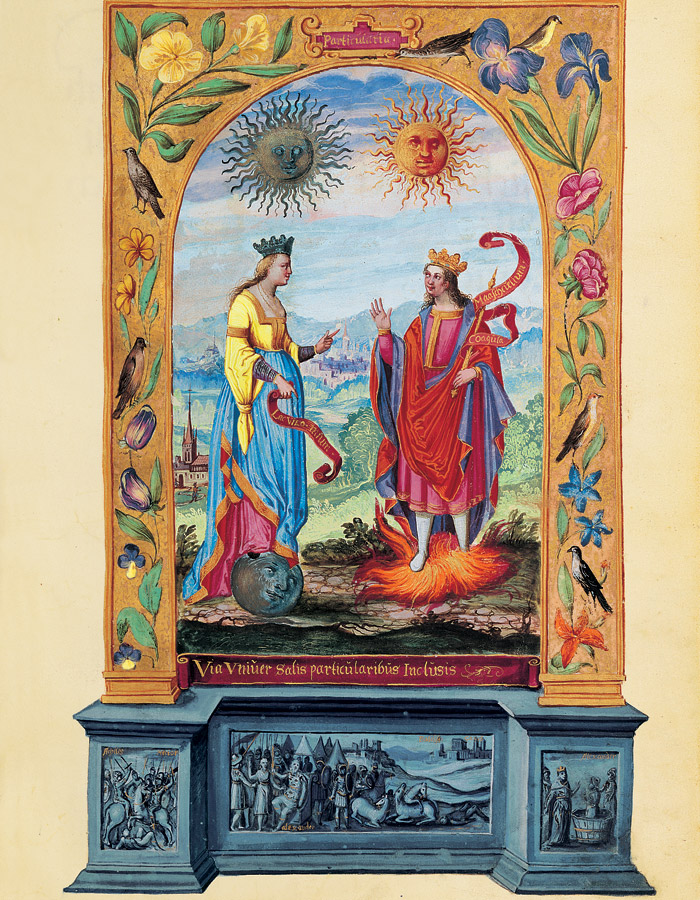
The meeting of the Sun King and the Moon Queen, from the Splendor Solis, a sixteenth-century German alchemical treatise.
A symbol only becomes universal when it manages to move beyond the cultural categories that gave birth to it, and that is almost never the case. The Sun and the Moon in Freemasonry, as understood in European rituals, above all tell of the way our culture — and our language — organises reality. Their supposed universality rests on a common starting point, but their meaning derives from a framework specific to Europe: a world of strongly gendered, valued and hierarchised polarities.
Recognising this does not diminish the symbol; it sheds a different light on it. The universal lies less in the meaning than in the availability of the celestial body to be interpreted. The rest — the reading, the polarity, the opposition — always belongs to a tradition. The Mason connects with the universal only by first knowing where his own culture begins and ends.
What can a symbol truly share across all cultures?
The universality of a symbol never comes from its meaning, but from whatever in it is open enough to welcome multiple readings. A phenomenon such as the rising of the Sun or the phases of the Moon belongs to this common ground, for no culture escapes it. On the other hand, the ways of describing them, naming them, valuing them or relating them to one another vary so widely that they are enough to turn experience into a worldview.
A symbol therefore becomes universal only because it remains available, malleable and capable of being reinterpreted without losing its anchor in reality. The Sun and the Moon in Freemasonry rest precisely on this availability, for everyone can recognise their presence in the sky, even without attributing the same qualities to them. This distinction is essential: what we share is the raw material of the symbol, not its interpretive code.
From this nuance, Masonic work can open up to something other than cultural reproduction. The Mason then recognises that the universal lies not in the values he projects, but in the initial experience, which can be translated differently from one tradition to another.
Why do cultures never read the same things in the same celestial bodies?
A culture never produces a symbol from a celestial body, but from the questions it asks, the fears it carries and the stories it hands down. Two peoples can look at the same sky without seeking the same thing in it, for the sky never answers of its own accord: it answers the expectations of those who question it. The Sun and the Moon in Freemasonry are no exception to this rule, for they reflect first and foremost the concerns of Enlightenment Europe, not a spontaneous reading of the cosmos.
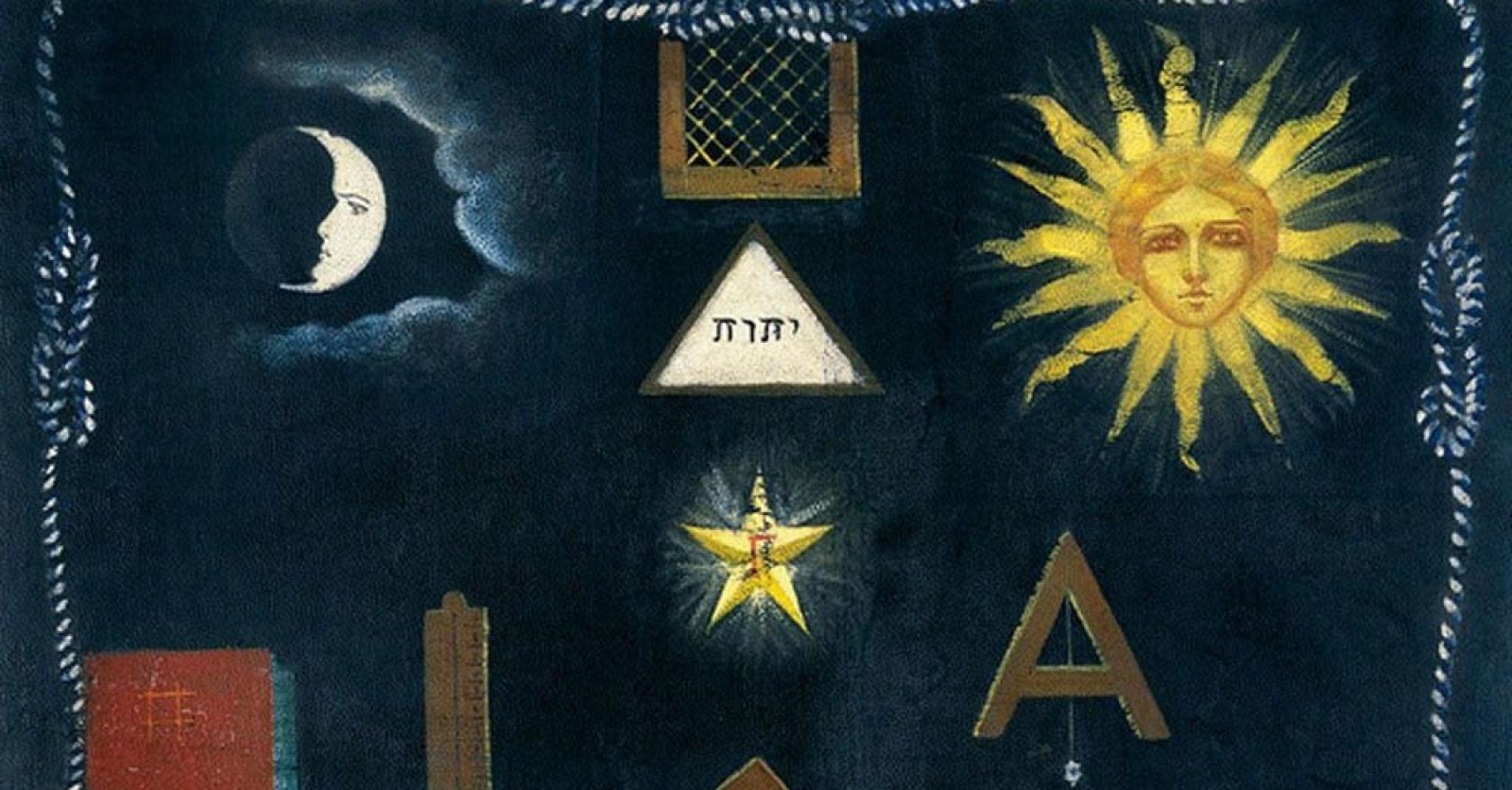
Detail of an old Lodge tracing board depicting the Sun and the Moon.
Where some traditions see night as a time of rest or protection, others perceive it as an unstable realm, peopled by ambiguous forces. In some societies, the Moon is sovereign, the dispenser of order and of the calendar; in others, it is a secondary, even unsettling presence. What Freemasonry has turned into a harmonious polarity is therefore not a human invariant, but a precise cultural choice, rooted in a worldview in which daylight is supposed to reveal the truth.
This gap between identical phenomena and symbolisms that diverge does not relativise Masonic meaning, but it demands greater lucidity of it. The Lodge does not work with the sky as it is, but with the sky as Europe has interpreted it. To understand this is to accept that universality lies not in the symbol itself, but in the possibility each culture has of projecting onto it whatever is meaningful to it.
What is the real risk of believing in a universal symbolism?
The danger does not lie in the symbol itself, but in the belief that its meaning must be obvious to everyone. As soon as we assume that others read the world as we do, we stop questioning the categories that organise our own thinking. The Sun and the Moon in Freemasonry then become not open doors to the universal, but mirrors in which Europe gazes at itself while believing it sees the whole of humanity.
This illusion creates a false common ground: we think we are speaking a shared language, when we are simply speaking louder from within our own tradition. This symbolic concordism works in this way, not out of malice but out of blindness: it treats as equivalent what has never been experienced as such. We believe we are bringing cultures closer together, but we look down on them without realising it.
It is precisely here that symbolic vigilance is born. It consists in recognising that universality is not a given but a quest: not an imposed symbol, but a patient, respectful translation, aware of its own limits. Only on this condition can Freemasonry hope to reach what it calls the universal, without confusing it with its own certainties.
Conclusion: a universal to be recognised rather than proclaimed
When we follow the path that leads from the old manuscripts to modern practice, we discover that the Sun and the Moon in Freemasonry reveal not only a vision of the cosmos, but also the cultural prism through which Europe has thought about order, light and balance. These celestial bodies, observed by all, take on meaning only through the categories, narratives and habits of thought that give them form. Recognising this situated dimension does not weaken the initiatory work; it gives it a more lucid foundation.
A symbol remains alive when it agrees to be reread, displaced or translated through contact with other traditions, without being presented as a universal self-evidence. It is by embracing this movement that Freemasonry can bring together what it has received and what it wishes to pass on. The Sun and the Moon then keep their depth, not as guarantors of a common truth, but as landmarks on a quest that transcends cultural boundaries without denying them.
By Ion Rajolescu, editor-in-chief of Nos Colonnes — in the service of an accurate, rigorous and living Masonic voice
Want to go further? The polarities of the Sun and the Moon find an echo in other symbolic systems. You can extend this reflection by reading our article on the Sephirothic Tree.
1. What do the Sun and the Moon represent in Freemasonry?
The Sun and the Moon in Freemasonry symbolise two complementary modes of light: the direct brilliance of day and the reflected clarity of night. They remind us that the Lodge works as much with consciousness as with its more inward regions.
2. Why does the Sun appear before the Moon in the old Masonic rituals?
In the seventeenth-century manuscripts, only the Sun is mentioned, because Freemasonry remained close to the operative traditions, in which work was done by daylight. The Moon only comes in later, when the symbolism becomes more inward.
3. Why is an active principle traditionally associated with the Sun and a receptive principle with the Moon?
This opposition does not come from the sky but from European languages, which gendered the celestial bodies and ordered their qualities according to their own imaginary. The Sun and the Moon in Freemasonry inherit this cultural reading.
4. Is the symbolism of the Sun and the Moon universal across all cultures?
No. The phenomena are universal, but their interpretation depends on languages and traditions. Some languages reverse the genders, and some do not even mark them, which directly alters the symbolic reading of the two celestial bodies.
5. Why are they placed in the East of the Lodge?
The Sun and the Moon are generally found on the eastern wall as a reminder that Masonic work opens under the sign of light, whether direct or reflected. They symbolically accompany the Entered Apprentice from the moment the blindfold falls.
6. How has European Freemasonry shaped the reading of these two celestial bodies?
It has structured them according to cultural oppositions: light/dark, active/receptive, stable/changing. The Sun and the Moon in Freemasonry therefore reflect a European logic first and foremost, not a universal language.
7. What is the first mention of the Moon in Masonic rituals?
The first clear appearance of the Moon is in the catechism “The Whole Institution of Masonry” (1724), where it already features among the twelve Lights of the Lodge. But it is the Graham manuscript (1726) that offers the first developed symbolic interpretation of it, associating it with water and nocturnal light.
8. Why does Freemasonry speak of harmony between the Sun and the Moon?
Because they form a symbolic polarity that invites the Mason to work as much on the clarity of day as on his more inward regions. This harmony is a cultural construct, but it serves the initiatory dynamic.
9. How does the meaning of these two celestial bodies depend on language?
In many Indo-European languages, the Sun is masculine and the Moon feminine, which directly influences their interpretation. Other languages reverse these genders, which overturns the entire symbolic reading.
10. How can a universal symbol be reconciled with a particular culture?
By recognising that the universal lies not in the meaning but in the observable phenomenon. The meaning of the Sun and the Moon in Freemasonry is cultural, but their presence in the sky opens the way to an interpretation that is both shared and adapted.
Here you will find the full transcript of the podcast on the Sun and the Moon in Freemasonry, for those who prefer reading or wish to explore the discussion further.
Podcast – The Sun and the Moon in Freemasonry — Universality or cultural construct
In most Lodges there are two silent presences that never utter a word, yet which no Mason can ignore: the Sun and the Moon. They are there, in the East, visible as soon as the Lodge opens, like two celestial bodies set at the edge of our gaze. Everyone knows them, everyone has observed them a thousand times, and yet their presence in the Lodge is not self-evident. Their symbolism, for its part, cannot be grasped at a glance. It must be approached as one approaches an inner light: slowly, carefully, and with the humility of one who knows that a symbol reveals as much as it questions.
In the oldest Masonic manuscripts, the Sun appears alone. We are at the end of the seventeenth century: the Edinburgh manuscript, dated sixteen ninety-six, mentions the star of the day as witness to the oath. The firmament, it says, sees everything, and the Sun illuminates everything. It thus becomes the image of divine justice, the justice that brings to light what must be brought to light and reminds each person of the gravity of their given word. At that time, Masonry remained close to operative practice: work was done by day, and the Lodge was closed when the Sun went down. Small wonder, then, that the star of the day still dominates the symbolic horizon.
It is only later, at the beginning of the eighteenth century, that the Moon makes its entrance. The catechism The Whole Institution of Masonry, dated seventeen twenty-four, already mentions it among the twelve Lights of the Lodge. The Graham manuscript, dated seventeen twenty-six, takes up this novelty and develops it: it describes the Moon as a dark body, born of water, receiving its light from the Sun. It is called the “queen of waters”, and we immediately understand that with it another dimension opens up: that of the inner part, shifting and sometimes uncertain.
From then on, the European Lodge, nourished by symbolic traditions from far afield, created a polarity. The Sun becomes the active, manifest, stable principle. The Moon, the receptive, changing, inner principle. Together they trace a kind of symbolic breathing: the clarity of day, the depth of night; that which illuminates, that which reveals in another way. And if these oppositions seem self-evident to us, they come not from the sky but from our own culture. They reflect the way European languages have gendered the celestial bodies, ranked their qualities and projected a certain imaginary onto them.
For what we regard as “universal” almost never is. The phenomena are: everyone sees the Sun rise and the Moon wax and wane. But interpretation depends on languages, narratives and traditions. Some languages reverse the genders: in German, the Moon is masculine and the Sun feminine. Other languages do not even mark gender, which shifts the entire symbolic reading. And this is precisely where the Mason must remain vigilant: what he believes he receives from nature often comes from history.
So what remains universal in these two celestial bodies? Their presence, their availability, their capacity to be interpreted. That is all. The rest — their meaning, their polarity, their symbolic role — belongs to a particular tradition, shaped by European languages, myths and mental categories. Recognising this does not diminish the scope of Masonic work; it makes it more accurate. For a symbol only truly breathes when it does not take itself for a self-evident truth.
When we stop projecting onto the universe what our culture has placed there, the Sun and the Moon cease to be certainties. They become invitations. Invitations to reread what we thought we knew. Invitations to recognise what we owe to our language, to our history, to our way of ordering the world. Invitations, finally, to understand that the universal is not something we possess, but something we reach, patiently, by crossing our own limits.
And perhaps that, in the end, is the Mason’s true work: to hold together what comes to him from the heavens and what comes to him from men, without confusing the two. Lit by the Sun, accompanied by the Moon, he moves forward in a light that is never simply given, but always built — and shared.


JE VEUX RECEVOIR LES ACTUALITÉS ET EXCLUSIVITÉS !
Restez au courant des nouveaux articles de blog, des nouveautés et promotions Nos Colonnes.
