






Grand Loge Nationale Française: History, Regularity, and Masonic Practice
The Grande Loge Nationale Française (French National Grand Lodge) holds a distinctive place within the landscape of Freemasonry in France. As the only French obedience recognised by the United Grand Lodge of England, the Grande Loge Nationale Française defines itself as regular and firmly attached to an explicitly theistic tradition. But what does this notion of Masonic regularity truly entail? Through its history, its principles and the rites practised within the Grande Loge Nationale Française, a particular understanding of initiatic continuity emerges. From its foundation in the early twentieth century to its present-day organisation, the Grande Loge Nationale Française embodies a specific path within the French Masonic landscape.
- 1. Grande Loge Nationale Française and Masonic regularity: what does it mean to be recognised by the United Grand Lodge of England?
- 2. 1877 and the reshaping of the French Masonic landscape
- 3. 1910–1913: from the Rectified revival to the foundation of the Grande Loge Nationale Française
- 4. From British influence to French affirmation
- 5. Growth, adjustments and stabilisation in the twenty-first century
- 6. The Workings practised within the Grande Loge Nationale Française
- 7. The Grande Loge Nationale Française today: continuity and influence
- Conclusion – The Grande Loge Nationale Française between fidelity and continuity
- FAQ - Grande Loge Nationale Française
- Podcast – Grande Loge Nationale Française: history, regularity and practised rites
1. Grande Loge Nationale Française and Masonic regularity: what does it mean to be recognised by the United Grand Lodge of England?
Masonic regularity constitutes one of the essential identity markers of the Grande Loge Nationale Française. Being recognised by the United Grand Lodge of England is not merely a diplomatic agreement between obediences; it is a recognition grounded in precise principles, gradually established from the eighteenth century and clarified during the twentieth century.
Among these principles are the affirmation of belief in God, designated as the Grand Architect of the Universe, the obligation for each member to take his obligation upon the Volume of the Sacred Law — most often the Bible — as well as the prohibition of political and religious discussions within lodge. These elements shape the understanding that the Grande Loge Nationale Française has of the Masonic tradition.
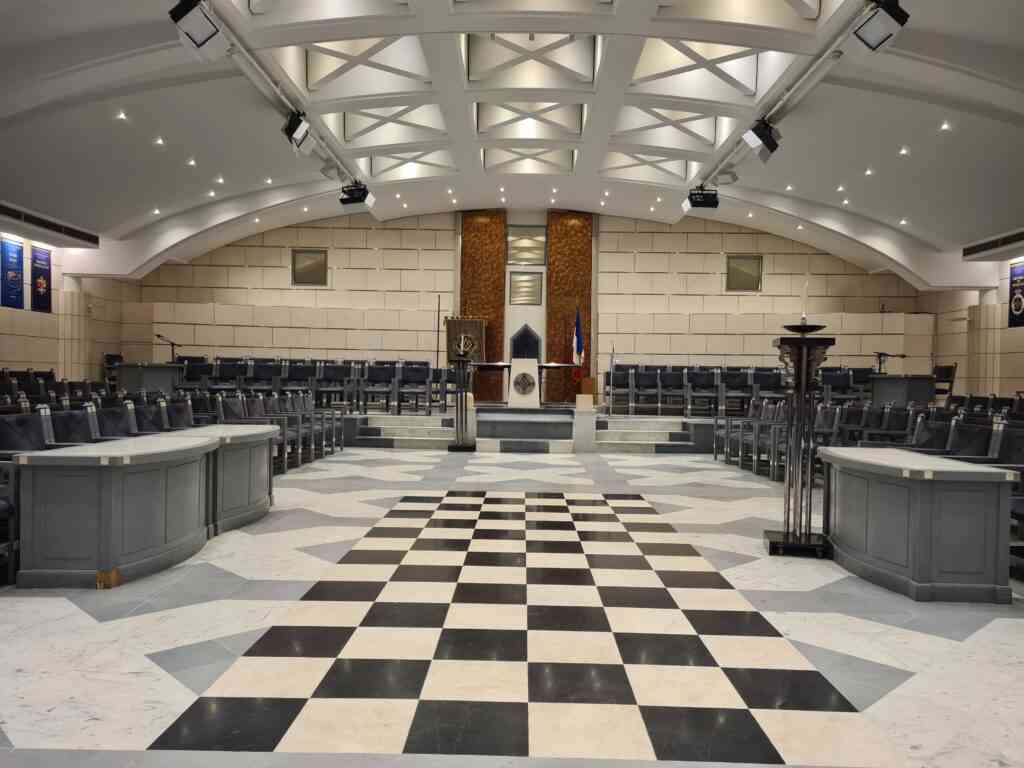
Grand Temple of the Grande Loge Nationale Française, where solemn meetings and institutional work of the obedience take place.
Recognition by the United Grand Lodge of England also implies territorial exclusivity: only one obedience per country is recognised as regular. In France, this recognition has belonged to the Grande Loge Nationale Française since 1913. This situation distinguishes it from other French obediences, which do not all claim the same understanding of Masonic regularity.
It should, however, be specified that regularity corresponds to an internal definition adopted by the United Grand Lodge of England and the obediences attached to it. It rests upon precise doctrinal and organisational criteria which these obediences regard as constitutive of the Masonic tradition. Other obediences, in France and elsewhere, refer to different conceptions of Freemasonry. The Grande Loge Nationale Française situates itself within this particular framework of reference and fully assumes its requirements.
To understand the Grande Loge Nationale Française therefore implies grasping what Masonic regularity encompasses: fidelity to principles considered fundamental, a claimed initiatic continuity, and integration within an international network of recognised obediences.
2. 1877 and the reshaping of the French Masonic landscape
The year 1877 marks a decisive turning point in the history of Freemasonry in France. The Grand Orient de France removed from its Constitution the obligation to believe in God, to work to the Glory of the Grand Architect of the Universe, and to display the Volume of the Sacred Law during lodge work. This decision formed part of a broader movement: as early as 1872, the Grand Orient of Belgium had already adopted a comparable measure. The transformation of the continental Masonic landscape was therefore not exclusively French.
This evolution concerned more than a ritual or terminological adjustment. It reflected a new conception of the Masonic institution, one more centred on the autonomy of individual conscience and on engagement within society. Some Freemasons fully embraced this orientation. Others, however, considered that the explicit reference to the Grand Architect of the Universe and the presence of the Volume of the Sacred Law constituted structural elements of the Masonic tradition.
Over the following decades, this divergence of sensibility did not disappear. It became firmly established and encouraged the search for an institutional framework capable of maintaining an explicitly theistic practice, in accordance with the criteria of Masonic regularity as defined in the Anglo-Saxon world. It was within this context that, at the beginning of the twentieth century, the project emerged that would lead to the birth of the Grande Loge Nationale Française.
Thus, well before its official foundation in 1913, the doctrinal and institutional conditions for the emergence of the Grande Loge Nationale Française were already in place. It did not arise from an improvised rupture, but from a gradual process of recomposition within French and European Freemasonry.
3. 1910–1913: from the Rectified revival to the foundation of the Grande Loge Nationale Française
This search for a framework consistent with Masonic regularity found decisive expression at the beginning of the twentieth century. Three French Freemasons — Édouard de Ribaucourt, Camille Savoire and Gustave Bastard — approached the Grand Lodge of Switzerland Alpina and the Independent Grand Priory of Helvetia, then the last active authority of the Rectified Scottish Rite. Their objective was clear: to restore in France a practice faithful to this rite, which had remained explicitly attached to reference to the Grand Architect of the Universe.
On 9 June 1910, they were received as Knights Beneficent of the Holy City and obtained the necessary patents to revive the Rectified tradition in France. A few days later, on 20 June 1910, they undertook to reactivate the lodge “Le Centre des Amis,” the last French lodge that had worked the Rectified Scottish Rite until 1830. At first, the Grand Orient de France accepted that this lodge adopt the rite and signed an agreement with the Independent Grand Priory of Helvetia.
Édouard de Ribaucourt became the first Worshipful Master of the lodge “Le Centre des Amis.” The work proceeded normally until 1913. That year, the Grand Orient de France attempted to impose a new ritual of the Rectified Scottish Rite, expurgated of references to the Grand Architect of the Universe. For Ribaucourt and his brethren, this alteration was incompatible with the very spirit of the rite. Their requests to maintain the traditional ritual did not succeed.
A break then became inevitable. On 5 October 1913, the lodge “Le Centre des Amis” established itself as the Grande Loge Nationale Indépendante et Régulière pour la France et ses Colonies. Less than two months later, on 3 December 1913, the United Grand Lodge of England granted official recognition. This founding act permanently placed the future Grande Loge Nationale Française within the international Masonic landscape and confirmed its orientation in favour of Masonic regularity.
4. From British influence to French affirmation
At the time of its recognition in 1913, the new obedience comprised only a limited number of lodges. A single lodge originating from the Grand Orient de France, “L’Anglaise 204” in the Orient of Bordeaux, immediately joined the emerging structure. The other affiliated lodges were mainly composed of British members residing in France and working according to Emulation Working. This initial configuration explains why some observers at the time described the obedience as a “Grande Loge Anglaise de France.”
Although the original intention of its founders had been to revive the Rectified Scottish Rite, Emulation Working gradually became the most widely practised working within the young obedience. The lodge “Le Centre des Amis” long remained the only lodge working the Rectified Scottish Rite. This coexistence of ritual sensibilities contributed to shaping the distinctive identity of the future Grande Loge Nationale Française.
In 1948, the Grande Loge Nationale Indépendante et Régulière pour la France et ses Colonies officially adopted the name Grande Loge Nationale Française. At that time, a significant proportion of its members were still British. Nevertheless, its French implantation progressively strengthened.
In 1958, seven lodges, including the founding lodge “Le Centre des Amis,” chose to separate in order to found the Grande Loge Nationale Française Opéra, which would later become the Grande Loge Traditionnelle et Symbolique Opéra. This split reflected differing views regarding relations with other French obediences and the internal evolution of the institution.
A major turning point occurred in 1965. Following a split within the Grande Loge de France, several of its members joined the Grande Loge Nationale Française, bringing with them the Ancient Accepted Scottish Rite. From that period onward, the obedience experienced more marked development within the French Masonic landscape, while retaining its international recognition and its attachment to the principles of Masonic regularity.
5. Growth, adjustments and stabilisation in the twenty-first century
From the second half of the twentieth century onward, the Grande Loge Nationale Française experienced steady growth in its membership. The integration of the Ancient Accepted Scottish Rite, alongside Emulation Working and other ritual practices, broadened its appeal among brethren attached to Masonic regularity and to a clearly theistic understanding of the tradition.
This momentum resulted in sustained growth at the turn of the two thousands. In 2011, the Grande Loge Nationale Française reached approximately 44,000 members and temporarily became the second largest Masonic obedience in France in terms of membership. This expansion was accompanied by structural and organisational adjustments required to administer a body that had become numerically significant.
The year 2012 marked a period of internal crisis that led to the departure of a number of lodges. These lodges went on to found the Grande Loge Alliance Maçonnique Française (GL-AMF). Following this delicate phase, the membership of the Grande Loge Nationale Française stabilised at around 29,000 before gradually consolidating. Today, the Grande Loge Nationale Française gathers approximately 32,000 members.
This sequence of growth, crisis and stabilisation forms part of the institutional history of an obedience of this scale. It did not alter the foundational principles that define its identity: international recognition, reference to the Grand Architect of the Universe, and fidelity to the criteria of Masonic regularity.
6. The Workings practised within the Grande Loge Nationale Française
Although the Grande Loge Nationale Française was born in the wake of the Rectified Scottish Rite, its historical development led it gradually to incorporate several workings within its symbolic lodges. This ritual plurality today constitutes one of its defining characteristics.
Emulation Working occupies an important place. Of English origin, it belongs to the tradition stemming from the United Grand Lodge of England and places emphasis on ceremonial precision, sobriety of ritual and fidelity to British usages. Its establishment within the Grande Loge Nationale Française is explained by the initial presence of lodges composed of British brethren residing in France.
The Ancient Accepted Scottish Rite has also been widely practised since the nineteen sixties. This working, widespread throughout the world, contributes to the international anchoring of the Grande Loge Nationale Française.
The French Rite is likewise present, in its traditional form consistent with the requirements of Masonic regularity. It offers a structured approach historically rooted in the French tradition of the eighteenth century.
The Grande Loge Nationale Française also works the York Rite and the Royal Standard of Scotland, thereby broadening the range of ritual workings available to its members. This diversity does not undermine the doctrinal unity of the obedience, which remains founded upon reference to the Grand Architect of the Universe and adherence to the criteria of Masonic regularity.
Beyond the symbolic degrees, the Grande Loge Nationale Française maintains relations with jurisdictions administering the higher degrees of the Rectified Scottish Rite, the Ancient Accepted Scottish Rite and the French Rite. It is also associated with several Anglo-Saxon side degrees, such as the Royal Arch, the Mark, the Royal Ark Mariner, the Allied Masonic Degrees and the Cryptic Degrees.
Finally, on a more familial level, the Grande Loge Nationale Française sponsors several chapters of the Order of DeMolay International, an organisation intended for young men aged between fifteen and twenty-one, reflecting a broader integration within the Anglo-American Masonic world.
7. The Grande Loge Nationale Française today: continuity and influence
Today, the Grande Loge Nationale Française gathers approximately 32,000 members distributed among several hundred lodges in France and abroad. It remains the only French obedience recognised by the United Grand Lodge of England and forms part of an international network of obediences sharing the same criteria of Masonic regularity.
Its internal organisation is based on a territorial structure articulated around provinces, which in turn group together the lodges. This structure ensures coherence in ritual workings while maintaining proximity between the lodges and the obedience. Contemporary communication tools, notably the Regius intranet and its associated application, accessible only to members, contribute to this organisation by facilitating institutional exchanges and the circulation of information.

The Regius Manuscript (c. 1390), one of the earliest known texts of the Old Charges. Its name was adopted by the Grande Loge Nationale Française for its institutional intranet, in reference to this early source of the Masonic tradition.
The review Les Cahiers Villard de Honnecourt also contributes to the intellectual life of the obedience. It offers research papers, historical studies and symbolic reflections that belong to a demanding tradition attentive to transmission and to the quality of its content.
Through its workings, its structures and its institutional instruments, the Grande Loge Nationale Française thus affirms a doctrinal continuity founded upon reference to the Grand Architect of the Universe, regular ritual practice and inclusion within an internationally recognised lineage. Its history, marked by phases of development and adjustment, reflects a constant intention to preserve the foundational principles that presided over its establishment in 1913.
Conclusion – The Grande Loge Nationale Française between fidelity and continuity
Since its recognition in 1913, the Grande Loge Nationale Française has followed a distinctive trajectory within the French Masonic landscape. Born of an explicit attachment to Masonic regularity and to reference to the Grand Architect of the Universe, the Grande Loge Nationale Française has progressively structured its identity around international recognition, a balanced plurality of workings and a consolidated institutional organisation.
From its origins linked to the revival of the Rectified Scottish Rite to the integration of other workings practised within the Grande Loge Nationale Française, its history reflects a will for continuity rather than rupture. Periods of growth, institutional adjustments and phases of recomposition have not altered its fundamental principles.
To understand the Grande Loge Nationale Française is therefore to grasp the articulation between history, Masonic regularity and ritual practice. It is also to observe how a French obedience has anchored itself durably within an international network while developing its own instruments, such as Regius, in the service of its internal coherence.
By Ion Rajolescu, Editor-in-Chief of Nos Colonnes — serving a Masonic voice that is just, rigorous, and alive
Discover our collection of regalia for the dignitaries of the Grande Loge Nationale Française, presented in our French National Grand Lodge (GLNF) Grand Officers collection, crafted in full respect of its usages and traditions.

1 What is the Grande Loge Nationale Française?
The Grande Loge Nationale Française is a Masonic obedience founded in 1913 and recognized by the United Grand Lodge of England. It defines itself as regular and works to the Glory of the Grand Architect of the Universe.
2 Why is the Grande Loge Nationale Française considered regular?
It is considered regular because it adheres to the criteria defined within the Anglo-Saxon Masonic tradition, including belief in God, the presence of the Volume of the Sacred Law during lodge rituals, and the prohibition of political and religious debates in lodge.
3 Since when has the Grande Loge Nationale Française been recognized by the United Grand Lodge of England?
Official recognition by the United Grand Lodge of England dates from 3 December 1913.
4 How many members does the Grande Loge Nationale Française have today?
The Grande Loge Nationale Française has approximately 32,000 members distributed among several hundred lodges in France and abroad.
5 Which workings are practised within the Grande Loge Nationale Française?
The workings practised within the Grande Loge Nationale Française include Emulation, the Ancient Accepted Scottish Rite, the French Rite, the York Rite and the Royal Standard of Scotland.
6 What is Regius within the Grande Loge Nationale Française?
Regius is the official intranet of the Grande Loge Nationale Française. It is used for administrative management, internal communication and access to information reserved for members. An associated mobile application, EgRegius, is also available.
7 Is the Grande Loge Nationale Française open to women?
The Grande Loge Nationale Française admits men only. This position forms part of the regularity criteria to which it adheres.
Read the full transcript of the podcast here for those who prefer reading or want more detail.
Podcast – Grande Loge Nationale Française: history, regularity and practised rites
The Grande Loge Nationale Française holds a distinctive place within the Masonic landscape in France. It is today the only French obedience recognised by the United Grand Lodge of England. That recognition, granted on the third of December nineteen thirteen, has shaped its identity ever since.
To understand the Grande Loge Nationale Française, however, we must go back several decades.
In eighteen seventy-two, the Grand Orient of Belgium adopted a measure removing the explicit obligation to refer to God in its work. Five years later, in eighteen seventy-seven, the Grand Orient of France made a comparable decision. It removed from its Constitution the obligation to work to the Glory of the Grand Architect of the Universe and to display the Volume of the Sacred Law in lodge.
This choice had lasting consequences for French Freemasonry. Some members embraced this evolution. Others considered that the explicit reference to the Grand Architect of the Universe and the presence of the Volume of the Sacred Law were structural elements of the Masonic tradition.
At the beginning of the twentieth century, three French Freemasons — Édouard de Ribaucourt, Camille Savoire and Gustave Bastard — turned to the Grand Lodge of Switzerland Alpina and to the Independent Grand Priory of Helvetia. Their aim was to revive in France the Rectified Scottish Rite, which had preserved a clearly theistic reference.
On the ninth of June nineteen ten, they were received as Knights Beneficent of the Holy City. On the twentieth of June of that same year, they reactivated the lodge “Le Centre des Amis.” At first, an agreement was reached with the Grand Orient of France. But in nineteen thirteen, when an attempt was made to impose a ritual expurgated of references to the Grand Architect of the Universe, a break became unavoidable.
On the fifth of October nineteen thirteen, the lodge “Le Centre des Amis” established itself as the Grande Loge Nationale Indépendante et Régulière pour la France et ses Colonies. Less than two months later, on the third of December nineteen thirteen, the United Grand Lodge of England granted official recognition. The Grande Loge Nationale Française thus entered the framework of Masonic regularity on the international stage.
In its early years, the obedience remained modest in size. It included lodges composed largely of British members working the Emulation Rite. Gradually, its French presence strengthened. In nineteen forty-eight, it officially adopted the name Grande Loge Nationale Française.
A significant turning point came in nineteen sixty-five. Following a split within the Grande Loge de France, a number of members joined the Grande Loge Nationale Française and brought with them the Ancient Accepted Scottish Rite. From that period onward, its development accelerated.
In two thousand and eleven, the Grande Loge Nationale Française reached approximately forty-four thousand members and temporarily became the second largest Masonic obedience in France. The following year, in two thousand and twelve, an internal crisis led several lodges to depart and establish the Grande Loge Alliance Maçonnique Française. After this period of reorganisation, membership stabilised and gradually consolidated at around thirty-two thousand members.
Today, the Grande Loge Nationale Française practises several rites within its symbolic lodges: Emulation, the Ancient and Accepted Scottish Rite, the French Rite, the York Rite and the Standard of Scotland. This ritual plurality exists within a common doctrinal framework: reference to the Grand Architect of the Universe and adherence to the criteria of Masonic regularity.
Beyond its lodges, the obedience relies on contemporary tools such as its intranet Regius and its associated mobile application EgRegius, which support its administrative and institutional life. It also publishes a respected review, Les Cahiers Villard de Honnecourt, contributing to historical and symbolic research.
To understand the Grande Loge Nationale Française is therefore to understand an obedience born of attachment to certain principles regarded as fundamental, and which chose to inscribe itself within an internationally recognised framework while developing its own institutional structure in France.


I WANT TO RECEIVE NEWS AND EXCLUSIVES!
Keep up to date with new blog posts, news and Nos Colonnes promotions.
