





The Knight Kadosh: a controversial Masonic degree at the heart of the AASR
The Chevalier Kadosh, 30th degree of the Ancient and Accepted Scottish Rite, is among the most notable – and undoubtedly the most controversial – of the Freemasonry high degrees. Heir to Templar legends and surrounded by symbols of vengeance and justice, the Chevalier Kadosh holds a unique place at the heart of the Masonic hierarchy. Its history, marked by debates and reluctance, reflects the tensions between memory, myth, and spiritual quest. Long perceived as a dangerous, even subversive degree, the Chevalier Kadosh has nevertheless eventually established itself as an essential stage in the initiatory journey. But what does this degree truly mean? Why does it still provoke questions and debate? And how can we understand its role today within the symbolic structure of Freemasonry? tesstt
- 1. What is the Chevalier Kadosh in Freemasonry?
- 2. When and how did the Kadosh degree appear?
- 3. Why is the Chevalier Kadosh degree so controversial?
- 4. How is the Kadosh connected to the legend of the Templars?
- 5. The Chevalier Kadosh: a degree of the Elect and of vengeance?
- 6. How did the obediences receive the Kadosh degree?
- 7. How did the Kadosh degree evolve in the 19th and 20th centuries?
- 8. What is the initiatory significance of the Chevalier Kadosh today?
- 9. Conclusion – The vocation of the Chevalier Kadosh today
- 10. Podcast – The Kadosh Knight
What is the Chevalier Kadosh in Freemasonry?
The Chevalier Kadosh is today the 30th degree of the Ancient and Accepted Scottish Rite and holds the same rank in the Rite of Memphis-Misraïm. It belongs to the small circle of so-called “major” degrees, those that are not just bestowed by communication but require a complete initiation ceremony. In the Masonic hierarchy of the Ancient and Accepted Scottish Rite, the Kadosh is considered the highest initiatory degree, while the next three are described as administrative grades.
Unlike other lesser-known and less practiced degrees, the Kadosh stands out for its reputation and mystique. From its appearance in the 18th century, it has been seen as a "chivalric" degree, linking Freemasonry to the supposed legacy of the Templars. It is not limited to moral instruction: it offers a vision of the Freemason as an avenger, guardian of a wounded memory and bearer of a mission. In this sense, the Chevalier Kadosh embodies both a historical figure and an initiatory archetype: one who, in the face of oppression, rises up to defend the ideal of justice.
When and how did the Kadosh degree appear?
Chevalier Kadosh probably appeared in France in the middle of the 18th century, at a time when high degrees were flourishing and every system was seeking to assert its originality. The two oldest known manuscripts date from 1750. Already, they contain the essential elements that would shape the identity of the degree in the decades to come: the Templar legend, the evocation of an unjustly persecuted order, and the claimed connection with Freemasonry. There are also specific ritual symbols: the black cordon, the dagger, the Hebrew word Nekamah — which means vengeance —, or even the ladder with two uprights and seven rungs, bearing Hebrew words.
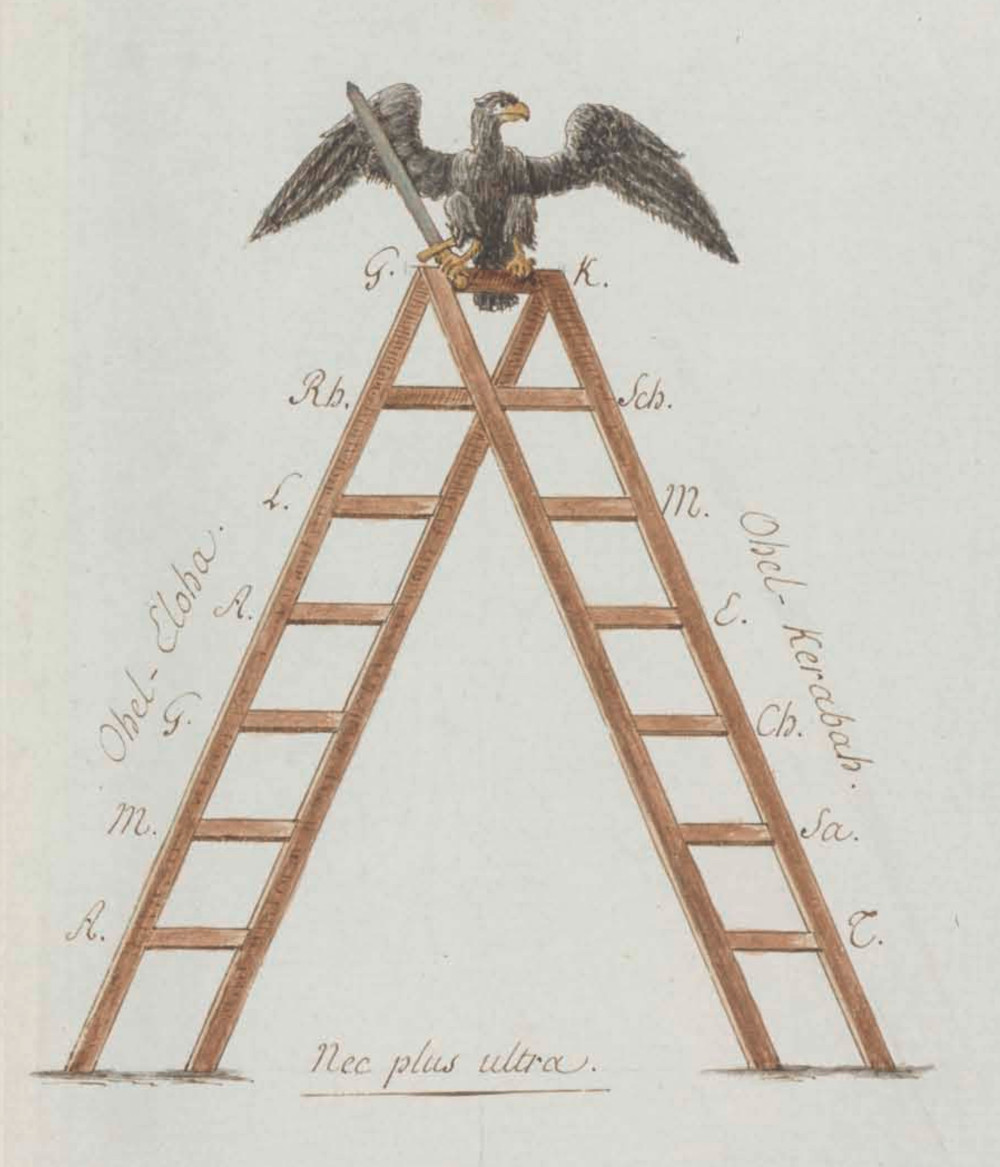
The Mysterious Ladder of the Kadosh
This group places the Kadosh in a particular category: it is not merely a rank of scholarship or moral reflection, but a dramatic ritual that enacts a wounded memory and a mission to fulfill. Through it, some 18th-century Freemasons projected the idea that Freemasonry is the heir, and perhaps even the continuator, of the Order of the Temple abolished in 1312.
The origin of the degree must therefore be understood within the intellectual context of the Age of Enlightenment, when the authority of the Church and the monarchy was increasingly being challenged. By creating the Kadosh, certain workshops took a decisive step: they did not simply recount a Templar legend, they asserted that this legend could become a living initiatory path, and even a program for action, which could consider operating without the approval of the Church and the monarchy.
Why is the Chevalier Kadosh degree so controversial?
The controversial nature of the Chevalier Kadosh lies as much in its imagery as in its ritual use. From its very inception, it was presented as a degree of vengeance. The dagger raised, the black cord worn from the left shoulder to the right hip, and the word Nekamah signified that the initiate was setting themselves in the lineage of the Elect, the avengers of Hiram. But this time, the target was no longer just the murderers of the legendary Master: it was oppression itself, symbolized by the throne and the altar, embodied by King Philip the Fair and Pope Clement V, held responsible for the downfall of the Order of the Temple.
Here lies the origin of the accusations made against this degree. In certain nineteenth-century versions, candidates were even asked to trample underfoot the royal crown and the papal tiara. This gesture was not insignificant: at the height of anticlerical and republican struggles, it expressed a desire to break away from the two powers that had long dominated Europe. For opponents of Freemasonry, this ritual became proof that the lodges were plotting a conspiracy against the Church and the monarchy.
From a Masonic degree, the Kadosh thus became a symbol of insubordination. For some, it embodied the spirit of freedom and justice. For others, it represented a political and religious danger. It is this ambivalence that still fuels its controversial aura today, between dark legend and chivalric ideal.
How is the Kadosh connected to the legend of the Templars?
From its very beginnings, the grade of Chevalier Kadosh has drawn upon the memory of the Templars. Arrested in 1307 and condemned in 1312, they came to symbolize the injustice arising from the combined power of the throne and the altar. By making the initiate the avenger of the Order of the Temple, the earliest rituals projected Freemasonry into an imaginary lineage: not the actual restoration of the knights in white robes, but the continuation of their struggle against tyranny.
_-_(MeisterDrucke-1046895).jpg)
Reception of a Kadosh, French illustration from the 19th century
This legend struck a particular chord in the 18th century. Since the Renaissance, some scholars had already cast doubt on the accusations made against the Templars and suspected that Philip the Fair had acted mainly out of greed. But before the Enlightenment, no one had dared to directly associate themselves with the abolished Order. In a context of questioning established powers, such boldness became possible.
The Kadosh was not alone in claiming this heritage. The German Order of Strict Templar Observance, from which the Rectified Scottish Rite was to derive, claimed to hold the direct succession of the Templars and even aimed to recover their property. In these narratives, the Templar became at once the martyr of oppression and the figure of hidden knowledge: treasures, alchemical secrets, Eastern initiation.
Thus, the Chevalier Kadosh appears as a Masonic transfiguration of the Templar: no longer a soldier of Christ, but a knight of justice, bearer of a memory of persecution and of a universal quest.
The Chevalier Kadosh: a degree of the Elect and of vengeance?
The Chevalier Kadosh is part of the tradition of the Elect Degrees. Dated 1750, the Quimper manuscript (manuscript 100 J 1623, Archives Départementales du Finistère) already links together, in the same narrative, the vengeance of Hiram and that of the Templars. The message is clear: the Kadosh continues the work of the Elect of Nine, but expands the scope of justice. It is no longer just the murder of a Master that calls for redress, but the condemnation of an entire order, unjustly struck down by the king and by the pope.
Ritual symbols express this continuity as much as they transform it. The dagger is not a ceremonial weapon: it is given to the recipient as an instrument of action. The black sash, worn as a sash from the left shoulder to the right hip, evokes mourning, but also mission. By its reversed orientation, it is distinguished from the traditional chivalric sash, which supported the warrior’s sword. Here, the knight does not carry a sword, but a dagger: a sign that his struggle does not belong to a worldly war, but to a symbolic quest for justice.
The word Nekamah, vengeance, further highlights this tension. Taken literally, it could lead to the excess of a bloody reprisal. But later rituals invite us to move beyond this initial meaning and see in it a higher requirement: to repair universal injustice. The seven-rung ladder completes this journey: step by step, the recipient learns that true elevation lies not in hatred, but in loyalty to an ideal.
How did the obediences receive the Kadosh degree?
The reception given to the rank of Chevalier Kadosh was far from unanimous. In the 1760s, the Grande Loge de France—which would become the Grand Orient de France in 1773—expressed marked hostility towards it. The vengeful nature of the ritual and its allusions to the throne and the altar seemed hardly compatible with a Freemasonry concerned with respectability. Jean-Baptiste Willermoz, founder of the Rectified Scottish Rite, for his part rejected the Kadosh with horror, as he did for the other degrees of vengeance. In his eyes, such a degree distorted the Christian and spiritual spirit he wanted to give to the Order.
The controversy was not confined to the lodges. During the Revolution, anti-clericalism and opposition to the monarchy gave new prominence to the Templar myth. But this legend quickly became a weapon in the hands of the opponents of Freemasonry. Abbé Barruel, in his famous Memoirs Illustrating the History of Jacobinism (1797), accused the lodges of having masterminded the French Revolution as an act of vengeance by the Templars, carrying out the program of the Kadosh. The argument was widely circulated within conservative Catholic circles in the 19th century.
Thus, from its very inception, the Kadosh placed the obediences before a dilemma: should it be accepted as a significant and meaningful degree, or kept at a distance in order to preserve the respectability of the Order? This hesitation would leave its mark on its history throughout the 19th century.
How did the Kadosh degree evolve in the 19th and 20th centuries?
In the 19th century, the practice of Kadosh remained uncertain for a long time. In 1806, the Supreme Council of France, founded two years earlier to administer the Ancient and Accepted Scottish Rite, decided that the 30th degree would only be conferred by communication, that is, without a formal initiation ceremony. This measure reflected a persistent mistrust toward a degree considered too dangerous because of its references to vengeance and confrontation with established authorities.
It was not until 1830 that two Areopagi actually began practicing the full ritual of Kadosh, soon joined by two others during the July Monarchy. The Second Empire also saw the creation of two additional Areopagi. But the spread of the grade remained limited, a sign that reservations had not been overcome.
The Third Republic, marked by anti-clericalism and the entrenchment of republican ideals, offered a more favorable context. Eight Kadosh Areopagi were created, but not all survived: by 1890, only five remained across France. Even at that time, the Kadosh thus remained an important but minority degree, more symbolic than widely practiced.
It was after the Second World War that perspectives changed profoundly. The persecution of Freemasons alongside other groups — Jews, Roma, members of the Resistance, political opponents — gave the degree a renewed meaning. The Kadosh was then interpreted not as a call for vengeance, but as an expression of the universal struggle against injustice and oppression. In this light, it became established as one of the major degrees of the Ancient and Accepted Scottish Rite.
What is the initiatory significance of the Chevalier Kadosh today?
At the end of its history, the degree of Chevalier Kadosh underwent a profound transformation in meaning. While the earliest rituals emphasized vengeance, contemporary obediences focus on an initiatory interpretation centered on justice. The dagger, the black sash, the word Nekamah, and the ladder with its seven rungs remain symbols of memory and struggle, but they are now seen as signs of an inner demand. The Kadosh no longer calls on the Freemason to seek revenge against designated enemies; instead, it asks him to recognize himself as a guardian of the ideal of justice and a defender of the oppressed.
Coat of Arms of the Knights Kadosh
In current rituals, the recipient is invited to understand that their struggle is not one of hatred, but one of fidelity to the universal values of liberty and fairness. The Knight Kadosh has thus become an exemplary figure: that of the Mason who upholds his commitment in the face of injustice, not through violence, but through steadfastness to an ideal.
This meaning becomes fully apparent when compared to the Rose-Croix Knight at the 18th degree of the AASR. Also regarded as an essential rank, the Rose-Croix guides the initiate toward forgiveness and reconciliation, in the light of the symbolic Christ. The Kadosh, encountered later in the journey, calls upon the initiate to take a stand against oppression and to actively defend justice. Far from opposing each other, these two figures complement one another and together shape the portrait of the accomplished Mason.
Conclusion – The vocation of the Chevalier Kadosh today
Chevalier Kadosh holds a unique place in the Masonic structure. Born in the eighteenth century during a period of ritual and intellectual ferment, it has carried from the outset a powerful symbolic charge, blending the memory of Hiram with that of the Templars. Controversial for its undertones of vengeance, rejected by some and celebrated by others, it has long divided lodges and fueled anti-Masonic polemics. Yet history has made it an essential degree of the Ancient and Accepted Scottish Rite.
Today, the Kadosh no longer calls for treading upon crowns or tiaras. It reminds us that the Freemason, in his initiatory journey, cannot ignore injustice. The dagger he receives is not a weapon of hatred, but a sign of an inner and universal struggle: to fight against oppression, to affirm the dignity of every human being, to defend freedom and justice tirelessly and without rest. As stated in the instruction of the 30th degree in the Tuileur de Lausanne (1875), the Knight Kadosh is called to "fight by all means, without truce or rest, against all injustice and all oppression."
By Ion Rajolescu, Editor-in-Chief of Nos Colonnes — dedicated to providing Masonic discourse that is fair, rigorous, and vibrant
Discover our regalia for the 19th to 30th degree of the Ancient and Accepted Scottish Rite — symbolic creations accompanying each step of the Masonic journey.

1. What is the Chevalier Kadosh degree in Freemasonry?
The Chevalier Kadosh is the 30th degree of the Ancient and Accepted Scottish Rite and the Rite of Memphis-Misraïm. Considered one of the principal grades, it is passed on through a complete ceremony. It embodies the ideal of the just Mason, tasked with fighting against oppression and defending human dignity.
2. Why is the Chevalier Kadosh considered controversial?
It is controversial because some 19th-century rituals required trampling the papal tiara and the royal crown underfoot. This symbolic gesture was interpreted as a call to revolt against the Church and the monarchy. For some, it embodied freedom; for others, a political and religious danger.
3. What are the main symbols of the Chevalier Kadosh?
The key symbols are the dagger, an instrument of justice, the black cord worn sash-style from the left shoulder to the right hip, the Hebrew word Nekamah ("vengeance"), and the seven-rung ladder. Together, they remind us that the Kadosh stands between remembrance of persecution and a call to spiritual elevation.
4. Is the Kadosh Knight connected to the Templars?
Yes. The Kadosh refers to the memory of the Order of the Temple, abolished in 1312, and presents the Freemasons as their spiritual heirs. It does not aim for an actual restoration, but rather an initiatory transformation: the Freemason symbolically takes up the Templars’ struggle against oppression and injustice.
5. When did the degree of Knight Kadosh appear?
The grade appeared in France around 1750, in a context where high degrees were flourishing. The oldest manuscripts already show the Templar legend, the black sash, the dagger, the word Nekamah, and the ladder. It was born in the Age of Enlightenment, at a time when ecclesiastical and royal authority was increasingly being challenged.
6. What is the Quimper manuscript?
The Quimper manuscript kept at the Departmental Archives of Finistère (manuscript 100 J 1623) is one of the oldest Kadosh rituals. It combines the vengeance of Hiram and that of the Templars, establishing a direct link with the cycle of the Elect. The main symbols of the degree can be found there. This document illustrates the early desire to unite biblical memory and Templar legend.
7. How did the Chevalier Kadosh evolve in the 19th century?
In 1806, the Supreme Council of France limited the 30th degree to a communication, indicating a lack of trust. Ritual practice developed only slowly from 1830 onwards. Under the Third Republic, eight Areopagi were created, but many disappeared. By 1890, only five remained active, a sign of limited dissemination.
8. What is the place of the Knight Kadosh in the AASR?
In the Ancient and Accepted Scottish Rite, the Kadosh is the highest initiatic degree. The 31st, 32nd, and 33rd degrees are administrative. Like the 18th Rose-Croix degree, it is essential. But while the Rose-Croix teaches forgiveness, the Kadosh calls for fighting injustice and actively defending freedom.
9. What is the meaning of the word Nekamah in the Kadosh ritual?
Nekamah means "vengeance" in Hebrew. It recalls the connection with the grades of the Elect, which focus on punishing the culprits of Hiram. In the Kadosh, this word broadens its scope: it is no longer about avenging an individual, but rather a persecuted order. Today, it is interpreted as a call for universal justice.
10. What is the initiatory vocation of the Knight Kadosh today?
Today, the Kadosh no longer calls for revenge but for justice. The dagger and the baldric serve as reminders that the mason must commit to opposing oppression. This degree invites recognition of all victims of injustice and solidarity with them, making the Kadosh the knight of universal justice.
Here you will find the full transcript of the episode for those who prefer reading or wish to delve deeper into the discussions.
Podcast – The Kadosh Knight
The Chevalier Kadosh. A major degree of Freemasonry, but also one of the most controversial.
Thirtieth degree of the Ancient and Accepted Scottish Rite, also present in the Rite of Memphis-Misraïm, it belongs to the select group of degrees that are not conferred simply through communication, but require a complete initiation ceremony.
In the Masonic hierarchy, the Kadosh is considered the highest initiatory degree. The following three, the thirty-first, thirty-second, and thirty-third, are said to be administrative.
Unlike other lesser-known degrees, the Kadosh stands out because of its reputation. As early as the eighteenth century, it was seen as a chivalric degree, connecting Freemasonry to the supposed legacy of the Templars.
It is not limited to moral instruction.It offers a vision of the Freemason as a justice-seeker, bearer of a wounded memory and entrusted with a mission.
When and how did this degree appear? The Knight Kadosh was born in France in the mid-eighteenth century, at a time when high degrees were flourishing.
The oldest known manuscripts date from seventeen fifty. They already contain the essential elements: the Templar legend, the account of an order unjustly persecuted, and specific symbols such as the black cord, the dagger, the Hebrew word Nekamah, or the seven-rung ladder.
This was not merely a level of learning, but a dramatic ritual that enacted a wounded memory and a mission to be fulfilled. Through it, some Freemasons put forward the idea that Freemasonry could become the heir—and perhaps the continuer—of the Order of the Temple, abolished in thirteen twelve.
Why is this degree controversial? From its inception, the Kadosh is presented as a degree of vengeance.
The dagger brandished, the black sash worn from the left shoulder to the right hip, the word Nekamah: all these things placed the recipient in the line of the Elect, the avengers of Hiram.
But here, the target was no longer just the murderers of the legendary Master: it was oppression symbolized by the throne and the altar, embodied by Philip the Fair and by Clement the Fifth.
In certain nineteenth-century versions, the candidate even had to trample underfoot the royal crown and the papal tiara.At the height of the anti-clerical struggles, this gesture clearly signified a break with both the Church and the monarchy.
From a Masonic degree, the Kadosh then became a symbol of insubordination.For some, it embodied the spirit of liberty and justice.For others, it represented a political and religious danger.
The Kadosh is also a degree of the Elect and of vengeance. One of the oldest rituals, dated seventeen fifty and kept in Quimper, already weaves together the vengeance of Hiram and that of the Templars within the same narrative.
The dagger becomes the symbol of this dual loyalty. As for the black baldric, it takes on a knightly form, but reversed. Traditionally, a knight’s baldric goes from the right shoulder to the left hip to support the sword.
Here, it descends from the left shoulder to the right hip to carry the dagger. This reversal is not insignificant: it highlights that the Kadosh is not a knight like the others. His weapon is not the sword of power, but the dagger of the avenger.
How did the obediences welcome this degree? With much reservation. In the seventeen-sixties, the Grand Lodge of France, which would later become the Grand Orient, was hostile toward the Kadosh.
Jean-Baptiste Willermoz, founder of the Rectified Scottish Rite, rejected it with horror. For him, such a degree distorted the Christian and spiritual spirit he wished to impart to the Order.
Then came the Revolution. Abbé Barruel accused the Freemasons of having instigated the Revolution as an act of vengeance by the Templars, carrying out the program of the Kadosh.
Thus, from the moment it appeared, this degree placed Freemasonry before a dilemma: should it be embraced as a major degree, or kept at a distance to preserve respectability?
Its evolution in the nineteenth century remained marked by mistrust. In eighteen hundred and six, the Supreme Council of France decided that the Kadosh would be conferred only by communication, without ceremony.
It was not until eighteen thirty that the first Areopagi practiced the ritual. Under the July Monarchy, and later under the Second Empire, a few were created, but only to a limited extent.
It was during the Third Republic that the degree experienced more significant development, with eight Areopagi, many of which quickly disappeared. By eighteen ninety, only five remained in France. The Kadosh remained symbolically powerful, but was a minority in practice.
It was in the twentieth century, after the Second World War, that the meaning of the Kadosh was transformed. It was no longer read as a call for vengeance, but as an identification with the victims of oppression. The persecuted Freemasons, alongside other populations, gave new significance to this degree. The dagger was no longer a weapon of hatred, but a symbol of an internal and universal struggle: to defend freedom and justice, ceaselessly and without rest.
What is the initiatory meaning of the Chevalier Kadosh today? It calls the Freemason to recognize themselves as a guardian of the ideal of justice and a defender of the oppressed. Their struggle is not one of hatred, but of loyalty to the universal values of liberty and fairness.
This calling takes on its full significance when compared to the Rose-Croix Knight, of the eighteenth degree of the Ancient and Accepted Scottish Rite. Also essential, the Rose-Croix leads the initiate towards forgiveness and reconciliation, in the light of the symbolic Christ.
The Kadosh, which comes later, calls for taking a stand against oppression and actively defending justice. Far from being in opposition, these two figures complement each other and together shape the face of the accomplished mason.
The Chevalier Kadosh thus occupies a unique place in the Masonic edifice. Controversial for its undertones of vengeance, rejected by some, exalted by others, it long divided the obediences. Today, it serves as a reminder that the Freemason, in his initiatory progression, cannot ignore injustice.
As stated in the instruction of the thirtieth degree in the Tuileur of Lausanne of eighteen seventy-five: the Knight Kadosh is called to "fight by all means and without truce or rest against all injustice and all oppression."


I WANT TO RECEIVE NEWS AND EXCLUSIVES!
Keep up to date with new blog posts, news and Nos Colonnes promotions.
