





Grand Loge de France: Two Obediences, One Historical Confusion
The expression Grande Loge de France appears to designate a clear reality within the French Masonic landscape. Yet behind this name lie two distinct histories, without any direct institutional continuity. The present Grande Loge de France, founded in 1894, is not the legal heir of the first Grande Loge de France that emerged in the eighteenth century, even though a symbolic connection is sometimes claimed. This ambiguity sustains a persistent confusion. What, then, does the name Grande Loge de France truly encompass? And how can these two obediences, which share nothing but the name, be distinguished? A return to the facts helps to clarify a history that is often oversimplified.
- 1. An initial Grande Loge de France in the eighteenth century
- 2. From the Grande Loge de France to the Grand Orient de France
- 3. The origins of the Grande Loge de France founded in 1894
- 4. Towards the autonomy of the Craft lodges of the Ancient Accepted Scottish Rite
- 5. The founding of the Grande Loge de France in 1894
- 6. Two obediences sharing the same name: what historical reality?
- Conclusion – Grande Loge de France: clarifying a historical confusion
- FAQ – Grande Loge de France: Two Obediences, One Historical Confusion
- Podcast – Grande Loge de France: two obediences, one historical confusion
1. An initial Grande Loge de France in the eighteenth century
Freemasonry spread in France from 1725 onwards, under the influence of the Grand Lodge of London founded in 1717 (or more probably 1721). In this context, the English established a Provincial Grand Lodge for France, in keeping with their practice abroad. The first Grand Masters were therefore British, beginning with the Duke of Wharton (1698–1731), former Grand Master in London from 1722 to 1723, followed in particular by the Scotsman James Hector MacLean and Charles Radclyffe (1693–1746), Earl of Derwentwater.
The year 1728 is generally taken as the starting point of this first organisation. Some historians, however, prefer 1738, the date of the election of Louis Pardaillan de Gondrin (1707–1743), Duke of Antin, the first French Grand Master. This moment marks less a foundation than an internal evolution, with the transition from British to French leadership.
It would nevertheless be misleading to view this as a structured obedience in the modern sense. The authority of the Grand Master remained limited, particularly outside Paris. In the provinces, lodges organised themselves into powerful intermediate structures—such as the Grande Loge Écossaise of Bordeaux or the Mère-Loge of Marseille—which exercised a wide degree of autonomy.
Under the Grand Mastership of Louis de Bourbon-Condé (1709–1771), Count of Clermont, in office from 1743 to 1771, these weaknesses became more apparent. Frequently absent, he delegated his authority, which further weakened the cohesion of the whole.
At the same time, the multiplication of higher degrees from the 1740s onwards introduced an additional factor of disorder. Faced with these competing systems, the Grande Loge de France attempted to impose limits, without managing to control their development.
These tensions, both institutional and linked to the evolution of Masonic practices, led to a lasting crisis. They prepared the transformation of 1773, when the Grande Loge de France was reorganised in depth to become the Grand Orient de France.
2. From the Grande Loge de France to the Grand Orient de France
The reform of 1773 did not mark the disappearance of the Masonic structure that had emerged in the eighteenth century, but rather its transformation. The Grande Loge de France adopted a more centralised organisation and took the name Grand Orient de France, under the Grand Mastership of Louis-Philippe d’Orléans (1747–1793), Duke of Chartres, later Philippe-Égalité.
This development responded to the need to put an end to an overly loose organisation and to the internal tensions that had weakened it for several decades. The new framework brought greater coherence to the whole, while strengthening the role of provincial lodges in the functioning of the obedience.
Certain lodges, attached to earlier practices—particularly the permanence of offices—refused this reform and regrouped within a dissident structure known as the Grande Loge de Clermont. This attempt remained marginal and ended with the gradual return of its lodges to the Grand Orient de France, completed in 1799.
Thus, the Grande Loge de France continued in another institutional form within the Grand Orient de France, which therefore constitutes its direct heir.
3. The origins of the Grande Loge de France founded in 1894
The history of the Grande Loge de France founded in 1894 does not follow on from the Grand Orient de France, but rather from the Ancient Accepted Scottish Rite. Its origins lie in a series of transmissions and reorganisations that took place between the end of the eighteenth century and the beginning of the nineteenth century.
In 1761, Stephen Morin received a patent, purportedly issued by the Grande Loge de France, authorising him to disseminate in the French colonies of the Americas a system of higher degrees known as the Rite of Perfection. This system subsequently evolved and was further developed, notably in Charleston, where the first Supreme Council of the Ancient Accepted Scottish Rite, in 33 degrees, was founded in 1801. The origins of this rite have been presented in a previous article.
This new system was introduced into France in 1804 by Alexandre de Grasse-Tilly (1765–1847). Unlike the American model, in which the Rite concerns only the higher degrees, the French rapidly developed Craft lodges of the Ancient Accepted Scottish Rite, which they grouped within an ephemeral Grande Loge Générale Écossaise.

Title page of the Guide des Maçons Écossais, early codification of the Craft degrees of the Ancient Accepted Scottish Rite in the early nineteenth century.
This overlap between Craft structures and higher-degree jurisdictions created an unstable situation. Several competing Supreme Councils claimed authority over the Rite, while the Grand Orient de France sought to integrate the Craft lodges of the Ancient Accepted Scottish Rite into its own structure. After many developments, these lodges remained within a hierarchical system dominated by a finally unified Supreme Council.
Over the course of the nineteenth century, a growing number of lodges of the Ancient Accepted Scottish Rite challenged their subordination to the Supreme Council, calling for autonomy in their functioning and the creation of a Craft Grand Lodge. This demand constituted one of the determining factors that would lead, a few decades later, to the creation of an independent symbolic obedience.
4. Towards the autonomy of the Craft lodges of the Ancient Accepted Scottish Rite
The desire of certain lodges of the Ancient Accepted Scottish Rite to free themselves from the Supreme Council formed part of a broader evolution of Masonic ideas in France, notably marked by the development of republican, democratic, and free-thinking ideals.
Several attempts at reform emerged within the Supreme Council, without succeeding in bringing about any lasting change to its organisation. The break came in 1880, when twelve lodges seceded to found the Grande Loge Symbolique Écossaise.
This new obedience distinguished itself by particularly progressive positions in political and social matters. It became a laboratory of ideas, but struggled to stabilise its organisation and failed to bring together all the lodges of the Rite.
Despite its limitations, this experience played a decisive role. It demonstrated to all the Craft lodges of the Ancient Accepted Scottish Rite that the establishment of an independent Grand Lodge was possible, and prepared the ground for a more stable solution: that which would be implemented in 1894.
5. The founding of the Grande Loge de France in 1894
The creation of the Grande Loge de France in 1894 marked the culmination of a process initiated throughout the nineteenth century by the Craft lodges of the Ancient Accepted Scottish Rite. It resulted from a decision by the Supreme Council of France, which agreed to relinquish direct administration of the first three degrees.
The new obedience brought together all the Craft lodges of the Ancient Accepted Scottish Rite that had previously been under the jurisdiction of the Supreme Council. It was conceived as an autonomous structure, based on a democratic mode of operation, in which the lodges governed themselves.

Grand Temple of the Grande Loge de France in Paris, historic seat of the obedience founded in 1894.
The initial objective was also to reintegrate the lodges of the Grande Loge Symbolique Écossaise. This convergence was only partially achieved: around a dozen lodges joined the new obedience, while others aligned with the Grand Orient de France or became dormant. Only two lodges held out and founded the Grande Loge Symbolique Écossaise Maintenue et Mixte, a marginal obedience that disappeared in 1911.
Although it did not succeed in bringing together all the lodges of the Ancient Accepted Scottish Rite, the Grande Loge de France gradually established itself as a stable obedience, distinct from both the Supreme Council and the Grand Orient de France. It retained an organic link with the Ancient Accepted Scottish Rite, administering the Craft degrees, while the higher degrees remained under the authority of the Supreme Council.
Thus, a lasting organisation was established, based on the separation between Craft lodges and higher-degree jurisdictions, which remains one of the defining characteristics of the Grande Loge de France to this day.
6. Two obediences sharing the same name: what historical reality?
The existence, over the course of history, of two obediences bearing the name Grande Loge de France should not lead one to assume any historical continuity between them. The first, which appeared in the eighteenth century, continued directly within the Grand Orient de France from 1773. The second, founded in 1894, developed within an entirely different dynamic, linked to the growth of the Ancient Accepted Scottish Rite and to the emancipation of its Craft lodges.
The links between these two realities are tenuous. They rest essentially on two elements: the patent granted to Stephen Morin in 1761—under irregular circumstances—and the lodge “St-Jean d’Écosse du Contrat Social”, which emerged from internal dissensions within the first Grande Loge de France and played a role in the establishment of the Ancient Accepted Scottish Rite in France at the beginning of the nineteenth century.
These points of contact do not constitute an institutional lineage. Rather, they reflect an indirect continuity, both historical and symbolic, which is insufficient to establish any organic link between the two obediences.
The confusion therefore lies primarily in the name. The Grande Loge de France founded in 1894 does not extend the first Grande Loge de France of the eighteenth century, but belongs to a different history, with its own logic, its own structures, and its own development.
Conclusion – Grande Loge de France: clarifying a historical confusion
The history of the Grande Loge de France shows how a single name can encompass profoundly different realities. Between the eighteenth-century structure, which became the Grand Orient de France, and the obedience founded in 1894 in the wake of the Ancient Accepted Scottish Rite, no institutional continuity can be established, despite a few indirect points of contact.
Understanding this distinction helps to avoid historical shortcuts and to restore each obedience to its proper place in the development of Freemasonry in France. The present Grande Loge de France is not the direct heir of the first of that name, but the product of a different dynamic, arising from the internal developments of the Ancient Accepted Scottish Rite in the nineteenth century.
It is precisely in this historical autonomy that its singularity lies.
By Ion Rajolescu, Editor-in-Chief of Nos Colonnes — serving a Masonic voice that is just, rigorous, and alive
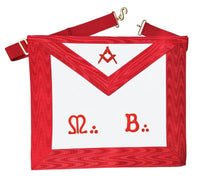
Discover our collection of regalia for the Grande Loge de France (GLDF), designed in accordance with the usages of the obedience.

1 What is the Grande Loge de France?
The Grande Loge de France is a French Masonic obedience founded in 1894, bringing together lodges working primarily under the Ancient Accepted Scottish Rite.
2 Have there been several Grande Loge de France in history?
Yes. Over the course of history, two distinct obediences have borne the name Grande Loge de France. The first emerged in the eighteenth century and became the Grand Orient de France in 1773. The second was founded in 1894.
3 Is the present Grande Loge de France the heir to the eighteenth-century one?
No. The first Grande Loge de France continued within the Grand Orient de France. The present Grande Loge de France arose from a different development, linked to the Ancient Accepted Scottish Rite.
4 What is the difference between the Grande Loge de France and the Grand Orient de France?
The Grand Orient de France is the direct heir of the first Grande Loge de France of the eighteenth century. The Grande Loge de France, founded in 1894, is a distinct obedience, resulting from the emancipation of Craft lodges within the Ancient Accepted Scottish Rite.
5 What is the link between the Grande Loge de France and the Ancient Accepted Scottish Rite?
The Grande Loge de France administers the three Craft degrees of the Ancient Accepted Scottish Rite, while the higher degrees remain under the authority of the Supreme Council.
6 Why is there confusion around the name Grande Loge de France?
The confusion arises because two distinct obediences have borne the same name at different periods, without any direct institutional continuity.
7 When was the present Grande Loge de France founded?
The present Grande Loge de France was founded in 1894, following the reorganisation of the Craft lodges of the Ancient Accepted Scottish Rite
Read the full transcript of the podcast here for those who prefer reading or want more detail.
Podcast – Grande Loge de France: two obediences, one historical confusion
The expression Grande Loge de France appears, at first glance, to refer to a single, clearly defined Masonic obedience. Yet behind this name lies a more complex reality, often misunderstood and frequently simplified.
Over the course of history, two distinct obediences have borne the name Grande Loge de France. Two obediences that never coexisted, and above all, that are not connected by any direct institutional continuity.
To understand this situation, we must return to the early eighteenth century.
Freemasonry began to spread in France around seventeen twenty-five, under the influence of the Grand Lodge of London. As in other territories, the English established a local structure: a Provincial Grand Lodge for France.
The first Grand Masters were therefore British. It was not until seventeen thirty-eight that a Frenchman, the duc d’Antin, assumed this office. This transition did not constitute a true refoundation, but rather a gradual evolution from an organisation still strongly marked by its English origins.
It is important not to project modern categories onto this early structure. This first Grande Loge de France did not function like a contemporary obedience. Its organisation was loose, its authority limited, and the provincial lodges enjoyed a wide degree of autonomy.
Under the Grand Mastership of the comte de Clermont, from seventeen forty-three to seventeen seventy-one, these structural weaknesses became more apparent. The central authority struggled to impose itself, and the whole functioned more as a network than as a unified institution.
At the same time, a new phenomenon emerged: the multiplication of higher degrees. From the seventeen forties onwards, numerous competing systems developed, further complicating the Masonic landscape.
These internal tensions, combined with institutional fragility, led gradually to a major reform.
In seventeen seventy-three, the Grande Loge de France was reorganised and became the Grand Orient de France, under the Grand Mastership of the duc d’Orléans, the future Philippe-Égalité.
This was not a disappearance, but a transformation. The structure born in the eighteenth century continued under a more centralised and coherent form.
The Grand Orient de France thus became the direct heir of the first Grande Loge de France.
At the same time, another history was unfolding, without direct connection to this evolution.
It begins in seventeen sixty-one, when Stephen Morin received a patent, purportedly issued by the Grande Loge de France, authorising him to disseminate a system of higher degrees in the French colonies of the Americas.
This system evolved and was enriched. In eighteen hundred and one, in Charleston, the first Supreme Council of the Ancient Accepted Scottish Rite was founded, organised into thirty-three degrees.
A few years later, in eighteen hundred and four, Alexandre de Grasse-Tilly introduced this system into France.
Unlike the American model, which concerned only the higher degrees, the French developed Craft lodges within the Ancient Accepted Scottish Rite. These lodges were briefly grouped within a structure known as the Grande Loge Générale Écossaise.
A structural difficulty quickly appeared. The Craft lodges remained under the authority of the higher degrees. This overlap created tensions, especially as several competing Supreme Councils claimed authority over the Rite, while the Grand Orient de France sought to integrate these lodges.
After numerous developments, a single Supreme Council eventually prevailed. The Craft lodges remained within a hierarchical system dominated by the higher degrees.
During the nineteenth century, this situation became increasingly contested.
Some lodges demanded autonomy and sought to govern themselves independently from any higher-degree jurisdiction. This movement took place within a broader context shaped by republican, democratic, and free-thinking ideals.
In eighteen eighty, a first rupture occurred. Twelve lodges broke away and founded the Grande Loge Symbolique Écossaise.
This obedience played an important role, but remained unstable. It did not succeed in bringing together all the lodges of the Rite.
However, it demonstrated that an independent organisation of Craft lodges was possible.
This idea gradually took hold.
In eighteen ninety-four, a decisive step was taken. The Supreme Council of France agreed to relinquish direct control over the first three degrees.
The Craft lodges were then grouped into a new obedience: the Grande Loge de France.
This marked the culmination of a long process. For the first time, the Craft lodges of the Ancient Accepted Scottish Rite operated within an autonomous structure, based on democratic principles.
Not all lodges immediately joined this new organisation. Some dispersed, others disappeared. Yet the dynamic had been set in motion.
The Grande Loge de France gradually established itself as a stable obedience, distinct from both the Supreme Council and the Grand Orient de France.
It maintained a close connection with the Ancient Accepted Scottish Rite, administering the Craft degrees, while the higher degrees remained under the authority of the Supreme Council.
We can now return to the initial question.
What does the name Grande Loge de France truly signify?
Over the course of history, this name has referred to two different obediences.
The first, in the eighteenth century, continued within the Grand Orient de France.
The second, founded in eighteen ninety-four, emerged from a completely different context, linked to the development of the Ancient Accepted Scottish Rite.
The links between them are indirect and limited. They rest on a few specific historical elements, but do not constitute any institutional continuity.
The confusion therefore stems from the name itself, and from the tendency to associate these two realities without clearly distinguishing them.
Understanding this distinction helps avoid historical shortcuts and restores each obedience to its proper place within the development of Freemasonry in France.
Only then can the true singularity of the Grande Loge de France be properly understood.


I WANT TO RECEIVE NEWS AND EXCLUSIVES!
Keep up to date with new blog posts, news and Nos Colonnes promotions.
