



The Origins of the Ancient Accepted Scottish Rite: An Investigation into a Franco-American Formation (1761–1804)
The origins of the Ancient Accepted Scottish Rite are usually presented in a straightforward, linear way: a patent in 1761, a development in the Caribbean, then the creation of a Supreme Council in 1801. Yet when we look at the dates and the surviving documents, the picture becomes less clear. Between the 25-degree Rite of Perfection and the 33-degree system, certain grey areas remain. The origins of the Ancient Accepted Scottish Rite cannot be reduced to a single, uniform narrative. To understand the origins of the Ancient Accepted Scottish Rite, we need to examine the established facts with close attention.
- 1. The French Foundations: Morin and the Rite of Perfection (1761–1771)
- 2. Charleston 1801: The Birth of the Supreme Council and the Emergence of the 33rd Degree
- 3. The Grand Constitutions of 1786: A Prussian Document or a Text of 1801?
- 4. Grasse-Tilly and the Question of the Eight French Degrees
- 5. Mitchell, Dalcho, and the Prussian Reference
- 6. Conclusion – A Construction That Became a Tradition
- 7. FAQ – The origins of the Ancient Accepted Scottish Rite
- 8. Podcast – The Origins of the Ancient Accepted Scottish Rite
The French Foundations: Morin and the Rite of Perfection (1761–1771)
The first identifiable foundation lies in France, in the middle of the eighteenth century. Stephen Morin (1705 or 1717–1771) appears as the central figure of this initial phase. His place of birth (New York or Cahors) remains debated, but his Masonic activity in Bordeaux is documented. He operated in a milieu where systems of higher degrees were already circulating, notably the one developed in Paris by the Council of Emperors of the East and West, founded in 1758.
Stephen Morin (1705 or 1717–1771), disseminator of the 25-degree Rite of Perfection and precursor of the Ancient Accepted Scottish Rite.
This system comprised 25 degrees and bore the title Order of the Royal Secret. It was later referred to as the Rite of Perfection. It is this 25-degree framework that constitutes the documented basis of all subsequent developments.
On 27 August 1761, Morin received in Paris a patent authorizing him to propagate this system in the New World. The original document has been lost, but several copies, in French and English, are known from as early as 1768. The signatories belonged to the Council of Emperors of the East and West, even though the document invoked the symbolic authority of the Grand Lodge of France. This institutional ambiguity is real, but the existence of the patent itself does not appear to be in doubt.
From 1762 onward, Morin settled in Saint-Domingue. His presence and Masonic activity there are attested. He disseminated the Rite of Perfection and appointed Deputy Grand Inspectors, including Henry Francken in 1768. Francken translated the rituals into English and contributed to their spread in North America.
At this stage, the facts are relatively solid: a 25-degree system of French origin was circulating throughout the Atlantic world. There is still no indication of a 33-degree system or of a Supreme Council structured according to the model that would later emerge.
It is in the interval between this documented Rite of Perfection and the later 33-degree system that the main uncertainties arise.
Charleston 1801: The Birth of the Supreme Council and the Emergence of the 33rd Degree
On 31 May 1801, the first Supreme Council of the 33rd degree was founded in Charleston. This fact is firmly documented. From that date onward, the 33-degree system appears clearly and in an established form.
Among the founders was John Mitchell (1741–1816). An officer of Irish origin settled in South Carolina, he had received in 1795 a patent as Grand Inspector from Barend Moses Spitzer. That patent still operated within the framework of the 25-degree Rite of Perfection. At that stage, there is no evidence of a fully developed 33-degree system.
Frederick Dalcho (1770–1836) also played a central role. A physician and Episcopal clergyman, he became one of the principal intellectual figures of the Charleston group. One detail deserves attention: Dalcho received the 33rd degree from Mitchell only six days before the official founding of the Supreme Council. This chronology is precise and documented.
John Mitchell (1741–1816) and Frederick Dalcho (1770–1836), founders of the Supreme Council of Charleston in 1801 and architects of the 33-degree Ancient Accepted Scottish Rite.
This raises a simple question. If the 33rd degree had existed since 1786 under Grand Constitutions established in Europe, why does it appear clearly only in Charleston in 1801? Why does its formal transmission occur immediately before the creation of the Supreme Council?
In 1802, a circular known as the Circular Throughout the Two Hemispheres announced the existence of the Supreme Council and referred to the Grand Constitutions attributed to Frederick II of Prussia. This is the first documented appearance of those Constitutions in Masonic records.
From Charleston onward, the 33-degree system assumed a stable institutional form. The Supreme Council became the sovereign body of the Rite. This structure was new. Nothing in the earlier French period allows us to identify an equivalent organization.
One fact therefore stands out clearly: between the 25-degree Rite of Perfection disseminated by Stephen Morin and the 33-degree system structured by a Supreme Council, a major transformation occurred. That transformation is unmistakably visible in Charleston in 1801.
It is from this point that the question of the Grand Constitutions becomes central.
The Grand Constitutions of 1786: A Prussian Document or a Text of 1801?
According to the traditional narrative, the 33-degree system was established by the Grand Constitutions signed in Berlin on 1 May 1786 by Frederick II of Prussia. This text would have elevated the Rite of Perfection from 25 to 33 degrees and instituted the authority of a Supreme Council composed of Sovereign Grand Inspectors General.
Several difficulties arise, however, when the document is examined more closely.
The first concerns chronology. Frederick II died on 17 August 1786. The traditionally accepted date of signature—1 May 1786—falls only a few months before his death. While this proximity does not make the act materially impossible, it renders it historically unlikely. At that time, the king was gravely ill, withdrawn from active Masonic affairs, and not engaged in this kind of institutional initiative.

Frederick II of Prussia (1712–1786), sovereign to whom the Grand Constitutions of the Ancient Accepted Scottish Rite were attributed.
The second difficulty concerns the language of the text. The Grand Constitutions are written in Latin. Yet Frederick II wrote and thought in French. He maintained extensive correspondence in that language and preferred it to German. Had he wished to promulgate a Masonic text of international scope, it is highly probable that he would have drafted it in French, the dominant diplomatic language of the eighteenth century. The use of Latin is therefore surprising in this context.
The third difficulty is documentary. No Prussian manuscript predating 1801 attests to the existence of these Grand Constitutions. Their first known appearance occurs in the 1802 circular published in Charleston by the founders of the Supreme Council. Prior to that date, no reliable trace establishes that a 33-degree system had been formally instituted in Europe.
These elements converge toward a plausible hypothesis: the Grand Constitutions do not date from 1786, but were likely drafted around 1801, in the context of the founding of the Supreme Council of Charleston. They would thus have served to provide historical depth and monarchical legitimacy to a newly established organization.
This hypothesis does not imply that everything was invented from nothing. The Rite of Perfection existed. The 25 degrees were documented. Additional degrees circulated in various French milieus at the end of the eighteenth century. But the definitive structuring into 33 degrees and the institution of a sovereign Supreme Council seem to appear clearly for the first time in Charleston.
If this is the case, the reference to Frederick II would not necessarily be a crude fabrication, but rather an act of legitimization. At the turn of the nineteenth century, attaching a Masonic system to an enlightened sovereign conferred upon it an unquestionable authority.
It remains to clarify the precise role of the men present in Charleston in 1801—particularly John Mitchell and Frederick Dalcho—in shaping this new institutional form.
Grasse-Tilly and the Question of the Eight French Degrees
Alexandre de Grasse-Tilly (1765–1845) is often presented in French-language Masonic literature as one of the instigators of the Ancient Accepted Scottish Rite. His role is more nuanced. He was initiated in 1783 in Paris in the lodge Saint-Jean d’Écosse du Contrat Social. This lodge occupies a distinctive place in the history of higher degrees in France. It claimed a Scottish lineage distinct from the Rite of Perfection in use in Paris and Bordeaux and was part of a network of southern “écossisme” systems whose precise origins remain debated.
The most widespread tradition refers to a patent from Avignon in 1776, transmitted through Deleutre, and identifies the so-called Mother Lodge of Avignon as the source of the system adopted in Paris. Other studies, however, question the existence—or at least the actual institutional role—of this Avignon “mother lodge” and instead emphasize the importance of the Mother Lodge of Marseille in the diffusion of these higher degrees. The available sources do not allow a definitive conclusion between these competing accounts.
What is beyond dispute, however, is the existence in France during the 1770s and 1780s of series of higher degrees distinct from the 25-degree Rite of Perfection. These southern Scottish systems—whether Marseillais, Avignonnais, or otherwise—included degrees that did not appear in the system Stephen Morin and his successors had implanted in the Caribbean and later in North America.
When we observe that in 1801 the American system expanded from 25 to 33 degrees, a question arises: where did the eight additional degrees come from? The known lists of so-called “Avignon” degrees do not correspond to the degrees added to the Ancient Accepted Scottish Rite. This was therefore not a simple mechanical transfer of a clearly identified block of eight degrees..
It is nevertheless difficult to imagine that these degrees were created ex nihilo in Charleston in 1801. The presence of Grasse-Tilly, trained in a Parisian lodge oriented toward southern Scottish systems, is a significant element. It is more than likely that he introduced into the American environment degrees that were previously unknown there but already circulating in France.
From this perspective, the eight degrees added to form the 33-degree system were neither purely American nor easily attributable to a single French “mother lodge.” They appear instead as the result of a selection made from a French reservoir of higher degrees to which Grasse-Tilly had access, integrated and ordered in Charleston within a new architectural framework.
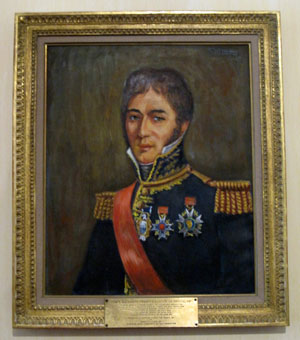
Alexandre de Grasse-Tilly (1765–1845), key figure in the transmission of the Ancient Accepted Scottish Rite from Charleston to France in 1804.
Grasse-Tilly was therefore clearly not the inventor of the Ancient Accepted Scottish Rite, but he was an indispensable actor in its formation and diffusion. He was one of the vectors through which French ritual materials were incorporated into a new institutional structure that stabilized in Charleston in 1801. He would later introduce this new Rite into France by establishing, in 1804, the Supreme Council of France of the Ancient Accepted Scottish Rite.
Mitchell, Dalcho, and the Prussian Reference
The structuring of the 33-degree system in Charleston in 1801 rests primarily on two figures: John Mitchell (1741–1816) and Frederick Dalcho (1770–1836). It was they who signed, in 1802, the circular announcing the existence of the Supreme Council and explicitly referring to the Grand Constitutions attributed to Frederick II.
John Mitchell had received in 1795 a patent as Grand Inspector from Barend Moses Spitzer. This patent still operated within the framework of the 25-degree Rite of Perfection. At that point, nothing indicates the existence of a complete 33-degree system. The institutional transformation appears clearly only in 1801.
Frederick Dalcho received the 33rd degree from Mitchell only six days before the official founding of the Supreme Council, on 31 May 1801. This chronological proximity is significant. It suggests that the 33-degree system had not long been firmly established, but rather that it crystallized precisely within this Charleston context.
The reference to Frederick II cannot be understood as the faithful transmission of an earlier European text. The elements examined above lead to the conclusion that the drafting of the Grand Constitutions should be situated in 1801. However, the choice of Frederick II as a symbolic authority was not arbitrary. The figure of the Prussian sovereign was already circulating in French Higher Degrees, notably through the degree of Noachite or Prussian Knight, attested from as early as 1766. It embodied a monarchical and chivalric legitimacy familiar to the milieu of French “écossisme.”
In this context, the presence of Dalcho, the son of a Prussian officer, and the patent received by Mitchell from Spitzer—whom some sources suggest was also of Prussian origin—help to clarify the recourse to this reference. The figure of Frederick II provided the new system with a prestigious authority, intelligible to Masons formed within the culture of the French Higher Degrees.
Thus, if the ritual materials were essentially French and the system itself took shape in Charleston in 1801, the Prussian reference appears as a coherent symbolic choice rather than evidence of a demonstrable historical filiation.
Conclusion – A Construction That Became a Tradition
The origins of the Ancient Accepted Scottish Rite do not correspond exactly to the narrative long transmitted. The 33-degree system took shape in Charleston in 1801. The Grand Constitutions do not date from 1786. The eight additional degrees find their source in earlier French currents of Higher Degrees. The facts can be viewed as they are.
This does not weaken the value or the relevance of the Rite. An initiatory rite does not rest on the perfection of a single, clearly identifiable founding act. Like all other rites, the Ancient Accepted Scottish Rite was formed from pre-existing ritual materials; it was structured within specific historical circumstances and gradually found its own coherence.
What remains is not a legend, but a living initiatory structure. The origins of the Ancient Accepted Scottish Rite belong to history. The Rite itself belongs to experience. It is within that experience—practiced and transmitted in speculative Freemasonry—that its legitimacy resides.
By Ion Rajolescu, Editor-in-Chief of Nos Colonnes — serving a Masonic voice that is just, rigorous, and alive
Discover our AASR Blue Lodge collection and explore the living foundations of the Rite.

1 Do the Constitutions of the Ancient Accepted Scottish Rite really date from 1786?
Available evidence indicates that they do not date from 1786. Their first documented appearance occurs in 1802, following the foundation of the Supreme Council of Charleston in 1801.
2 Is the Ancient Accepted Scottish Rite of French origin?
It has a solid French foundation in the 25-degree Rite of Perfection developed in the 1760s. However, its organization into 33 degrees took shape in Charleston in 1801.
3 Who was Stephen Morin in the history of the Rite?
Stephen Morin received a patent in 1761 authorizing him to spread the Rite of Perfection in the New World. He played a key role in establishing the 25-degree system in the Caribbean.
4 What was John Mitchell’s role?
John Mitchell was one of the founders of the Supreme Council of Charleston in 1801. He transmitted the 33rd degree shortly before its foundation and co-signed the 1802 circular.
5 What role did Frederick Dalcho play?
Frederick Dalcho contributed significantly to the doctrinal structuring of the 33-degree system and co-signed the foundational documents issued after 1801.
6 Was Alexandre de Grasse-Tilly the founder of the Ancient Accepted Scottish Rite?
He was not the sole founder, but he played a crucial role in transmitting French higher degrees to America and in introducing the Rite to France in 1804.
7 Where did the eight additional degrees come from?
They appear to have originated in French higher -degree systems active in the 1770s and 1780s, distinct from the original 25-degree Rite of Perfection.
8 Why is Frederick II associated with the Rite?
Frederick II is mentioned in the Constitutions published after 1801. This reference likely served as a symbolic legitimizing device rather than reflecting proven historical authorship.
9 Does the later drafting of the Constitutions undermine the Rite’s legitimacy?
No. The initiatory value of a rite depends on the coherence of its symbolic structure and its living transmission, not solely on the date of a constitutional text.
10 Is the Ancient Accepted Scottish Rite still practiced today in speculative Freemasonry?
Yes. It remains one of the most widespread higher-degree systems within speculative Freemasonry worldwide.
Read the full transcript of the podcast here for those who prefer reading or want more detail.
Podcast – The Origins of the Ancient Accepted Scottish Rite
The origins of the Ancient Accepted Scottish Rite are often presented in a simple and linear way. A patent in seventeen sixty-one. A development in the Caribbean. The creation of a Supreme Council in eighteen hundred and one. The story seems clear.
Yet when we look closely at the dates and at the surviving documents, the picture becomes more complex.
Everything begins in France, in the middle of the eighteenth century, with Stephen Morin. He was active in Bordeaux and received, in August seventeen sixty-one, a patent authorizing him to propagate a system of twenty-five degrees known as the Order of the Royal Secret, later called the Rite of Perfection. From seventeen sixty-two onward, Morin settled in Saint-Domingue and began to spread this system across the Atlantic world.
At this stage, everything concerns twenty-five degrees. There is no clear trace of a thirty-three degree structure, and no Supreme Council as later understood.
The decisive moment appears in Charleston, on May thirty-first, eighteen hundred and one. On that day, the first Supreme Council of the thirty-third degree was founded. This event is firmly documented. Among its principal figures were John Mitchell and Frederick Dalcho.
Mitchell had previously received, in seventeen ninety-five, a patent as Grand Inspector within the framework of the twenty-five degree Rite of Perfection. Dalcho, for his part, received the thirty-third degree from Mitchell only six days before the official foundation of the Supreme Council. This chronology is striking. It suggests that the full thirty-three degree system crystallized precisely at that moment.
In eighteen hundred and two, a circular known as the Circular Throughout the Two Hemispheres announced the existence of the Supreme Council and referred to Grand Constitutions allegedly signed in Berlin on May first, seventeen eighty-six, by Frederick the Second of Prussia.
However, several difficulties arise. Frederick the Second died on August seventeenth, seventeen eighty-six. By that time, he was gravely ill and long removed from active Masonic affairs. Moreover, the so-called Grand Constitutions are written in Latin, whereas Frederick habitually wrote and thought in French. No document prior to eighteen hundred and one confirms the existence of a thirty-three degree system in Europe.
These elements strongly suggest that the Grand Constitutions were drafted around eighteen hundred and one, in Charleston, to provide historical depth and sovereign authority to a newly structured system.
Yet this does not mean that everything was invented from nothing. The Rite of Perfection in twenty-five degrees was real and well attested. In France, during the seventeen seventies and seventeen eighties, various systems of Higher Degrees circulated beyond the original structure of twenty-five degrees.
This is where Alexandre de Grasse-Tilly enters the picture. Initiated in seventeen eighty-three in Paris in the Lodge Saint-Jean d’Écosse du Contrat Social, he was connected to circles where additional Higher Degrees were practiced. It is more than plausible that he brought to America ritual material unknown within the strict twenty-five degree framework previously used there.
The thirty-three degree system that emerged in Charleston can therefore be understood as a synthesis. French ritual material. An American institutional structure. A Prussian symbolic reference.
The Ancient Accepted Scottish Rite did not descend fully formed from a single founding act. It took shape through historical circumstances, through individuals, and through the gradual organization of pre-existing materials.
Its origins belong to history.
The Rite itself belongs to lived experience.


JE VEUX RECEVOIR LES ACTUALITÉS ET EXCLUSIVITÉS !
Restez au courant des nouveaux articles de blog, des nouveautés et promotions Nos Colonnes.
