



The Robe in Freemasonry : not a sign of gender or decoration, but a symbol.
Freemasons in robes ? The idea makes some people smile and others sigh. Some see it as a feminine fad or a postmodern fashion shift. However, the ritual robe is by no means a recent addition to Freemasonry. In fact, it predates the admission of women to the lodge by a considerable amount of time. Evidence of it can be found in the Higher Degrees of the eighteenth century, the Egyptian Rites and several Anglo-Saxon Side Degrees, as well as in more recent women's or mixed obediences. In short, the ritual robe is a serious matter in Freemasonry. Masonic robe says nothing about gender, but a great deal about function. It does not flatter appearance ; it signifies passage. Masonic robe is simply a continuation of an age-old tradition.
1. A Forgotten Tradition : The Ritual Robe in Masonic Higher Degrees
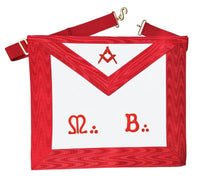
Contrary to popular belief, the ritual robe in Freemasonry is neither a recent invention nor unique to women. It appeared as early as the 18th century in several Higher Degrees, notably in the Ancient Accepted Scottish Rite. The rituals clearly state that a ritual robe must be worn for the 19th, 23rd, 24th, 27th, 28th and 29th degrees, with specific colours : white for the 19th and 23rd, starry blue for the 24th, and red for the 28th and 29th. Additionally, some Chapter Masters wear different coats or tunics, such as a yellow tunic over a red robe for the 23rd degree or an ermine coat for the 27th degree.

Members of the Supreme Chapter of the English Royal Arch
There's nothing anecdotal here. These colours are not just for decoration ; they have a function and say something about the role and status of the person wearing the robe. White conveys purity and light ; red, authority, fire and perhaps blood ; and celestial blue is linked to an ordered transcendence. Ritual robe in Freemasonry is not theatrical costume, but a garment of passage, authority and knowledge. It's no coincidence that similar patterns are found in the Anglo-Saxon side degrees, such as the Royal Arch, where the Three Principals wear specific robes — sometimes sumptuous, always significant. Once again, it is not the habit that makes the Mason, but it does manifest the function.
2. The Egyptian Rites : another tradition of robes
In Craft Freemasonry, the use of ritual robes is rare, except in one specific branch : the Egyptian Rites. From the end of the eighteenth century, the Egyptian Rite of Cagliostro appears to have introduced a distinctive robe, a more formal version of which features in the rituals of the Rite of Misraïm, which were compiled between 1815 and 1820. Here, the white robe forms an integral part of Masonic attire. The Rite of Memphis, founded in 1838, also adopted the robe but changed its colour to sky blue as a nod to the starry sky.
In these contexts, the ritual robe in Freemasonry does not play the same role as in the higher degrees of the AASR. It is not reserved for a high rank, but forms part of the attire from the craft lodge onwards. It immediately connects the initiate to a symbolism of the transformed body, inhabited silence and self-denial. This can be seen as a sign of a more liturgical and visual form of Masonry, a feature that is sometimes criticised, but which fully embraces the link between ritual and incarnation.
3. The contemporary revival of the ritual robe in Freemasonry
Following the establishment of the Grande Loge Féminine de France in 1946, the ritual robe experienced a revival within Freemasonry. This time, the robe was black — a symbolic choice, as black absorbs light, just as the initiate is supposed to receive the Light. Some have interpreted this as a sign of effacement or even the negation of femininity, with some going so far as to describe the garment as a 'Masonic chador'. This kind of reading, as patronising as it is simplistic, misses the point. The robe conceals nothing here ; it unifies, prepares and establishes equality among the sisters in the lodge.

GLFF black ritual robe
In the men's lodges, all you need is a dark suit and tie. In the women's lodges, however, this apparent simplicity becomes problematic. The robe resolves this sartorial tension while expressing the body through a shared symbolic language. It doesn't erase differences ; it merely silences them for the duration of the ritual. This logic is not unique to the Grande Loge Féminine de France. Other women's or mixed lodges, such as the Grande Loge Féminine de Memphis-Misraïm, also opt for a robe, which is sometimes white and sometimes black. Once again, this choice speaks to the expected simplicity — and the ritual function — of the garment.
4. Current uses : between symbolic coherence and diversity of practices
The wearing of ritual robes in Freemasonry is not universal. Some women's or mixed obediences insist on it, while others do without. The Grande Loge Féminine de Memphis-Misraïm adopts white robes in a spirit of luminous simplicity. Conversely, obediences stemming from the GLFF tradition, such as the Grande Loge Féminine de Suisse, favour black robes in keeping with the idea of absorbing the light during initiation.

Annie Besant surrounded by members of the English DH
For its part, Le Droit Humain began by imposing a white chasuble, only to abandon it a few years later. Some lodges have retained it or adopted it locally, but it is rarely used. None of this is inconsistent. The robe is not an article of faith. It is a symbolic tool. It can disappear without affecting the work, but when chosen consciously, it can also reinforce the ritual atmosphere by erasing visible differences, marking the threshold and creating silence around the body. Perhaps its most discreet function is to create equality of presence.
5. What else does the ritual robe tell us about Freemasonry ?
It is not indispensable. There is nothing universal about it. In fact, it is not always understood. And yet, it keeps coming back. Whether by choice, loyalty or intuition, it remains. In Freemasonry, the ritual robe acts as a reminder that rituals are also experienced through the body. Clothes are not just clothes. They prepare us, frame us and signal that we are entering another time.
The robe does not say : 'I am this or that'. Rather, it says, 'I am ready to be silent, to receive, and to serve the common work'. It is neither masculine nor feminine. It is vertical. It connects the ground with the invisible. You can manage without it. However, when it is present, it conveys the essence of the lodge : a space for stripping away, listening and transformation, without saying a word.
Conclusion
Should you wear a robe in the lodge ? There is no general answer to this question. Some rites require it, some ignore it and some are rediscovering it. It is neither a sign of orthodoxy nor an optional ornament. It is a threshold. It is a garment that prepares you for entering not a stage, but an interior space. It imposes silence without demanding it. Sometimes, the simple act of putting on a robe and erasing one's appearance to become one with the ritual is enough to remind us that Freemasonry is not just something to think about, but something to experience.
By Ion Rajolescu, editor-in-chief of Nos Colonnes, dedicated to delivering an accurate, rigorous and vibrant Masonic message.
Keen to explore the symbolism of the masonic robes further ?
Have a look at our collections of ritual Masonic robes
FAQ: Ritual Robes in Freemasonry
1. Are ritual robes reserved for women in Freemasonry ?
No, ritual robes have been worn by men in several higher degrees since the 18th century. They were used before women were admitted to the lodge.
2. What is the purpose of ritual robes in Freemasonry ?
They mark a change of status. They erase visible differences, establish silence, and place the body in a symbolic space prepared for work.
3. Which AASR degrees include a ritual robe ?
The rituals mention robes for the 19th, 23rd, 24th, 27th, 28th and 29th degrees. These robes differ in colour and function depending on rank and role.
4. Do all women’s or mixed obediences require the wearing of robes ?
No, some do, such as the GLFF and the GLFMM. Others, such as Droit Humain, leave it to the lodges' discretion.
5. Why are the robes black in some lodges ?
In the GLFF, the colour black symbolises the absorption of light. During the ritual, the initiate is supposed to receive the Light while wearing black.
6. Does the white robe have another meaning ?
Yes, it represents simplicity, purity and availability. It is a colour adopted by the GLFMM, for example, as a symbol of elevation and neutrality.
7. Is the ritual robe used in a Craft Lodge ?
Very rarely, in the best-known rites. However, it does appear in the Egyptian Rites, such as Misraïm and Memphis, from the first grades.
8. Is the ritual robe compulsory in the Anglo-Saxon Side Degrees ?
Not always, but frequently. In the Royal Arch, for example, the Three Principals wear codified robes with specific symbolic colours.
9. Is the wearing of robes a Masonic dogma ?
No, it is a ritual choice and sometimes a local custom. Robe-wearing is neither imposed nor proscribed, but its presence is always significant.
10. What does the return of the robe to certain lodges reveal ?
It reflects a desire to rediscover a more embodied, quieter liturgy in which the body plays a fuller role in the ritual act.


I WANT TO RECEIVE NEWS AND EXCLUSIVES!
Keep up to date with new blog posts, news and Nos Colonnes promotions.
