



Origin and Meaning of the Director of Ceremonies' Wand
When the Director of Ceremonies moves ritually within the Lodge, he holds in his right hand a discreet yet constant object: the Director of Ceremonies’ wand. Present in the vast majority of Masonic workings, this wand movement, marks the rhythm of the work and orders ritual paths. But what does the Director of Ceremonies’ wand truly signify? Is it merely an accessory intended to enhance the solemnity of Masonic ceremonies, or the vestige of a more ancient usage, bearing a meaning that has gradually faded? In speculative Freemasonry, nothing is left to chance. If the Director of Ceremonies’ wand is always present, held with rigor and constancy, it is because it forms part of a precise symbolic language, inherited at once from history, operative practice and ritual tradition.
- 1. Origin of the Director of Ceremonies’ Wand in Speculative Freemasonry
- 2. The Builders’ Wand and the Medieval Quine
- 3. The Director of Ceremonies’ Wand as an Operative Heritage
- 4. Uses and Variations According to the Rites and Workings
- 5. Conclusion – From Tool to Ritual Gesture
- 6. FAQ – The Director of Ceremonies’ Wand in Freemasonry
- 7. Podcast – Origin and Meaning of the Director of Ceremonies’ Cane
Origin of the Director of Ceremonies’ Wand in Speculative Freemasonry
The appearance of the Director of Ceremonies’ wand in Masonic practice must be placed within the context of the emergence of speculative Freemasonry in the 17th and 18th centuries. At that time, the wand was already a socially codified object, associated with authority, dignity and self-mastery. It accompanied the movements of kings, nobles, officers and magistrates, not as a weapon, but as a visible sign of status and function.
When speculative Freemasonry took shape in England and then spread throughout Europe, it naturally inherited these symbolic codes drawn from the profane world. The Director of Ceremonies, responsible for ordering movements in the Lodge, accompanying the Brethren and ensuring the correctness of ritual paths, was thus endowed with an attribute that expressed his role without recourse to speech. The Director of Ceremonies’ wand became a silent extension of his functional authority.
It is important to distinguish this wand from any instrument of command. The Director of Ceremonies’ wand is neither a weapon nor a means of constraint. It is not intended to impose order by force, but to render a ritual path legible. By its mere presence, it signals a function, a precise role within the economy of the Lodge, and recalls that Masonic order does not proceed from injunction, but from a shared and recognized framework.
The Builders’ Wand and the Medieval Quine
The wand, now employed as a ritual instrument by the Director of Ceremonies, nevertheless has its roots in a much older usage, directly linked to the practices of builders.
Among medieval operative Masons, the wand was not a symbolic attribute but a working tool. Ancient representations frequently show Master Builders holding a long wand, alongside the square and the compasses. This wand was used to measure, to transfer proportions and to order the built space. It was known as the builders’ gauge, or quine.

Modern reconstruction of an articulated quine, a measuring instrument used by builders, based on anthropometric units and proportional relationships.
The quine brings together, in increasing order, the customary units of measurement, articulated or marked on a single instrument. It thus includes the palm, the handbreadth, the span, the foot and the cubit. These measures, whose values varied from one region to another, nevertheless allowed for a coherent practice based on constant ratios. The wand thus became an instrument of proportion before being a simple instrument of length.
The interest of the quine lies in its very structure. By adding two successive measures, the next is obtained. Palm and handbreadth give the span, handbreadth and span give the foot, span and foot give the cubit. This progression corresponds to a Fibonacci sequence applied in a practical manner. The ratio between two successive measures tends toward the value of the Golden Ratio, without any need for theoretical formulation.
The builder’s wand is therefore not an abstract symbol, but a condensation of know-how. It makes it possible to inscribe harmonious proportions in stone through use rather than calculation. It bears witness to an embodied form of knowledge, transmitted through gesture and experience, long before any mathematical formalization.
The Director of Ceremonies’ Wand as an Operative Heritage
The wand used today by the Director of Ceremonies is no longer a measuring tool in the operative sense. It is neither graduated nor articulated, nor is it used to transfer proportions. Yet its presence in the Lodge preserves the trace of an operative usage, inherited by speculative Freemasonry without the full transmission of its original function.
What remains is not the technical instrument, but the principle it embodied. The wand orders space, accompanies gesture and inscribes movement within a measure. It no longer serves to build stone, but it continues to regulate the body and its movements. In this sense, it marks a transition from the operative to the ritual, not through abrupt rupture, but through transformation.
The Director of Ceremonies’ wand thus bears witness to an operative memory that has been partially preserved. It recalls that Masonic ritual does not rest solely on words or abstract symbols, but also on a discipline of gesture, rhythm and measure. What was once inscribed in matter has now been displaced into the symbolic space of the Lodge.
This heritage is discreet, sometimes almost effaced. It is no longer explicitly articulated as such in the rituals, yet it remains perceptible in use. The wand no longer measures stone; it measures movement. It no longer regulates the worksite; it regulates the unfolding of the rite. It is within this silent continuity that one of the deepest links between operative Masonry and speculative Freemasonry is to be found.
Uses and Variations According to the Rites and Workings
The use of the Director of Ceremonies’ wand is not strictly uniform from one working to another. In many rites practiced today, it remains a stable attribute of the office and accompanies ritual movements, according to forms and uses that are relatively consistent within each ritual framework.
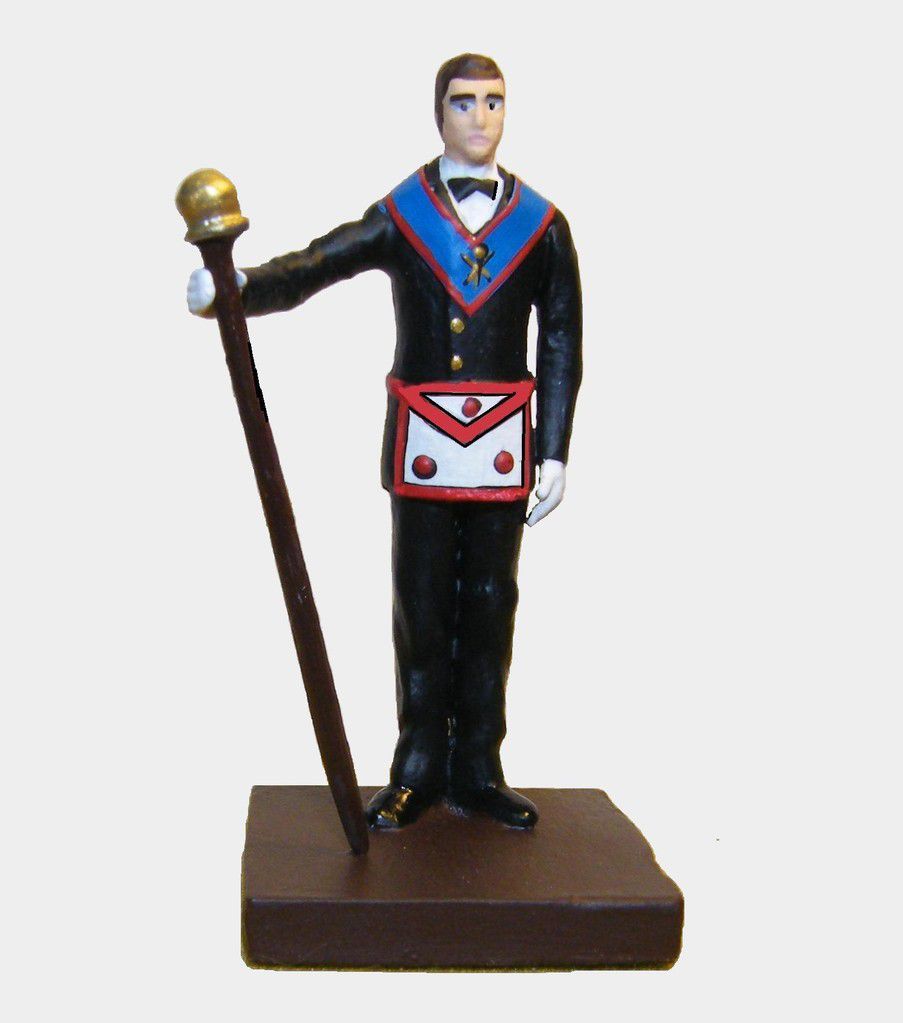
Figurine representing the Master of Ceremonies of the Ancient and Accepted Scottish Rite, holding the wand associated with his ritual office.
In the Rectified Scottish Rite, the Director of Ceremonies does not carry a wand. This absence reflects the specific orientation of the rite, which places greater emphasis on chivalric symbolism than on operative heritage. The role of the Director of Ceremonies is conceived differently, and the use of the wand has not been retained.
In Anglo-Saxon workings, by contrast, the wand is not reserved solely for the Director of Ceremonies. It may be carried by several officers, notably the Deacons and the Steward, depending on the ritual workings and established uses. The wand thus becomes a shared functional attribute, associated with the conduct of movements, the transmission of messages and the organization of motion within the Lodge.
Conclusion – From Tool to Ritual Gesture
The Director of Ceremonies’ Wand, as it is employed today in Freemasonry, cannot be reduced to a mere accessory of solemnity or a simple badge of office. It belongs to a longer continuity, in which the tool preceded the symbol and in which gesture itself carried measure.
If the wand is no longer, within the Lodge, an operative instrument in the strict sense, it nevertheless retains the trace of a heritage derived from the builders, displaced from the domain of construction to that of ritual. It no longer acts upon stone, but upon movement, space and the rhythm of progression. Through its discreet presence, the Director of Ceremonies’ wand recalls that the ritual is also embodied in the body and in gesture, and that speculative Freemasonry remains, in its own way, the bearer of a transformed operative memory.
By Ion Rajolescu, Editor-in-Chief of Nos Colonnes — serving a Masonic voice that is just, rigorous, and alive
The Director of Ceremonies’ wand is one of the many accessories used in the Lodge. Discover our collection dedicated to the Craft Lodge tools and accessories.

1 What is the purpose of the Director of Ceremonies’ wand in Freemasonry ?
The Director of Ceremonies’ wand accompanies and regulates ritual movements in the Lodge. It marks a specific function, without being an instrument of command or a mere decorative accessory.
2 Is the Director of Ceremonies’ wand used in all Masonic Workings ?
No. While it is used in most workings, it is absent from the Rectified Scottish Rite, whose symbolism emphasizes a chivalric orientation rather than an operative heritage.
3 Why is the Director of Ceremonies’ wand held in the right hand ?
The right hand is traditionally associated with measured action and the just gesture. Holding the wand in this hand underscores the ritual function of the Director of Ceremonies during movements.
4 Is the Director of Ceremonies’ wand a symbol of power ?
No. It confers no personal power. It makes visible a temporary function exercised in the service of the ritual and the order of the works.
5 Is there a link between the Director of Ceremonies’ wand and medieval builders ?
Yes. The wand has its origin in the measuring tools of operative Masons, notably the quine, used to order proportions and structure built space.
6 What is the builders’ quine ?
The quine is a measuring wand bringing together, in increasing order, the palm, the handbreadth, the span, the foot and the cubit. It allowed proportional relationships to be used without recourse to theoretical calculation.
7 Does the Director of Ceremonies’ wand retain an operative function ?
Not in a technical sense. It no longer measures matter, but it retains the trace of an operative heritage transposed into ritual and gesture.
8 Why do several officers carry a wand in Anglo-Saxon Workings ?
In certain Anglo-Saxon workings, the wand is carried not only by the Director of Ceremonies, but also by the Deacons or the Steward, in connection with the conduct of movements and the transmission of messages.
9 Does the Director of Ceremonies’ wand have a universal symbolic meaning ?
No. Its meaning depends on the rite or working, its usage and the symbolic economy in which it is situated. It cannot be reduced to a single interpretation.
10 Does the Director of Ceremonies’ wand still hold a central place in contemporary rituals ?
Yes. Even though its uses vary from one working to another, the wand remains an important functional attribute of the Director of Ceremonies and fully participates in the organization of ritual movements.
Read the full transcript of the podcast here for those who prefer reading or want more detail.
Podcast – Origin and Meaning of the Director of Ceremonies’ Cane
When one observes ritual movements in the Lodge attentively, a discreet object comes into view: the Director of Ceremonies’ cane. Present in most Masonic workings, it accompanies movement, regulates the prescribed paths and inscribes gesture within a precise form. It is neither decorative nor incidental.
Far from being a late invention intended merely to add solemnity to ceremonies, the wand belongs to a much longer history. Long before speculative Freemasonry, it was part of the world of builders. Among medieval operative Masons, the wand was a measuring tool known as the quine. It brought together, in increasing order, the palm, the handbreadth, the span, the foot and the cubit, allowing proportions to be ordered without recourse to abstract calculation.
By adding two successive measures, the next was obtained. This progression, corresponding to a Fibonacci sequence, made it possible to approach the Golden Ratio through practice rather than theory. The wand was thus an instrument of embodied knowledge, placed at the service of construction.
In speculative Freemasonry, this operative use has disappeared, but it has left a trace. The Director of Ceremonies’ wand no longer measures stone; it accompanies the body. It no longer regulates the worksite, but the unfolding of the rite. It bears witness to an operative memory transformed and displaced into the symbolic space of the Lodge.
Its use varies according to the workings. Absent from the Rectified Scottish Rite, marked by a chivalric symbolism, it remains central in many other rites. In Anglo-Saxon traditions, several officers may even carry a cane. These variations remind us that the wand is never a mere accessory, but a functional element inscribed within a precise ritual economy.


I WANT TO RECEIVE NEWS AND EXCLUSIVES!
Keep up to date with new blog posts, news and Nos Colonnes promotions.
