



The Chisel in Freemasonry: Symbol of Discernement and Inner Balance
The first act of a Freemason is an act of shaping. Armed with the Mallet and the Chisel, he strikes the Rough Stone as if to free himself from the shapeless. In this dialogue between strength and precision, something stirs within him — an awareness of the inner work to be done.
The Mallet without the Chisel would be sheer force; the Chisel without the Mallet, mere weakness. Together they remind him that self-transformation is neither a constraint nor a miracle, but a patient labour in which will is guided by balance.
What, then, is the deeper meaning of the Chisel in Freemasonry, and what silent wisdom lies hidden in its steel blade?
- 1. What are the origins of the Chisel in Freemasonry?
- 2. Why did the Chisel become a Masonic symbol?
- 3. How can the union of the Mallet and the Chisel in Freemasonry be understood?
- 4. What is the meaning of working the Stone with the Masonic Chisel?
- 5. What does the Chisel in Freemasonry represent for the Mason’s inner life?
- 6. Conclusion – The Silence of the Chisel
- 7. FAQ – The Chisel in Freemasonry
- 8. Podcast – The Chisel in Freemasonry
What are the origins of the Chisel in Freemasonry?
The Chisel in Freemasonry is not a direct legacy of the operative lodges of the Middle Ages. In the old English and Scottish catechisms of the late seventeenth century it does not yet appear. It emerges only in 1724, in The Whole Institution of Masonry, then in 1725 in The Whole Institution of Free-Masons Opened, and finally in 1726 in the Graham Manuscript.
Its appearance coincides with the birth of the Grand Lodge of London, founded, according to tradition, in 1717 — a decisive moment when Masonry began to move from the quarry of stone to the quarry of the spirit.
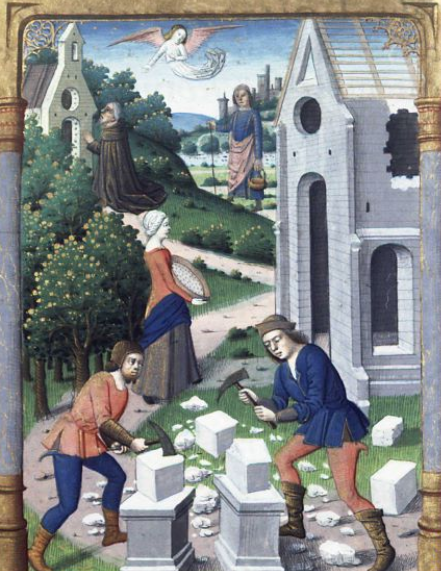
Stonemasons at work – illumination from the Golden Legend, circa 1485
In the operative lodges, the stonemason possessed an entire array of tools — mallets, hammers, axes, picks, bush-hammers — each with its particular function: to rough-hew, to level, to adjust, to polish. The Chisel was merely one among many, reserved for the finest and most precise finishing work, when the gesture becomes almost a caress.
As Freemasonry gradually detached itself from the craft to become an art of living, it simplified this workshop language so that all could grasp its meaning. From this refinement emerged a foundational pair: the Mallet and the Chisel, sufficient to represent the entire process of working the Rough Stone — the patient effort through which a man shapes his own nature.
When the Entered Apprentice ritually strikes the Stone three times with these two tools, he is not repeating an ancient practice: he performs an act of awareness. In those three blows lies a method: to unite will and discernment — the strength of the Mallet and the delicacy of the Chisel — in order to turn the roughness of the block into the promise of form.
Why did the Chisel become a Masonic symbol?
The Chisel in Freemasonry entered the rituals only at a later stage, for it marks a decisive turning point — the passage from knowing how to do to knowing how to be. At the moment when Masonry left the operative quarry to build an inner Temple, the tools ceased to be instruments of labour and became emblems of moral refinement.
In the lodges of the stonemasons, every tool had its purpose: the bush hammer for rough-hewing, the stone pick for cutting, the sledge hammer for striking with force. But when this language of the workshop had to be translated into a symbolic language comprehensible to all, the system was simplified. Speculative Freemasonry retained what best expressed the spirit of the work — the Mallet, symbol of strength, and the Chisel, emblem of discernment.
The choice was not accidental. The Mallet acts through the power of the arm; the Chisel, through the precision of the hand. One without the other achieves nothing: strength without intelligence destroys, intelligence without strength remains barren. Together they embody the twofold discipline of the Masonic method — the will to transform oneself, yet with measure; to strike, yet with discernment; to act, yet in full awareness of the aim.
Thus, the symbolism of the Masonic Chisel no longer refers only to the tool of the operative craftsman: it becomes the image of inner work, of that vigilance which refines the rough matter of man and makes of him a living stone in the spiritual Temple.
How can the union of the Mallet and the Chisel in Freemasonry be understood?
The union of the Masonic Mallet and the Chisel reveals the creative tension between strength and balance, between impulse and control. The Mallet, held in the right hand, embodies energy, determination, and active will. The Chisel, held in the left, represents measure, clarity, and the precision of thought. One is active, the other receptive. One drives, the other directs.
In the symbolic gesture, the blow is never struck directly upon the Rough Stone. The stroke of the Mallet is transmitted through the Chisel, which channels and tempers its force. Without this mediation, the stone would split apart. The Chisel thus stands as the sign of spiritual discernment — that inner faculty which transforms raw energy into a creative act.

The founding gesture: the mallet and chisel shaping the rough stone
This triangular relationship — Mallet, Chisel, and Stone — expresses the principle of harmony that runs through all Freemasonry. Strength without discernment is mere blind momentum; discernment without strength remains sterile. Their union teaches that true wisdom is not a tepid balance between opposites, but a living complementarity that gives birth to form.
In the Mason’s work, every strike finds its inner rhythm: strength acts, thought guides, matter responds. Through this silent dialogue between man and stone, will becomes awareness — and awareness becomes creation.
What is the meaning of working the Stone with the Masonic Chisel?
The work of the Stone in Freemasonry was never meant to imitate the labour of the stonemason, but to carry its lesson into another realm. The Rough Stone represents the human being in his first state — still marked by ignorance, vanity, and the sharp edges of the ego. The Masonic Chisel teaches the art of refining this inner substance, clearing away whatever prevents the light from entering.
Yet such refinement cannot be achieved by strength alone. The Mallet, when it acts without the discernment of the Chisel, breaks more than it builds. Conversely, the work of the Chisel, without the impulse and support of the Mallet, remains shallow. Their alliance holds the key: action enlightened by reflection, and reflection sustained by action.
Each strike upon the stone becomes a metaphor for moral and spiritual transformation. To work toward the perfection of one’s nature is to learn to balance strength with gentleness, to cut true without wounding, to release the form without destroying the substance. The Freemason comes to see that the Chisel in Freemasonry is not merely a tool but a method of life — an invitation to know, correct, and shape oneself, without indulgence yet with respect.
What does the Chisel in Freemasonry represent for the Mason’s inner life?
In the silence of the Lodge, the Chisel in Freemasonry becomes more than a tool — it becomes an attitude. It reminds the Mason that true transformation lies not in rupture, but in the patient refinement of the self. Each roughness corrected, each excess cut away, each imperfection polished contributes to the same task: the shaping of consciousness.
The Chisel symbolises lucidity applied to inner life. It teaches the Mason to discern what within him must be preserved, corrected, or removed. Beneath its blade lives a demand for balance — not to strike too hard, nor to let too many flaws pass unnoticed. Such constant vigilance, humble and steadfast, forms the very heart of Masonic ethics.
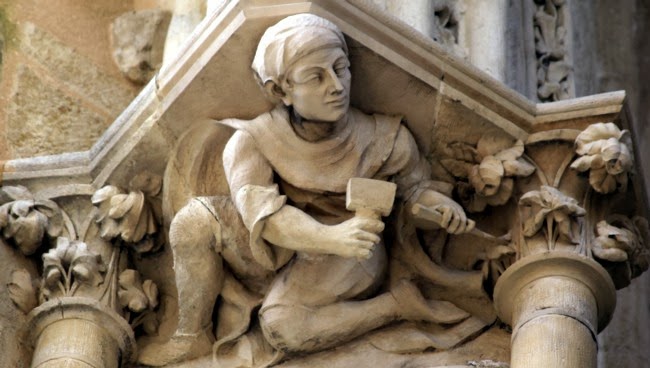
The Stonemason, sculpture at Notre-Dame de Paris – a medieval tribute to the builder’s art
Thus, even when the rituals no longer mention it, the Chisel remains alive in the Mason’s initiatory memory. It calls him to pursue his work beyond the degrees, to remain the craftsman of his own humanity. For every Mason, whatever his rank, remains an Apprentice before the stone that he is. And as long as the blade of discernment continues its work, the Temple will keep rising — without and within.
Conclusion – The Silence of the Chisel
Within the symbolic order of Freemasonry, few tools are as discreet — and yet as essential — as the Chisel. It does not shine, command, or triumph; it works in silence, in detail, in the unseen. Its strength lies in precision, its teaching in patience. Where the Mallet embodies creative impulse, the Chisel recalls measure, restraint, the art of shaping without destruction.
The Mason thus learns that true progress is not won by sheer willpower, but through discernment. To work with the Chisel is to learn to listen to the resistance of matter, to attune to the rhythm of the just gesture, and to understand that all enduring work is built through nuance.
In the stone he polishes, the Mason sculpts his own humanity. And in the steady sound of the Mallet upon the Chisel, one may hear the echo of conscience itself — the quiet voice of a man who, in shaping himself, helps raise the harmony of the world.
By Ion Rajolescu, Editor-in-Chief of Nos Colonnes — in service of a Masonic voice that is just, rigorous, and alive.
Perfect your symbolic work: Explore our collection of Masonic working tools — Mallets, Chisels, Squares and Compasses — faithful companions of the Lodge’s inner work. Designed to unite beauty, precision, and tradition.

1. What is the meaning of the Chisel in Freemasonry?
The Chisel in Freemasonry symbolises discernment, precision, and inner refinement. It channels the force of the Mallet into an act of conscious creation.
2. Why are the Mallet and the Chisel always associated in Masonic rituals?
Because they represent two complementary forces : will and understanding. Their union reflects the balance between action and reflection in Masonic work.
3. When did the Chisel appear in Masonic tradition?
It first appeared in early eighteenth-century English texts, shortly after the founding of the Grand Lodge of London in 1717. Its inclusion marks the shift from operative to speculative Masonry.
4. What does the Rough Stone worked with the Mallet and the Chisel represent?
The Rough Stone symbolises the imperfect human being. Shaping it with the Mallet and Chisel expresses the Mason’s effort to refine himself into the harmony of the Perfect Ashlar.
5. How does the Masonic Chisel differ from other operative tools?
Operative tools such as the hammer, the pick, or the adze served material purposes. The Masonic Chisel transforms their craft into a moral and spiritual lesson.
6. What is the meaning of the three ritual blows on the stone?
They symbolise awareness, intention, and right action — the first conscious steps in every inner transformation.
7. Is the Chisel present in all Masonic rites?
No. It appears in most continental rites but disappears in some Anglo-Saxon systems, surviving mainly in the Mark Masonry degree.
8. How can the Chisel guide a Mason’s daily life?
It teaches moderation and discernment : to cut away excess, to smooth harsh words, and to correct one’s judgments before acting.
9. What does the “silence of the Chisel” mean in Masonic symbolism?
It refers to the quiet strength of precision — a power that builds through accuracy, not noise, like conscience working in silence.
Questions 10
10. How does the Chisel relate to the Masonic quest for perfection?
Read the full transcript of the episode here for those who prefer reading or want more detail.
Podcast – The Chisel in Freemasonry
The first gesture of a Freemason is a gesture of shaping.
Armed with the Mallet and the Chisel, he strikes the Rough Stone —
as though freeing himself from what is still unformed.
In this dialogue between strength and precision, something awakens:
a consciousness of the inner work to be done.
The Mallet without the Chisel would be violence.
The Chisel without the Mallet, impotence.
Together, they remind us that transformation is neither constraint nor miracle,
but a patient labour where will and discernment are brought into harmony.
What, then, does the Chisel in Freemasonry truly signify?
And what silent wisdom does its steel blade hold?
The Chisel in Freemasonry is not a direct survival from the medieval operative lodges.
In the old English and Scottish catechisms of the late seventeenth century,
it is not yet mentioned.
It appears for the first time in 1724,
in The Whole Institution of Masonry,
then in 1725, in The Whole Institution of Free-Masons Opened,
and in 1726, in the Graham Manuscript.
Its emergence coincides with the birth of the Grand Lodge of London,
founded, according to tradition, in 1717 —
a decisive moment when Masonry began to leave the quarry of stone
to invest the quarry of the spirit.
In the operative lodges,
the stonemason possessed a true array of tools:
mallets, mauls, bush hammers, stone picks, sledge hammers.
Each had its purpose — rough-hewing, cutting, levelling, polishing.
The Chisel was only an auxiliary among others,
reserved for the finest touches, when the gesture became almost a caress.
As Freemasonry detached itself from the trade to become an art of living,
it simplified this workshop language to make it intelligible to all.
From that refinement was born a founding pair: the Mallet and the Chisel.
Two tools sufficient to symbolise the entire process of working the Rough Stone —
the patient effort through which man shapes his own nature.
When the Entered Apprentice ritually strikes the Stone three times with these tools,
he does not repeat an ancient usage:
he performs an act of awareness.
In those three blows lies a method —
to unite will with rightness,
the strength of the Mallet with the finesse of the Chisel,
to turn roughness into a promise of form.
The Chisel entered Masonic ritual late,
for it marks a transition —
from knowing how to do to knowing how to be.
At the moment when Masonry left the operative quarry
to build an inner Temple,
the tools ceased to be instruments of labour
and became signs of moral refinement.
In the lodges of the stonemasons,
each tool had its function.
The bush hammer for rough-hewing,
the stone pick for cutting,
the sledge hammer for striking with force.
But when this language of the workshop had to be translated
into a symbolic language comprehensible to all,
it was simplified.
Speculative Freemasonry retained what best expressed the spirit of the work:
the Mallet — symbol of strength,
and the Chisel — emblem of discernment.
The choice was not accidental.
The Mallet acts through the power of the arm;
the Chisel through the precision of the hand.
One without the other achieves nothing:
strength without intelligence destroys,
intelligence without strength remains barren.
Together they express the twofold discipline of the Masonic method —
to will one’s transformation, but with measure;
to strike, but with discernment;
to act, but in full awareness of the aim.
Thus, the symbolism of the Chisel no longer refers
only to the tool of the craftsman:
it becomes the image of inner work,
of that vigilance which refines the rough matter of man
into a living stone of the spiritual Temple.
The union of the Mallet and the Chisel reveals a creative tension
between strength and balance, between impulse and control.
The Mallet, held in the right hand, embodies energy and will.
The Chisel, held in the left, represents measure and lucidity.
One drives, the other directs.
In the symbolic gesture, the blow is never struck directly upon the Rough Stone.
The stroke of the Mallet is mediated by the Chisel,
which channels and tempers its force.
Without this mediation, the stone would shatter.
The Chisel thus becomes a sign of spiritual discernment —
that inner faculty which transforms raw energy into a creative act.
This triangular relationship — Mallet, Chisel, and Stone —
expresses the principle of harmony that runs through all Freemasonry.
Strength without discernment is blind momentum;
discernment without strength remains powerless.
Their union teaches that wisdom is not a tepid balance between opposites,
but a living complementarity that gives birth to form.
In the Mason’s work, every strike finds its inner rhythm:
strength acts, thought guides, matter responds.
Through this silent dialogue between man and stone,
will becomes awareness,
and awareness becomes creation.
The work of the Stone was never meant to imitate the labour of the mason,
but to transpose its lesson.
The Rough Stone represents man in his first state —
still marked by ignorance, vanity, and the angles of ego.
The Chisel teaches him to refine this inner substance,
to free it from all that blocks the entry of light.
Yet refinement cannot be achieved by strength alone.
The Mallet, without the discernment of the Chisel,
breaks more than it builds.
Conversely, the Chisel, without the impulse of the Mallet,
remains shallow.
Their alliance holds the key:
action enlightened by reflection,
reflection sustained by action.
Each strike upon the Stone becomes a metaphor
for moral and spiritual transformation.
To work toward the perfection of one’s nature
is to learn to balance strength and gentleness,
to cut true without wounding,
to reveal form without destroying substance.
The Freemason discovers that the Chisel in Freemasonry
is not merely a tool —
it is a way of life,
an invitation to self-knowledge and self-discipline,
to shape oneself without indulgence, yet with respect.
In the silence of the Lodge, the Chisel becomes more than a tool:
it becomes an attitude.
It reminds the Mason that transformation does not come through rupture,
but through patient refinement.
Every roughness corrected, every excess cut away, every flaw polished
belongs to the same work — the work of consciousness.
The Chisel symbolises lucidity applied to the inner life.
It teaches the Mason to discern what must be preserved, corrected, or removed.
Beneath its blade lives a demand for rightness —
not to strike too hard,
nor to let too many flaws pass unnoticed.
Such humble, constant vigilance
forms the very heart of Masonic ethics.
Thus, even when the rituals no longer mention it,
the Chisel remains alive in the Mason’s initiatory memory.
It calls him to continue his work beyond the degrees,
to remain the craftsman of his own humanity.
For every Mason, whatever his rank, remains an Apprentice
before the Stone that he is.
And as long as the blade of discernment endures,
the Temple continues to rise — within and without.
In the symbolic order of Freemasonry,
few tools are as discreet, and yet as essential, as the Chisel.
It does not shine, command, or triumph:
it acts in silence, in detail, in the unseen.
Its strength lies in precision; its lesson, in patience.
Where the Mallet embodies creative impulse,
the Chisel recalls measure, restraint,
the art of shaping without destroying.
The Mason thus learns that true progress
is not conquered by sheer willpower,
but through discernment.
To work with the Chisel
is to learn to listen to the resistance of matter,
to sense the rhythm of the right gesture,
to understand that every lasting work is built through nuance.
In the Stone he polishes,
the Mason sculpts his own humanity.
And in the steady sound of the Mallet upon the Chisel,
one may hear the echo of conscience itself —
the voice of a man who, in shaping himself,
helps raise the harmony of the world.


I WANT TO RECEIVE NEWS AND EXCLUSIVES!
Keep up to date with new blog posts, news and Nos Colonnes promotions.
