







The Lacs d'Amour: Origins, Symbolism and Meaning
The Lacs d’Amour (love knot) in Freemasonry is a discreet motif, yet it appears everywhere: on tracing boards, Masonic aprons, gloves and ritual jewels. At first glance, it is nothing more than a simple rope knot. And yet, the Lacs d’Amour in Freemasonry carries a long history, inherited from heraldic art, operative practice and spiritual traditions. To this day, it remains a symbol of brotherhood and unity. But what exactly does the Lacs d’Amour in Freemasonry mean, and why has it found such a central place in Masonic regalia?
- 1. What Is the Lacs d’Amour in Freemasonry?
- 2. Heraldic and Religious Origins of the Lacs d’Amour in Freemasonry
- 3. The Lacs d’Amour in Freemasonry in the 18th Century
- 4. Spiritual and Masonic Symbolism of the Lacs d’Amour in Freemasonry
- 5. The Lacs d’Amour in Freemasonry on Regalia and Ritual Objects
- 6. The Lacs d’Amour in Freemasonry as a Sacred Geometry of Union
- 7. Conclusion – The Lacs d’Amour in Freemasonry, a Living Heritage of Brotherhood
- 8. FAQ – The Lacs d’Amour in Freemasonry
- 9. Podcast – The Lacs d’Amour in Freemasonry
What Is the Lacs d’Amour in Freemasonry?
Before exploring its origins and meanings, we first need to understand what the Lacs d’Amour actually is. In operative terms, it is a simple figure-of-eight knot tied on a single strand of rope. In sailors’ parlance, it is also known as the Flemish knot. Its distinctive feature is its mobility: it can be loosened and slid along the rope, which makes it a practical and adaptable tool.
This use is far from trivial. Medieval builders relied on it to devise a fundamental instrument: the thirteen-knot rope. With this device, workers could divide a length into twelve equal intervals, thus reproducing the 3-4-5 proportion of the right triangle. This simple piece of rope thus became a means of laying out the right angle, essential to raising a stable wall or a harmonious temple. Three workers were enough: one held the ends, the second the fourth knot, the third the eighth. When the rope was pulled taut, a perfect figure appeared, taken straight from the Pythagorean theorem.
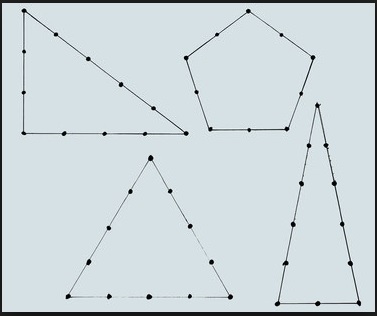
Geometric figures that can be drawn with the thirteen-knot rope.
Behind the apparent simplicity of the knot, we therefore discover a high-precision tool. The Lacs d’Amour immediately links two worlds: that of the builders’ practical work and that of symbolic geometry. This knot, found today on Masonic regalia, recalls both the craft of the builder and the spiritual quest of the initiate, for whom the right angle remains the foundation of every inner edifice.
Heraldic and Religious Origins of the Lacs d’Amour in Freemasonry
The term Lacs d’Amour is not Masonic in origin. It comes from the vocabulary of heraldry, that subtle art which codified the blazoning of the arms of noble families and European states. The motif appears notably in the heraldic descriptions of Savoy and Brittany, where it is called the Savoy knot or the Brittany knot.

Arms of Amadeus VI of Savoy, known as "The Green Count" (1334-1383), who in 1364 founded the Order of the Annunciation, to which he granted a collar made of lacs d’amour.
But where does this symbolic choice come from? Heraldry seems to have sought to pay tribute to a religious tradition: that of the Franciscans, then called Cordeliers, followers of Saint Francis of Assisi. These friars wore at their waist a cord tied with three knots, recalling their vows of poverty, chastity and obedience. Francis’s ardent charity, his devotion and his universal love left such a deep mark on people’s minds that the motif became associated with the idea of “love”. This is how, in heraldic language, people came to speak of Lacs d’Amour.
A common confusion should be cleared up: lacs — with an s even in the singular — does not refer to a lake (lac), but comes from the Latin laqueus, meaning rope, bond, tie. This old French word, now fallen out of use, survives almost only in its diminutive lacet (lace).
Thus, long before being adopted by Freemasonry, the Lacs d’Amour already carried a rich dimension: a heraldic bond, a religious tribute, a symbol of attachment and brotherhood. It was at once a sign of noble belonging and a spiritual evocation, which predestined it to enter the Masonic world later on.
The Lacs d’Amour in Freemasonry in the 18th Century
It was during the 18th century that the Lacs d’Amour entered the Masonic world. Above all in France, where Freemasonry, first imported from England, very quickly took on a character of its own, shaped by the aristocratic, learned and symbolist spirit of the lodges of the time. The builders’ tools were no longer used to work stone: they were becoming allegories meant to instruct the initiate in the language of symbols.
French Freemasons, often drawn from the nobility or the upper bourgeoisie and familiar with heraldic codes, then chose to name the knots of the Masonic rope with the prestigious term they already knew: Lacs d’Amour. This choice was less a reference to Franciscan charity than a desire to express, in noble vocabulary, the ideal of brotherly love.
The rope surrounding the lodge, adorned with these knots, thus becomes a visible symbol of the members’ unity. A parallel in gesture is even pointed out: the Lacs d’Amour evoke the position of the crossed arms during the Chain of Union, that ritual moment when all the Brethren bind themselves to one another in a living circle.
Through this semantic transfer, an operative and heraldic motif becomes fully Masonic. From that time on, the Lacs d’Amour embodies a core value in French lodges: a brotherhood that transcends social differences and unites initiates in a single spiritual chain.
Spiritual and Masonic Symbolism of the Lacs d’Amour in Freemasonry
The Lacs d’Amour is not merely a decorative motif: in Freemasonry, it has become one of the most eloquent symbols of brotherhood. Each knot reminds the initiate that he is connected to the others, like a thread linking the stones of a single edifice. It expresses the union, concord and brotherhood that must prevail among all Freemasons.
When it is depicted on the rope surrounding the lodge, the Lacs d’Amour forms a protective circle. It does not enclose: it gathers. It does not separate: it connects. Its meaning comes fully into its own at the ritual moment of the Chain of Union, when the Brethren, arms crossed, together form a living ring. The knot so often seen on regalia then joins the concrete gesture of the bodies, and from this union arises what some call the egregore, that collective spiritual force which goes beyond each individual.
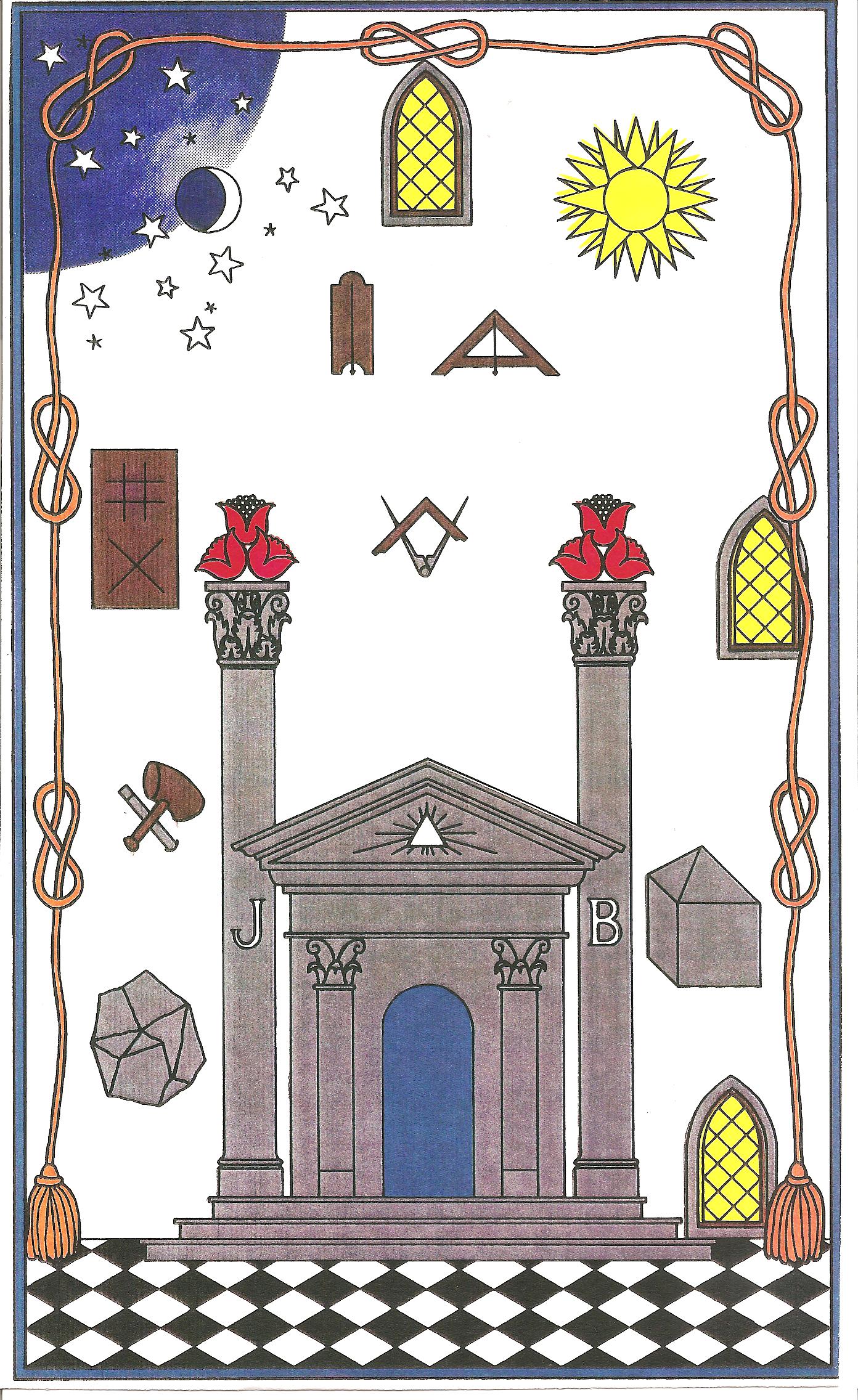
Tracing board bordered with lacs d’amour.
Yet this spiritual symbol remains consistent with the operative use of the knot. In the thirteen-knot rope, three workers had to cooperate to lay out a perfect right angle. The union of their gestures produced the accuracy of the figure. Thus, from operative tool to symbolic meaning, the message remains the same: without union, no true edifice; without concord, no harmony.
The Lacs d’Amour in Freemasonry therefore embodies both a memory of the builders and a demand placed on initiates: to build together, in balance and brotherhood, a temple worthy of bearing the Light.
The Lacs d’Amour in Freemasonry on Regalia and Ritual Objects
The use of the Lacs d’Amour is not limited to the symbolic rope surrounding the lodge. Over time, this motif has found its way onto a great many Masonic regalia and objects, becoming one of the most recognizable ornaments of Masonic art.
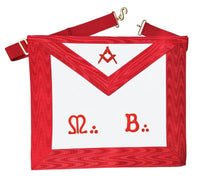
It appears first of all on tracing boards, particularly in the first two degrees, where it punctuates the border and recalls that the ritual space is bounded by the fraternal bond. On aprons too, it may appear as embroidery, underlining that Masonic dignity is set within a framework of brotherhood.
Sashes and collars are also adorned with Lacs d’Amour, showing that offices and duties, whatever their responsibilities, remain united in a single chain. Later, the ornament spread to more modest but equally eloquent objects: gloves, hats, pins, medals or lodge jewels.
This proliferation is far from trivial: it illustrates the permanence of a symbol that goes beyond operative uses to become fully part of the visual culture of Freemasonry. The Lacs d’Amour acts as a discreet but constant reminder of the Masonic ideal: brotherhood, concord and shared construction.
Even today, whether embroidered on an apron, engraved on a jewel or printed on a tracing board, it signals to the Freemason that he never walks alone. Every time the eye meets this motif, it is an invitation to remember that initiation only has meaning when lived in union.
The Lacs d’Amour in Freemasonry as a Sacred Geometry of Union
The Lacs d’Amour is not merely an ornamental motif: its very shape suggests symbolic depth. Made from a single strand of rope, it draws a closed loop that evokes the idea of infinity. Many see in it a reminder of the lemniscate (∞), the mathematical sign of eternity, which expresses both the continuity of the Masonic bond and the opening towards a spiritual dimension.
In its operative use, the knot only had value through the coordinated action of three journeymen: one holding the ends of the rope, the other two grasping the intermediate knots to form a perfect triangle. From this union of gestures came the accuracy of the right angle. Transposed into the symbolic order, the message is crystal clear: only the harmony of wills makes it possible to build a solid edifice, whether material or inner.
The Lacs d’Amour thus expresses a sacred geometry. It is not simply a physical bond, but a figure that reveals a spiritual law: union begets balance, concord founds harmony. Each knot becomes the visible sign of an invisible principle: the accord of hearts and minds.
Thus, to contemplate a Lacs d’Amour is to remember that Freemasonry is not the sum of individual paths, but a shared construction. The inner temple is built only insofar as each Mason agrees to unite with the others, so as to strive together towards rectitude and the Light.
Conclusion – The Lacs d’Amour in Freemasonry, a Living Heritage of Brotherhood
The Lacs d’Amour in Freemasonry beautifully illustrates the passage from an operative tool to a spiritual symbol. Born of the simple gesture of the figure-of-eight knot, handed down through heraldry and religious tradition, it found a new meaning in the lodges of the 18th century: that of fraternal union. Even today, whether it adorns an apron, a tracing board or a jewel, it reminds every Freemason that building the Temple is only possible together. In every Lacs d’Amour are knotted together the memory of the builders and the living demand of Masonic brotherhood.
By Ion Rajolescu, editor-in-chief of Nos Colonnes — in the service of Masonic writing that is accurate, rigorous and alive
From symbol to ornament! The Lacs d’Amour also features on our Tracing Boards. Discover the collection!
1. What Is the Lacs d’Amour in Freemasonry?
It is a figure-of-eight knot inherited from the builders and from heraldry, which became a symbol of union and brotherhood in the lodges.
2. Why does the word “lacs” take an “s” in the singular?
In French, lacs comes from the Latin laqueus, meaning rope or tie. A peculiarity: it is always written with an “s”, even in the singular, but it is pronounced “la”. This old term survives today mainly in its diminutive “lacet” (lace).
3. What are the origins of the Lacs d’Amour?
It is found in heraldic blazonry, notably in Savoy and Brittany, as well as in the Franciscan tradition.
4. When did it enter Freemasonry?
In the 18th century, when French lodges adopted the motif to express brotherly love and the unity of Masons.
5. How is it related to the thirteen-knot rope?
The figure-of-eight knot was used to mark the regular divisions of the rope used to lay out perfect right angles.
6. What does the Lacs d’Amour symbolize?
It embodies the union, concord and brotherhood needed for the shared construction of the spiritual Temple.
7. Where is it found on Masonic regalia?
On aprons, tracing boards, sashes, gloves, hats, jewels and other symbolic ornaments.
8. Does it have a religious meaning?
Originally, yes, through its link with the Franciscans known as Cordeliers; in Freemasonry, it above all expresses brotherly love.
9. Does the Lacs d’Amour evoke infinity?
Its shape recalls the lemniscate (∞), a symbol of eternity, continuity and spiritual harmony.
10. What does it remind Freemasons of?
That they never build alone but together, in union and concord.
Here you will find the full transcript of the episode, for those who prefer reading or wish to explore the discussion in more depth.
Podcast – The Lacs d’Amour in Freemasonry
Today, I invite you to dive into a discreet but essential symbol of Freemasonry: the Lacs d’Amour. At first glance, it is just a knot in a rope. Yet its history and meaning make it a common thread linking medieval builders, noble heraldry, religious traditions and the symbolic world of the lodges.
The Lacs d’Amour is, first of all, a figure-of-eight knot. In seafaring, it is known as the Flemish knot. Its distinctive feature: it is mobile. It can be loosened and moved. The builders of old used it to create a fundamental tool: the thirteen-knot rope. With it, they could divide a length into twelve equal intervals and lay out a perfect right angle, following the Pythagorean theorem. Three journeymen were enough: one holding the ends, the other two grasping the intermediate knots. Together, they achieved the rectitude essential to a harmonious edifice.
But the term Lacs d’Amour actually comes from heraldry. It is found in the blazonry of the arms of Savoy and Brittany, where it is called the Savoy knot or the Brittany knot. The motif paid tribute to the Franciscans, then known as Cordeliers. Their rope belt, tied with three knots, recalled their vows of poverty, chastity and obedience. The ardent charity of Saint Francis of Assisi gave rise to the expression: Lacs d’Amour. Here, “lacs” is always written with an “s”, even in the singular, because it comes from the Latin laqueus, meaning rope or tie.
In the 18th century, French Freemasons adopted this symbol. Often drawn from the nobility, they were familiar with the language of heraldry. The Lacs d’Amour then became the ornament of the rope surrounding the lodge. The reference was no longer to the charity of Saint Francis, but to the brotherly love that unites Masons. And these knots came to be likened to the position of the crossed arms during the Chain of Union.
The symbol then spread to many items of regalia: tracing boards, aprons, sashes, gloves, hats, jewels. Each time, it recalls that Freemasonry is not a sum of individuals, but a living brotherhood. The knot becomes the visible sign of union and concord.
One can even see in the Lacs d’Amour a figure of infinity, close to the lemniscate. As if this knot were saying that Masonic brotherhood is called to transcend time and space, placing each initiation within a spiritual continuity.
Thus, behind a simple rope knot lies a whole teaching. Operative or symbolic, heraldic or Masonic, the Lacs d’Amour always says the same thing: only the harmony of wills makes it possible to build an edifice worthy of bearing the Light.


I WANT TO RECEIVE NEWS AND EXCLUSIVES!
Keep up to date with new blog posts, news and Nos Colonnes promotions.
