









Light in Freemasonry: Origins, Symbols and Ritual Evolution
Light in Freemasonry holds a central place, at once obvious and yet often misunderstood. Present everywhere in the rituals, in Masonic regalia and in symbolic language, it seems self-evident, to the point that we no longer ask where it comes from or why it takes so many forms. Are we speaking of the Lights of the Lodge, many and structuring, or of the Light received at initiation? Are these two realities one and the same, or do they belong to separate histories and serve different functions? To understand what light in Freemasonry really covers, we must go back to older usages, follow how they evolved in the eighteenth century, and separate what belongs to an inherited operative symbolism from what forms part of a later initiatory construction. This article sets out to bring that clarity, step by step, to the question of light in Freemasonry.
- 1. The Lights in early speculative freemasonry
- 2. The Lights in modern Freemasonry
- 3. The Lights or the Light
- 4. The emergence of the theme of receiving the Light
- 5. The two faces of the Light in the eighteenth century
- 6. Conclusion – Light in Freemasonry, between heritage and construction
- 7. FAQ – Light in Freemasonry
- 8. Podcast – Light in Freemasonry: from the Lights of the Lodge to the reception of the Light
The Lights in early speculative freemasonry
The earliest attested forms of the Lights in Freemasonry appear in the English and Scottish speculative freemasonry that predates the founding of the Grand Lodge of London in 1717. The sources available to us — symbolic catechisms, ritual manuscripts and indirect accounts — are late, since they date from the end of the seventeenth century or the very beginning of the eighteenth, but they very probably reflect usages already well established during the seventeenth century. At this stage, the theme of light in Freemasonry is neither unified nor fixed: it appears in a variety of forms, still flexible, yet already structuring.
The primary reference is cosmic and natural. Light is understood above all as sunlight. The texts speak of the Sun rising in the east, crossing the south at its zenith, then setting in the west. This solar course gives the Lodge its symbolic orientation and grounds a first understanding of the Lights in Freemasonry as a principle of order, measure and rhythm. From this comes the recurring mention of three windows placed in the east, the south and the west, meant to light the meeting place symbolically. These three openings are not mere decorative features: they set the Lodge within a space ordered by natural light.
Very early on, the Three Lights of the Lodge partly merge with these three windows, to the point that the old texts sometimes use the two expressions interchangeably. This overlap shows that the Lights in Freemasonry are not yet conceived as autonomous symbolic objects, but as functions linked to lighting, visibility and the orientation of the work. Light has not yet been received; it is simply there, as a principle of order.
In some old catechisms, these Three Lights are also identified with persons holding specific offices in the Lodge. They are associated, for example, with the Master, the Fellow of the Craft (Compagnon de Métier) and the Warden. Here again, light in Freemasonry is tied to the exercise of an office, to a responsibility, to a position in space and in the order of the work, far more than to any inner or spiritual experience.
This point is essential for what follows. In early speculative freemasonry, the Lights of the Lodge refer neither to a personal revelation nor to an inner transformation of the candidate. They organise space, time and the symbolic hierarchy. They light the Lodge before they enlighten the man. This gap will later help us understand why the reception of the Light represents a major innovation of Freemasonry in its modern form, and not the simple continuation of an older usage.
The Lights in modern Freemasonry
With the development of Freemasonry in its modern form in the eighteenth century, the symbolism of the Lights becomes more precise, more fixed and more hierarchical. Where early speculative freemasonry used images that were still flexible and sometimes shifting, light in Freemasonry gradually becomes a structured symbolic system, built into the rituals and the Lodge furnishings, and differentiated according to the Rites. This stabilisation does not do away with variations, but it brings in a more rigorous terminology and a clearer distribution of symbolic functions.
Many rituals then distinguish between the Great Lights, the Lesser Lights and the Luminaries. This distinction is not universal, but it is especially representative of the way light in Freemasonry is conceived in the ritual systems that came out of the eighteenth century. In the Ancient and Accepted Scottish Rite, for example, the Three Great Lights are the Square, the Compasses and the Volume of the Sacred Law. These objects are not merely moral or spiritual symbols; they are placed at the centre of the ritual arrangement and serve as a constant reference for the work of the Lodge.
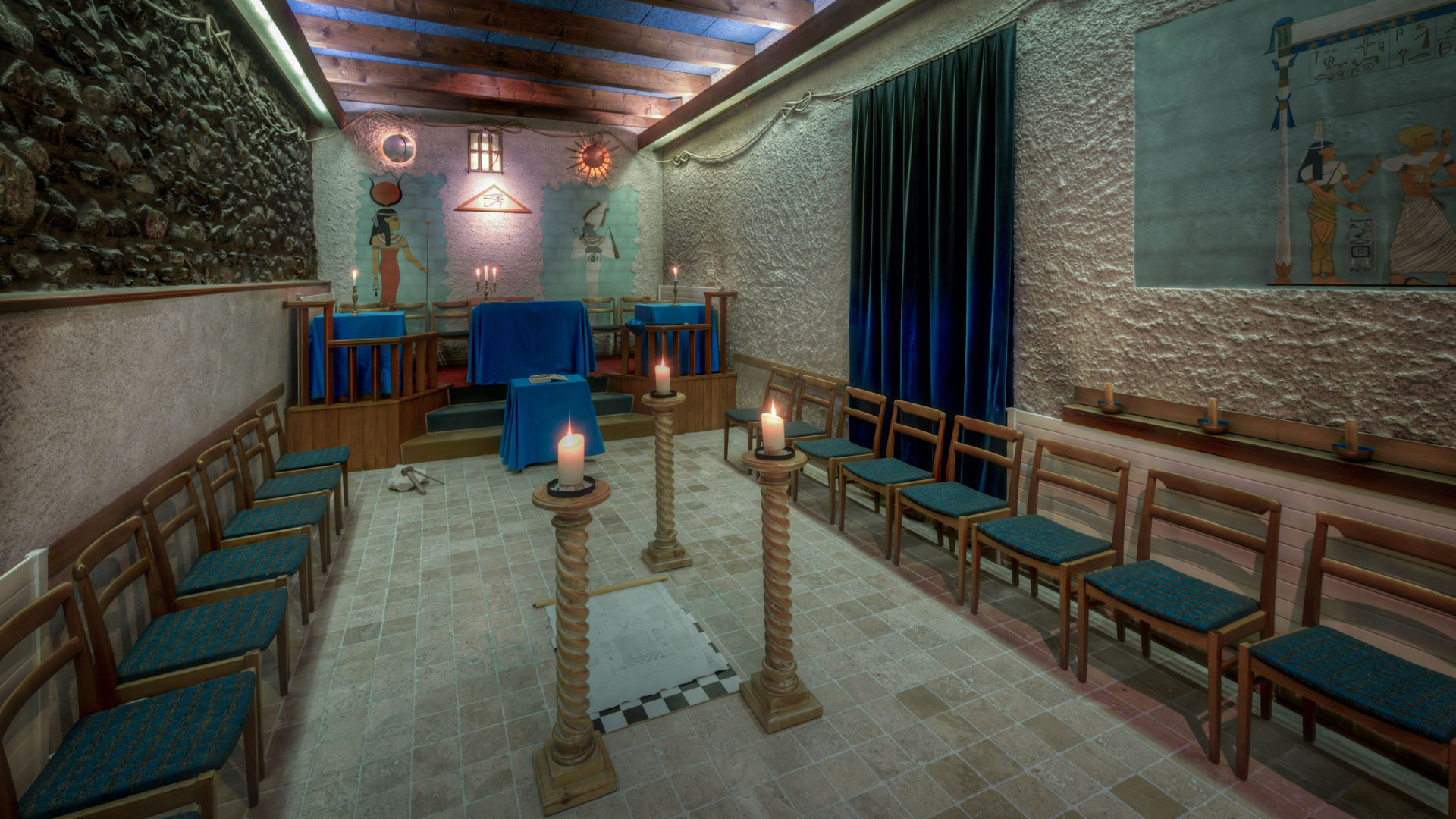
The Lights of the Lodge structure the ritual space and organise the collective work of Freemasons.
The Three Lesser Lights, for their part, are associated with the Three Pillars of Wisdom, Strength and Beauty. They no longer refer to the natural lighting of the Lodge, but to abstract principles meant to support and order the Masonic Work. Here light in Freemasonry begins to move away from the cosmic register and into that of symbolic and moral construction.
Finally, the Three Luminaries are generally identified with the Sun, the Moon and the Master of the Lodge, or sometimes with the Luminous Delta. This triad keeps an explicit link with natural light, but places it within a hierarchical and ritualised reading. The Sun and the Moon are no longer just heavenly bodies; they become symbolic markers within an initiatory order. As for the Master of the Lodge, he is not a light by nature but by function: he embodies a symbolic authority whose task is to regulate and to transmit.
In every case, the Lights of the Lodge must not be confused with personal illumination. They designate functions, principles and markers intended to structure the collective work. At this stage, light in Freemasonry lights the ritual space and the symbolic order far more than it inwardly transforms the individual. This distinction is essential to understanding the conceptual break that will occur once the reception of the Light is built into the initiation ceremony.
The Lights or the Light
The Lights are not yet the Light. This distinction, which may seem obvious to today's Freemason, is in fact the product of a relatively late historical construction. In the older usages of speculative freemasonry, the Lights of the Lodge designate collective markers, symbolic functions and ritual arrangements. They organise space, order the work and structure a hierarchy, but they do not refer to an inner experience lived by the candidate.
It is with modern Freemasonry, after 1717, that the idea gradually takes hold that initiation consists in receiving the Light. This development profoundly changes the understanding of light in Freemasonry. A new element is then introduced into the reception ceremony: the blindfold placed over the eyes of the candidate, whose removal becomes the central moment of the ritual. Light is no longer simply present in the Lodge; it becomes the object of an unveiling, set within an initiatory drama.
It must be stressed that this practice was unknown both to the old Masonry of the Mason Word, as practised by the Accepted Masons in Scotland in the seventeenth century, and to the first English speculative freemasonry. The Scottish sources are particularly explicit on this point. The Edinburgh manuscript of 1696, which describes a seventeenth-century Scottish Masonic reception, mentions neither a blindfold nor any reception of the Light. The heart of the ceremony lies in the transmission of the Mason Word, that is, the names of the two Pillars of Solomon's Temple, together with an oath and gestures designed to leave a lasting impression on the candidate.
On the English side, the reception rituals of the same period have not come down to us in detailed form, but we do have a valuable indirect account. In his book Natural History of Staffordshire, published in 1686, Robert Plot gives a brief description of the customs of English Freemasons. Although he was not a Freemason himself, his closeness to Elias Ashmole, an important figure in English freemasonry, lends his account real credibility. It shows that the core of the ceremony consisted in communicating secret signs and words that allowed Freemasons to recognise one another. One material detail is nonetheless mentioned: the candidate had to present gloves to the Masters who received him, as well as to their wives, and pay for a collation held before the ceremony. Here again, no allusion is made to a blindfold or to a reception of the Light.
Everything therefore suggests that, in the earliest forms of speculative freemasonry, what made a man a Freemason was not an inner illumination but the possession of symbolic secrets passed on through ritual. Light in Freemasonry was not yet received as such; it remained implicit, collective and functional. This gap allows us to measure the scope of the innovation that the explicit introduction of the reception of the Light would represent in the eighteenth century, shifting the centre of gravity of initiation from the shared secret to the symbolic experience lived through.
The emergence of the theme of receiving the Light
It is difficult to pinpoint exactly when the Masonic reception ceased to be understood mainly as the transmission of symbolic secrets and became a true initiation centred on the reception of the Light. This shift did not happen abruptly; it was the result of a gradual evolution of practices and representations over the course of the eighteenth century. Light in Freemasonry then changes status: from a structuring element of the Lodge, it becomes the very stake of the reception ceremony.
The first ritual exposures from the tradition of the Grand Lodge of London, founded in 1717, do not yet bear witness to this transformation. The Wilkinson manuscript, dated 1727, like Samuel Pritchard's famous Masonry Dissected published in 1730, both ignore the use of the blindfold and describe no explicit reception of the Light. They mention the Lights of the Lodge, in direct continuity with the old symbolic catechisms of speculative freemasonry, but without taking the step towards an initiatory drama centred on blindness and unveiling.
On the Continent, however, and in France in particular, the situation is different. As early as 1737, the use of the blindfold during the reception of a Freemason is formally attested by the report of the lieutenant of police Hérault. This document, written at a time of close surveillance of Masonic societies, describes the course of a reception in great detail, and explicitly mentions the moment when the blindfold is removed from the candidate's eyes. The reception of the Light appears here as a central element of the ritual, already fully formed.

The blindfold marks the passage from darkness to clarity and symbolises the gradual reception of the Light in Freemasonry.
The oldest known Masonic ritual in the French language, the Berne manuscript, dated to the years 1740–1744, confirms this usage. It clearly incorporates the blindfold and the reception of the Light into the structure of the ceremony. Everything therefore suggests that this ritual innovation took hold during the 1730s, probably under the influence of French Freemasonry, before spreading more widely across the European Masonic world.
This shift is no small matter. By introducing the theme of the reception of the Light, Freemasonry changes the symbolic purpose of initiation. It is no longer simply a matter of entering a community that holds shared signs and words, but of living through an experience marked by the passage from darkness to clarity. Light in Freemasonry then begins to be conceived as a symbolic conquest, set within an initiatory narrative, and no longer merely as a collective framework that exists prior to the work of the Lodge.
The two faces of the Light in the eighteenth century
When the reception of the Light gradually established itself in the Masonic rituals of the eighteenth century, there was no single agreed interpretation of it. Light in Freemasonry thus becomes a symbol with two entry points, reflecting the very nature of Freemasonry in its modern form, standing at the crossroads of distinct and sometimes competing intellectual currents.
On one side, a rationalist and philosophical reading clearly asserts itself. In the context of the Age of Enlightenment, the Masonic Light is understood as a metaphor for Reason, knowledge and intellectual emancipation. It stands against the darkness of ignorance, superstition and fanaticism. Receiving the Light then means gaining access to an enlightened order of thought, founded on critical examination, tolerance and self-mastery. This interpretation fits squarely within the cultural horizon of Europe in the age of the Enlightenment, without, however, reducing Freemasonry to a mere philosophical club.
At the same time, another reading develops, more inward and more spiritual. In certain Masonic currents shaped by illuminism, the Light is not the same as human reason alone. It points to a higher knowledge, symbolic or spiritual in nature, sometimes conceived as participation in a divine principle. From this perspective, light in Freemasonry is not acquired solely through study or the exercise of the mind; it presupposes a gradual transformation of one's being, through ritual work and inner discipline.
These two readings are not necessarily mutually exclusive. They coexist, sometimes within the same Lodges, sometimes according to the Rites or to individual sensibilities. The tension between them is one of the defining features of Freemasonry in the eighteenth century. The reception of the Light therefore does not point to a single meaning, but to a field of interpretations whose richness lies precisely in this controlled plurality.
Conclusion – Light in Freemasonry, between heritage and construction
Light in Freemasonry cannot be reduced to a single definition or to a simple origin. The Lights of the Lodge, inherited from the older usages of speculative freemasonry, belong to a collective, spatial and functional order meant to structure the work and the ritual space. The reception of the Light, introduced later in the eighteenth century, marks a decisive shift: light in Freemasonry then becomes a symbolic experience lived by the candidate, set within an initiatory drama.
Between these two poles, continuity and rupture intertwine. Modern Freemasonry has layered distinct symbolic strata on top of one another without ever fully merging them. Understanding light in Freemasonry therefore means accepting this historical and symbolic complexity, without trying to resolve it artificially. It is in this controlled tension that the Light retains its initiatory force.
By Ion Rajolescu, editor-in-chief of Nos Colonnes — in the service of Masonic writing that is accurate, rigorous and alive.
Candlesticks play a full part in the luminous and symbolic organisation of the Lodge — Visit our collection of candlesticks.

1 – What does light mean in Freemasonry?
Light in Freemasonry refers both to a set of symbolic markers present in the Lodge and, in modern Freemasonry, to the initiatory experience linked to the reception of the Light.
2 – What is the difference between the Lights of the Lodge and the Light received at initiation?
The Lights of the Lodge structure the ritual space and the collective work, whereas the reception of the Light corresponds to a symbolic stage experienced personally by the candidate.
3 – Did the Lights exist in early Freemasonry?
Yes, the Lights of the Lodge are attested as early as the speculative freemasonry of the seventeenth century, but with no connection to an initiatory reception of the Light.
4 – Is the reception of the Light an ancient practice?
No, the explicit reception of the Light appears in the eighteenth century and is an innovation of modern Freemasonry.
5 – Was the blindfold part of the earliest Masonic rituals?
No, seventeenth-century sources mention neither a blindfold nor a reception of the Light during reception ceremonies.
6 – Why do Freemasons speak of Light in both the singular and the plural?
The plural refers to the Lights of the Lodge, while the singular designates the Light received at initiation: two distinct but complementary realities.
7 – Do the Lights have the same meaning in every Rite?
No, their arrangement and interpretation vary from one Rite to another, even though some symbolic structures are widely shared.
8 – Is Masonic Light purely symbolic?
It is symbolic by nature, but it can be interpreted in philosophical, moral or spiritual terms depending on sensibilities and contexts.
9 – Is light in Freemasonry linked to the Age of Enlightenment?
Yes, in part, particularly in its rationalist reading, but it cannot be reduced to that and retains a genuinely initiatory dimension.
10 – Can a single definition of Light in Freemasonry be given?
No, light in Freemasonry is a complex historical and symbolic construction that cannot be confined to a single definition.
Here you will find the full transcript of the podcast, for those who prefer reading or wish to explore the discussion further.
Podcast – Light in Freemasonry: from the Lights of the Lodge to the reception of the Light
Light in Freemasonry is so pervasive that it ends up seeming self-evident. It runs through the rituals, structures the space of the Lodge and permeates Masonic vocabulary. Yet this self-evidence is misleading. Speaking of Light in the singular or of Lights in the plural is not a mere variation in wording; it refers to different realities that emerged at different moments in Masonic history.
In the older forms of speculative freemasonry, before seventeen seventeen, the Lights of the Lodge are above all collective markers. They organise the symbolic space, orient the work and set the Lodge within an order founded on natural light, mainly the light of the sun. The Lodge is lit, structured, ordered. Light is not yet received; it is simply there, as a principle of order. It lights the place before it enlightens the man.
This conception is reflected in the old texts, where the Lights are sometimes confused with the windows of the Lodge, located in the east, the south and the west, or with certain functions performed by the officers. Light is then tied to an office, a position, a responsibility. It is neither revealed nor won inwardly. It belongs to the collective organisation of Masonic work.
A turning point comes in the eighteenth century. With modern Freemasonry, the idea gradually emerges that initiation consists in receiving the Light. The introduction of the blindfold into the reception ceremony profoundly transforms the meaning of the ritual. Light ceases to be merely a symbolic framework and becomes the very stake of the initiatory passage. The removal of the blindfold marks access to a new symbolic condition, lived by the candidate.
It is essential to recall that this practice was unknown to the older forms of the Masonry of the Mason Word, as practised by the Accepted Masons in Scotland in the seventeenth century, and to the first English speculative freemasonry. The Scottish sources, notably the Edinburgh manuscript of sixteen ninety-six, describe a reception centred on the transmission of the Mason Word, that is, the names of the two Pillars of Solomon's Temple, accompanied by an oath and gestures designed to leave a lasting mark on the candidate. No mention is made of a blindfold or of a reception of the Light.
On the English side, the indirect account of Robert Plot, in his book Natural History of Staffordshire, published in sixteen eighty-six, confirms this absence. The ceremony appears there as a transmission of secret signs and words allowing Freemasons to recognise one another. Here again, light does not come into play as a personal initiatory experience.
The reception of the Light is therefore a major innovation of modern Freemasonry. It does not simply extend older usages; it shifts the centre of gravity of initiation. What made a man a Freemason is no longer only the possession of shared secrets, but the symbolic experience of a passage from darkness to clarity.
In the eighteenth century, this new Light lends itself to contrasting interpretations. In a rationalist and philosophical reading, it embodies the Reason, knowledge and intellectual emancipation characteristic of the Age of Enlightenment. It stands against ignorance and superstition, and places Freemasonry within a cultural horizon marked by critical examination and self-mastery.
At the same time, a more inward and spiritual reading develops in certain Masonic currents. There, the Light is understood as a deeper symbolic knowledge, linked to a gradual transformation of one's being through ritual work. These two approaches are not necessarily mutually exclusive. They coexist, sometimes within the same Lodges, and contribute to the richness and complexity of Masonic symbolism.
Understanding light in Freemasonry therefore means accepting this plurality without trying to reduce it. Between the Lights of the Lodge and the reception of the Light, between ancient heritage and modern construction, the Light remains a living symbol. It lights both a collective space and an individual path, without ever allowing itself to be confined to a single definition.


I WANT TO RECEIVE NEWS AND EXCLUSIVES!
Keep up to date with new blog posts, news and Nos Colonnes promotions.
