







The Mosaic Pavement and the Symbolic Reading of the World in Freemasonry
The Mosaic Pavement occupies a central place in the Masonic Lodge, whether physically at the heart of the temple or represented on the Tracing Board. It is one of the most immediately recognisable features of Masonic symbolism. Yet the Mosaic Pavement in Freemasonry is neither mere decoration nor a static emblem. Rooted in an ancient opératrice practice, the Mosaic Pavement in Freemasonry has become a means of reading the world, structured by duality and governed by measure. How did the Mosaic Pavement in Freemasonry evolve from a practical tool into a symbol, and what does it reveal today about the human condition?
- 1. Where does the Mosaic Pavement in Freemasonry come from?
- 2. Why is it called the “Mosaic Pavement” in Freemasonry?
- 3. What does the Mosaic Pavement symbolise in Freemasonry?
- 4. Why is the Mosaic Pavement not walked upon in Freemasonry?
- 5. Does the number of squares of the Mosaic Pavement have a meaning?
- 6. The Mosaic Pavement, a symbol for thinking the world
- 7. FAQ – Mosaic Pavement in Freemasonry
- 8. Podcast –The Mosaic Pavement and the Symbolic Reading of the World in Freemasonry
Where does the Mosaic Pavement in Freemasonry come from?
The Mosaic Pavement appears in the earliest Scottish and English Masonic catechisms. Manuscripts such as the Edinburgh Register House (1696) and the Chetwode Crawley manuscript (c. 1700) already refer to it in the context of the Word of Mason practised in seventeenth-century Scotland. It is mentioned again in several English, Scottish and Irish manuscripts and exposures from the early eighteenth century, although without detailed explanation of its form or function.
Two documents, however, provide a clearer indication of its original use: A Mason’s Confession (c. 1727) and the Wilkinson manuscript (1727). Both state that the Mosaic Pavement served as a surface on which the Master traced plans. In operative practice, designs were drawn directly on the floor of the working space. The grid of the Mosaic Pavement made it possible to transpose a drawing to a different scale. At its origin, therefore, the Mosaic Pavement was not symbolic but operative, directly linked to the practical art of construction.
Why is it called the “Mosaic Pavement” in Freemasonry?
Early Masonic texts do not speak of a Mosaic Pavement but of the Square Pavement, a term that refers explicitly to geometry and the use of the square. The expression Mosaic Pavement appears later, in 1727, in the Wilkinson manuscript, and again in Masonry Dissected in 1730.
This change in terminology seems to belong to the tradition of the Moderns, associated with the Grand Lodge of London. Contrary to a widespread assumption, the word “mosaic” does not refer to Moses or Mosaic Law. It is more plausibly derived from the medieval Latin mosaicus, itself rooted in musivus and ultimately in the Greek mouseios, relating to the Muses and the arts. The Mosaic Pavement thus reflects the humanist culture of the early eighteenth century, shaped by classical antiquity, geometry and the search for harmony.
What does the Mosaic Pavement symbolise in Freemasonry?
In modern Freemasonry, the Mosaic Pavement has lost its operative function and has become a fully developed symbol. At an uncertain point in its evolution, it took the form of a chequered floor, alternating black and white squares. The Mosaic Pavement in Freemasonry came to represent the manifested world, structured by duality. It stands alongside other symbolic pairs within the Masonic temple, such as the two Columns, the Sun and the Moon, the South and the North.
Mosaic Pavement covering the floor of a Masonic Lodge, symbolising the dual nature of the manifested world.
What distinguishes the Mosaic Pavement is that it contains both poles within a single figure. Light and darkness, life and death, progress and regression are not separated but intertwined. The symbol does not seek to resolve duality; it presents it as a fundamental condition of existence.
This representation demands a demanding form of reading. The Mosaic Pavement offers no immediate synthesis and no comforting reconciliation. It confronts the Freemason with a world structured by permanent oppositions, which must not be abolished but understood. The initiatic path does not erase duality; it transforms it into a field of inner work, where experience, awareness and measure gradually lead to a clearer understanding of reality.
Why is the Mosaic Pavement not walked upon in Freemasonry?
In many continental Constitutions, it is customary not to walk upon the Mosaic Pavement. It is reserved for the Tracing Board and may only be stepped over during certain ceremonies, notably at the third degree. This practice tends to set the Mosaic Pavement apart as a symbolic space, almost untouchable, as though the representation of the world itself were to be held at a distance.
This restriction, however, raises questions. If the Mosaic Pavement symbolises the world in its duality, why should ritual practice exclude physical engagement with it? Is the Freemason not called to work within the world rather than to observe it from afar? In contrast, in Anglo-Saxon Workings and in the Rite of Memphis-Misraim, the Altar of Obligation is placed at the centre of the Mosaic Pavement, and both the Worshipful Master and the candidate necessarily walk upon it. In this context, the Mosaic Pavement is not sacralised in itself but assumed as the very place where Masonic commitment is enacted.
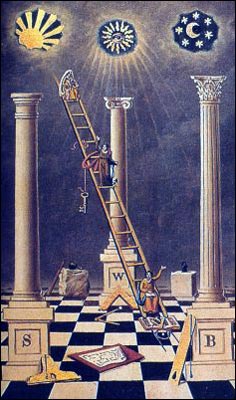
Entered Apprentice Tracing Board, where the main symbols are laid upon the Mosaic Pavement, forming the symbolic framework of the Lodge.
These differing practices reveal two complementary readings of the symbol: one more contemplative, tending to sanctuarise the representation of the world; the other more dynamic, inviting direct engagement with duality in order to move beyond it. The tension between these approaches is an integral part of the symbolic richness of the Mosaic Pavement.
Does the number of squares of the Mosaic Pavement have a meaning?
The number of squares composing the Mosaic Pavement is far from arbitrary. When incorporated into the floor of a temple, it is often determined by architectural constraints. When represented on the Tracing Board, however, the choice of configuration may carry a deliberate symbolic intention.
The 64-square Mosaic Pavement: the world as it is
This straightforward configuration offers a descriptive reading of the created world, focusing on structure, space, and stability rather than interpretation.
A Mosaic Pavement of eight by eight squares, totalling sixty-four, refers to the created world in its most immediate form. Sixty-four is the cube of four, a number associated with the elements, the cardinal points and the seasons. This configuration describes the world as it is perceived, without interpretation. It may therefore correspond to the first degree, in which the Entered Apprentice becomes aware of the world and its duality without yet possessing the tools to act upon it.
The Mosaic Pavement based on the Golden Ratio
Here the pavement is no longer merely descriptive: it introduces a language of proportion and harmony, inviting a more qualitative understanding shaped by measure and balance.
A Mosaic Pavement constructed according to the Golden Ratio, such as a five by eight arrangement, results in forty squares. Forty is a significant number in the Judeo-Christian tradition, associated with trial, waiting and transformation. Based on a proportion revealed to the Fellowcraft through the Blazing Star, this configuration introduces a more harmonic reading of the world, founded on measure and proportion.
The Pythagorean Mosaic Pavement and the number 108
In this configuration, geometry becomes openly initiatic: numbers do not simply describe the world, they point towards completion and the inner work of transformation.
A Mosaic Pavement based on the Pythagorean relationship, such as nine by twelve squares, produces one hundred and eight squares. The number nine, the square of three, frequently appears at the Master Mason degree, while twelve symbolises completeness and fulfilment. The number one hundred and eight, prominent in several Eastern traditions, represents completion and liberation. Such a configuration may accompany the meditation of the third degree, marked by symbolic death and inner transformation.
From pattern to meaning: how to read the Mosaic Pavement
These different configurations do not exclude one another. They offer complementary levels of reading, corresponding to different stages of initiatic progress. The Mosaic Pavement thus ceases to be a repetitive pattern and becomes a true symbolic grid. The number of squares is no longer decorative; it shapes how the Freemason situates himself in the world, perceives its tensions and measures the path still to be travelled. Through number and geometry, the Mosaic Pavement reminds us that understanding reality depends as much on symbolic intelligence as on inner experience.
This progression cautions against fixing the symbol in a single interpretation. The Mosaic Pavement accompanies the initiatic journey without ever exhausting its meaning. It remains a living support for reflection, deepening as the gaze itself is transformed.
The Mosaic Pavement, a symbol for thinking the world
The Mosaic Pavement is neither a simple ornament nor a fixed emblem. Born of an ancient operative practice, it has become in Freemasonry a tool for reading the world and the human condition. Through its embraced duality, its geometric structure and the numbers that compose it, it invites the Freemason to reflect on his place in the world and on the manner of his engagement within it. Whether contemplated or ritually traversed, the Mosaic Pavement reminds us that Masonic work does not consist in fleeing duality, but in passing through it with discernment, measure and awareness.
By Ion Rajolescu, editor-in-chief of Nos Colonnes — serving a Masonic voice that is just, rigorous, and alive.
The Mosaic Pavement forms the symbolic floor of the Lodge. The Tracing Board is laid upon it to give shape to the symbols and support the ritual work. Explore our collection of Lodge Tracing Boards, designed to meet the requirements of different Masonic traditions.

1. What is the Mosaic Pavement in Freemasonry?
The Mosaic Pavement is a symbolic chequered floor made of black and white squares, placed at the centre of the Lodge or represented on the Tracing Board. It symbolises the manifested world structured by duality.
2. What does the Mosaic Pavement symbolise in Freemasonry?
The Mosaic Pavement symbolises the fundamental duality of existence: light and darkness, good and evil, life and death. It invites Freemasons to confront and understand these opposites rather than deny them.
3. What is the origin of the Mosaic Pavement in Freemasonry?
Originally, the Mosaic Pavement was an operative tool. It served as a gridded surface on which Masters traced their plans on the floor. Its symbolic meaning developed later with speculative Freemasonry.
4. Why is it called the “Mosaic Pavement”?
The term appeared in the eighteenth century within the tradition of the Moderns. It does not refer to Moses, but derives from the Latin mosaicus, linked to the arts and the Muses, emphasising geometry and harmony.
5. Why is the Mosaic Pavement not walked upon in some rites?
In many continental rites, the Mosaic Pavement is treated as a reserved symbolic space. This reflects a contemplative approach to the symbol rather than an active or ritualised one.
6. Can Freemasons walk on the Mosaic Pavement?
Yes. In Anglo-Saxon rites and in the Rite of Memphis-Misraïm, the Altar of Obligation is placed on the Mosaic Pavement, and both officers and candidates walk upon it as part of the ritual.
7. How many squares should the Mosaic Pavement have?
8. What does a 64-square Mosaic Pavement represent?
A 64-square Mosaic Pavement symbolises the created world in its material structure, associated with the four elements, cardinal points, and the stability of the physical realm.
9. What is the meaning of a Mosaic Pavement based on the Golden Ratio?
A Mosaic Pavement based on harmonic proportions such as 5 x 8 reflects balance, growth, and proportion. It aligns with the symbolic work of the Fellowcraft.
10. What does a 108-square Mosaic Pavement symbolise?
A 108-square Mosaic Pavement symbolises completion and spiritual fulfilment. In several traditions, the number 108 represents the end of the initiatic path and the overcoming of passions.
Read the full transcript of the podcast here for those who prefer reading or want more detail.
Podcast –The Mosaic Pavement and the Symbolic Reading of the World in Freemasonry
The Mosaic Pavement occupies a central place in the Masonic Lodge. It is seen, circled, sometimes stepped over, sometimes walked upon. Yet it is rarely examined for what it truly reveals. The Mosaic Pavement is not decoration. It is not simply one symbol among others. It is a way of reading the world.
Originally, the Mosaic Pavement had nothing speculative about it. In operative masonry, it was a working tool. A gridded floor on which the Master traced plans. This grid made it possible to transpose a figure, to change scale, to move from drawing to construction. The Mosaic Pavement was practical. It served a purpose.
The earliest Scottish and English Masonic manuscripts from the late seventeenth and early eighteenth centuries mention this pavement without developing its meaning. Two texts stand apart, however. They clearly state that the pavement was used for tracing plans. This point is essential, because it reminds us that Masonic symbols do not appear out of nowhere. They arise from use, from gesture, from concrete practice.
The expression “Mosaic Pavement” itself appeared later. Early texts speak of the Square Pavement, a pavement laid out by the square. The term “mosaic” emerges in the early eighteenth century within the tradition of the Moderns. Contrary to a common assumption, it does not refer to Moses. It derives from the Latin mosaicus, linked to the arts and the Muses. The Mosaic Pavement thus belongs to a humanist culture shaped by Antiquity, geometry, and the search for harmony.
Gradually, the Mosaic Pavement lost its operative function and became a symbol. It took the form of a chequered floor, alternating black and white squares. It came to represent the manifested world, structured by duality. Light and darkness. Life and death. Good and evil. Progress and regression.
The Mosaic Pavement does not seek to resolve this duality. It displays it. It places it before the eyes of the Freemason. More importantly, it maintains it. Unlike symbols that separate opposing principles, the Mosaic Pavement interweaves them. Black and white are inseparable. They coexist. They structure the very space in which initiatic work takes place.
This representation is demanding. It offers no immediate synthesis and no easy reconciliation. It confronts the Freemason with a world shaped by constant tensions. Initiatic work does not consist in denying these tensions, but in learning to inhabit them, to understand them, and to cross them with discernment.
This question becomes very concrete in ritual practice. In many continental rites, the Mosaic Pavement is not walked upon. It is reserved for the Tracing Board and kept at a distance, almost sanctuarised. Elsewhere, in Anglo-Saxon rites and in the Rite of Memphis-Misraïm, the Altar of Obligation is placed at the centre of the Mosaic Pavement, and both the Worshipful Master and the candidate necessarily walk upon it.
Two readings emerge. One favours contemplation of the symbol. The other engages the body and movement. One keeps the represented world at a distance. The other affirms that it is at the very heart of duality that Masonic commitment is exercised. These approaches do not cancel each other out. They express a fertile tension at the core of the initiatic path.
The Mosaic Pavement can also be read through the numbers that compose it. A pavement of sixty-four squares describes the world in its stability, materiality, and elemental organisation. A pavement based on the Golden Ratio introduces a more harmonious reading, grounded in proportion and measure. A pavement of one hundred and eight squares opens onto a symbolism of completion and transcendence, found in several spiritual traditions.
The Mosaic Pavement is therefore not a fixed motif. It is a tool for reading. A support for reflection. A mirror held up to the Freemason. As one’s gaze changes, the symbol deepens. It never exhausts its meaning. It accompanies the path without ever replacing it.
In this sense, the Mosaic Pavement remains one of the most demanding symbols in Freemasonry. It provides no answers. It keeps a question open. How can one inhabit duality without being lost in it? How can one work in the world without dissolving into it? How can one advance, step by step, on a ground that is never perfectly stable?


I WANT TO RECEIVE NEWS AND EXCLUSIVES!
Keep up to date with new blog posts, news and Nos Colonnes promotions.
