





Prince Hall and African American Freemasonry: A Test of Masonic Fidelity
Prince Hall remains a largely unknown figure in European Masonic history, even though his life and work put some of Freemasonry’s most fundamental principles to the test. Through the experience initiated by Prince Hall in the late 18th century, the question of Masonic universalism is raised in a concrete way, within a context shaped by racial exclusion and the refusal of institutional recognition. Far from founding a breakaway form of Freemasonry, Prince Hall sought to root his work in a strict initiatic continuity. What does the legacy of Prince Hall still reveal today about Freemasonry’s ability to remain faithful to its ideals when they are put to the test of history?
- 1. Prince Hall, a founding figure between history and uncertainty
- 2. Prince Hall’s entry into Freemasonry, between ideal and refusal
- 3. The African Lodge, a Freemasonry prevented from transmitting
- 4. The structuring of Prince Hall Grand Lodges in the nineteenth century
- 5. Conclusion – Prince Hall, the refusal of reverse segregation
- 6. FAQ – Prince Hall Freemasonry
- 7. Podcast – Prince Hall, or the Refusal to Transmit Segregation
Prince Hall, a founding figure between history and uncertainty
The origins of Prince Hall remain uncertain, as is often the case for men who emerged from slavery in the eighteenth century. Sources diverge as to his place and date of birth, some pointing to Barbados around 1735, others to Boston a few years later. This area of uncertainty is not a mere biographical detail. It sheds light on Prince Hall’s very condition, positioned from the outset in a legal and social in-between, neither fully recognised nor entirely invisible.
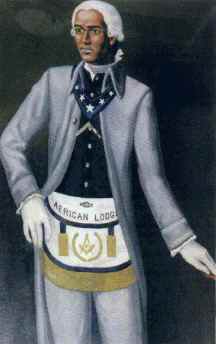
Prince Hall, founder of African-American Freemasonry
One certainty nevertheless stands out. Officially manumitted in 1770, Prince Hall is already described in the deed of manumission as having always been regarded as a free man. This singular wording suggests a de facto freedom that preceded legal freedom, and it gives Prince Hall’s trajectory a particular symbolic depth: that of a man who acts as a free man even before institutions recognise him as such. This tension between inner freedom and external recognition would run through his entire Masonic work and largely explain the emergence of African-American Freemasonry.
Prince Hall’s entry into Freemasonry, between ideal and refusal
Prince Hall’s approach to Freemasonry followed a path consistent with his civic and moral commitment. In an America still deeply shaped by segregation, Freemasonry appeared as one of the rare spaces in which equality among men was affirmed in principle. Prince Hall saw in it the possibility of a form of recognition grounded not in origin, but in the moral and initiatic worth of the individual.
The first request for initiation, submitted together with fourteen other free Black men to a lodge in Boston, was met with refusal. This failure reveals a fundamental tension: proclaimed Masonic universalism collided with very real practices of exclusion. In 1775, Prince Hall and his companions were finally initiated in a military lodge under the jurisdiction of the Grand Lodge of Ireland. This initiation, fully regular from a Masonic standpoint, nevertheless did not lead to normal integration into the local Masonic landscape.
After the departure of the British troops, the creation of the African Lodge marked a decisive step. Although authorised to meet, the lodge was deprived of the right to initiate and thus maintained in an ambiguous position, tolerated but not recognised. This institutional marginalisation illuminates the central paradox experienced by Prince Hall: to be a Freemason in law, yet kept at a distance in practice. This structural contradiction would become the seed of an autonomous African-American Freemasonry, not through a desire for separation, but out of the necessity of initiatic survival.
The African Lodge, a Freemasonry prevented from transmitting
The creation of the African Lodge confronted Freemasonry for the first time with an unprecedented situation: the existence of a regular lodge, composed of men duly initiated according to the rules, yet durably kept outside the normal circuit of transmission. This was no longer merely a matter of admission or occasional recognition, but the establishment of a lasting anomaly within the Masonic order, in which initiatic filiation was suspended without being broken.
By denying the African Lodge the faculty to initiate, local Masonic authorities clearly intended to contain, and ultimately to exhaust, this nascent experience. A lodge deprived of transmission is a lodge destined to disappear. This choice reveals a restrictive conception of Masonic universalism, reduced to an abstract principle the moment it was required to take shape within a social reality deemed disturbing.
Prince Hall’s response was neither rupture nor revolt. It was legal, Masonic, and patient. By requesting a regular warrant directly from London, the African Lodge affirmed its attachment to regularity and initiatic continuity. The granting of this warrant in 1784 transformed the African Lodge into a fully recognised lodge, capable of transmitting Freemasonry without depending on hostile local authorities. This founding decision would make the African Lodge the true mother lodge of African-American Freemasonry.
The structuring of Prince Hall Grand Lodges in the nineteenth century
The course pursued by Prince Hall and his Brethren after the granting of the London warrant did not stem from a spirit of secession, but from a desire for continuity. By founding new lodges from the African Lodge, first in Philadelphia and then in Providence in 1797, they were not creating a parallel form of Freemasonry, but extending an initiatic lineage that had finally become operative. The multiplication of lodges reflected less a strategy of expansion than a vital necessity: enabling African-American Freemasonry to transmit itself under normal conditions.
The death of Prince Hall in 1807 did not bring this dynamic to an end. On 24 June 1808, the three existing African Lodges came together to form the African Grand Lodge of Massachusetts. This transition to the level of a Grand Lodge marked a decisive step. For the first time, an African-American Grand Lodge fully assumed Masonic responsibilities without depending on external authorities liable to hinder its development.
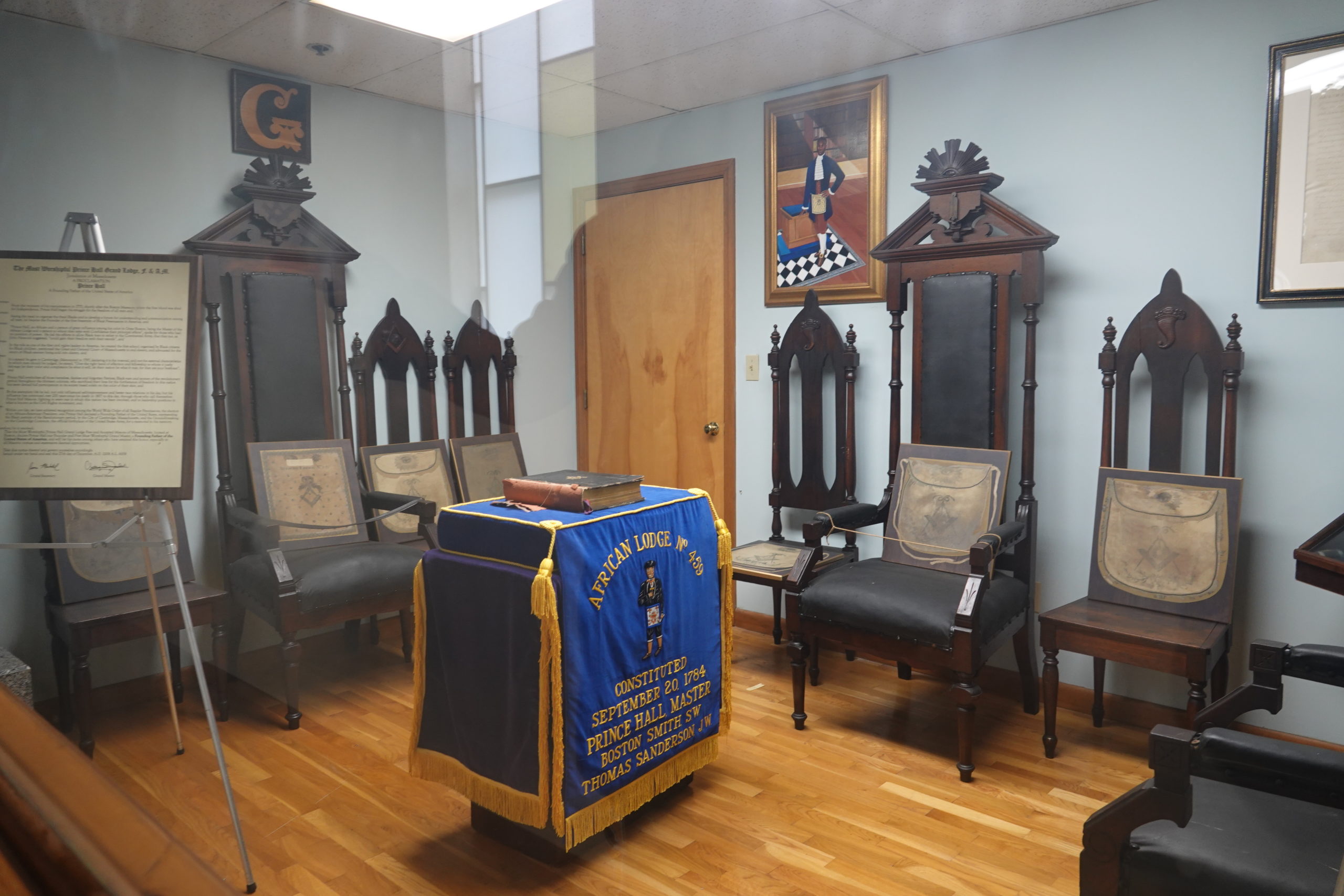
Historic temple of the first African Lodge in Boston, Massachusetts
In 1827, the African Grand Lodge of Massachusetts declared its independence from the United Grand Lodge of England, thereby affirming its full Masonic sovereignty. This decision did not remain an isolated one. In the years that followed, African-American lodges formed in other states likewise adopted the American model of one Grand Lodge per state, giving rise to several autonomous African-American Masonic jurisdictions.
In 1847, these various Grand Lodges chose to unite within a federal structure under the name Prince Hall Grand Lodge, in order to affirm their shared origin and strengthen their institutional coherence. Two years later, in 1849, a schism occurred. Certain lodges, a minority, favouring the direct heritage of the three historic African Lodges, separated to form a unified National Grand Lodge, known as Prince Hall Origin (PHO). The Grand Lodges that remained within the federal framework then adopted the designation Prince Hall Affiliated (PHA).
Conclusion – Prince Hall, the refusal of reverse segregation
One of the most striking facts in the history of African-American Freemasonry lies less in the discrimination it endured than in the way it chose to respond to it. Born in a context of racial segregation openly accepted by part of American society, the Freemasonry that emerged from Prince Hall could, by reaction, have reproduced a logic of reverse separation. It did not. From its very beginning, membership in a Prince Hall lodge was never conditioned by ethnic origin, but by Masonic criteria shared by all regular jurisdictions.
This choice was by no means self-evident. Other African-American movements, engaged in the struggle for emancipation, made the understandable choice of communal withdrawal or reciprocal exclusion. Prince Hall Freemasonry followed a different path. It did not instrumentalise the Order in the service of an identity-based cause; on the contrary, it upheld initiatic rigor as a higher principle, refusing to turn experienced discrimination into an operating rule.
In this sense, Prince Hall Freemasonry does not merely constitute a historical response to segregation, but a lasting Masonic lesson. It shows that universality is not a slogan designed to conceal the fractures of reality, but a demanding discipline, capable of resisting both the temptation of resentment and that of revenge. It is undoubtedly here that the deepest significance of Prince Hall’s legacy lies, and the reason why his experience deserves to be reflected upon far beyond the African-American context alone.
By Ion Rajolescu, Editor-in-Chief of Nos Colonnes — serving a Masonic voice that is just, rigorous, and alive
Prince Hall Freemasonry, like all American Grand Lodges, works in the York Rite. Discover the collection dedicated to York Rite Blue Lodges.

1 Who was Prince Hall ?
Prince Hall was a formerly enslaved Black man of the eighteenth century, initiated into Freemasonry in 1775, and regarded as the founder of African-American Freemasonry and the origin of what are known as Prince Hall Grand Lodges.
2 What is Prince Hall Freemasonry ?
Prince Hall Freemasonry refers to the body of lodges and Grand Lodges that originated from the African Lodge founded in Boston at the end of the eighteenth century, created to allow a regular Masonic practice in a context of racial segregation.
3 Why were Black Freemasons not admitted into American lodges ?
In Prince Hall’s time, many American lodges refused to admit Black men for social and racial reasons, despite the principles of equality publicly affirmed by Freemasonry.
4 Is Prince Hall Freemasonry regular ?
From a historical and initiatic standpoint, Prince Hall Freemasonry is based on regular initiations and legitimate warrants. Debates have mainly concerned its institutional recognition rather than its ritual validity.
5 Why did the African Lodge request a warrant from London ?
Deprived of the right to initiate by local Masonic authorities, the African Lodge sought a warrant directly from London in order to ensure the continuity and legitimacy of initiatic transmission.
6 What is the Prince Hall Grand Lodge ?
The Prince Hall Grand Lodge is a federal structure created in 1847 to unite several African-American Grand Lodges sharing a common origin rooted in the work of Prince Hall.
7 What is the difference between Prince Hall Affiliated and Prince Hall Origin ?
Prince Hall Affiliated refers to the Grand Lodges that remained within the federal structure after 1847, while Prince Hall Origin designates those that emerged from the 1849 schism, claiming direct continuity with the three historic African Lodges.
8 Is Prince Hall Freemasonry reserved for African-Americans ?
No. Prince Hall lodges have never imposed any ethnic criteria for membership and admit men of all backgrounds according to the usual Masonic requirements.
9 What is the universal significance of the Prince Hall experience ?
Its essential significance lies in the refusal of Prince Hall Freemasonry to reproduce the segregation it had itself endured, maintaining an openness consistent with Masonic principles.
10 Why is Prince Hall still little known in Europe ?
Prince Hall remains relatively unknown in Europe because Masonic history there is most often approached through national and continental developments, leaving aside experiences that emerged in different historical and social contexts.
Read the full transcript of the podcast here for those who prefer reading or want more detail.
Podcast – Prince Hall, or the Refusal to Transmit Segregation
Prince Hall is often described as a founder. That is true. But stopping there would mean missing what matters most. What Prince Hall founded was not merely an African American Masonic structure. He inaugurated a way of remaining a Mason at a moment when everything seemed to push one to cease being so.
Prince Hall was born in the eighteenth century, in a world where skin colour determined social, legal, and human status. His exact origins remain uncertain. Barbados or Boston, it hardly matters in the end. What matters is this initial condition of a man held at a distance, even when recognised as legally free, in seventeen seventy.
From an early stage, Prince Hall committed himself to the education of Black children, to the abolition of slavery, and to the equality of rights. Like many others, he believed that a new America would be able to honour its promises. He was mistaken. But he did not give up.
When he discovered Freemasonry, he saw in it a space where equality should not be an empty word. He submitted a request for initiation together with fourteen other free Black men. The refusal was clear. Without ambiguity.
It was not until seventeen seventy-five that Prince Hall and his companions were initiated, in a military lodge dependent on the Grand Lodge of Ireland. An initiation that was regular, unquestionable. And yet, recognition continued to be denied by the local lodges after the departure of the British troops.
This is where the story truly begins.
For the African Lodge existed. It worked. But it was prevented from transmitting. It was tolerated, not recognised. A form of Freemasonry deprived of its very heart: initiatory transmission.
Most would have broken away. Prince Hall chose another path. He requested a warrant directly from London. It was granted in seventeen eighty-four. The lineage was restored. Transmission became possible. Without provocation. Without ritual rupture. Without vindictive discourse.
After Prince Hall’s death, in eighteen oh seven, the work continued. In eighteen oh eight, the African Grand Lodge of Massachusetts was founded. In eighteen twenty-seven, it declared itself independent. Other states followed. In eighteen forty-seven, the Grand Lodges united under the name Prince Hall Grand Lodge. Then came divisions, schisms, and competing structures.
All of this matters. But it is not the essential point. What matters is that the Freemasonry issuing from Prince Hall never reproduced the segregation it had endured. Never did it reserve initiation on the basis of ethnic origin. Never did it transform an experienced injustice into a principle of exclusion.
This is where the point of truth lies. Other African American movements chose withdrawal, sometimes separation. That was humanly understandable. Prince Hall Freemasonry refused this temptation. It did not use the Order as an instrument of revenge. It maintained Masonic exigency at a moment when everything invited it to relax that demand.
Prince Hall did not seek to prove that Freemasonry was wrong. He showed, silently, what it could be.
And this is perhaps why his legacy remains unsettling. Because it allows no excuse. Because it compels a choice.


JE VEUX RECEVOIR LES ACTUALITÉS ET EXCLUSIVITÉS !
Restez au courant des nouveaux articles de blog, des nouveautés et promotions Nos Colonnes.
