









Traditional French Rite: The Overlooked Legacy of French Freemasonry
Masonic Rites are quite numerous, especially in the French-speaking cultural sphere: among the best known are the Ancient Accepted Scottish Rite, the French Rite (in at least three different forms), the Rectified Scottish Rite, the Rite of Memphis-Misraïm, the Operative Rite of Solomon, not to mention the Anglo-Saxon rites, such as Emulation Working, the York Rite, or the Royal Standard of Scotland… This list is far from exhaustive, but it does reflect the practices commonly found in French-speaking Freemasonry.
It is to one of the versions of the French Rite, called Traditional French Rite, which is what we’ll be focusing on today. What is the Traditional French Rite, where does it come from, and what are its features?
The Concept of a Masonic Rite
First of all, it is important to recall what is referred to as a "Masonic Rite." This term denotes a number of Masonic degrees brought together within a coherent and progressive system, marked by a particular philosophical and spiritual nuance.
A Masonic Rite may include the three symbolic degrees (Entered Apprentice, Fellowcraft, and Master Mason) and/or a system of higher degrees. The French Rite Traditionally, the Ancient Accepted Scottish Rite, the Rectified Scottish Rite, and the Rite of Memphis-Misraïm, for example, include both the three craft degrees and higher degrees, while the Schroeder Rite (mainly practiced in Germany, Switzerland, and Brazil) contains only the three degrees of Entered Apprentice, Fellowcraft, and Master Mason. In Anglo-Saxon countries, the situation is generally different: the symbolic degrees and higher degrees are independent from each other, though they are related, and so, for example, the Ancient Accepted Scottish Rite exists only as a structure of higher degrees and therefore does not have craft Lodges (except within the Le Droit Humain Federations).
The term Rite in this sense did not appear in France until relatively late and only truly became established in the nineteenth century. In the eighteenth century, people preferred to speak of Regimes or Systems. In Anglo-Saxon countries, the term Rite was reserved for systems of higher degrees and was never applied to the craft degrees—except in American Freemasonry, where the York Rite refers to both the blue lodges and the system of higher degrees that follows them.

Origin of the French Rite
What is known as the French Rite is the result of a history, that of the introduction of Freemasonry into France starting in 1725, driven by the Grand Lodge of London, known as the "Moderns." It is anachronistic to speak of the French Rite at this stage: the rituals in use within the Lodges were not yet unified, and so there were several different rituals in use, as evidenced by the disclosures published between 1740 and 1760, as well as the 18th-century rituals that have come down to us ( of Bern, Ritual of the Marquis de Gages, Ritual of the Duke of Chartres, "Berté" Ritual, etc.).
But all these rituals, even though they show differences in their wording or in the trials to which the candidate is subjected, share a fundamental unity: they all belong to the family of so-called Modern Rites, which place the J Column in the north and the B Column in the south.
The Grand Orient of France, born in 1773 from a reorganization of the first Grande Loge de France, felt it was necessary to bring some order to the abundance of rituals. At its second assembly, on December 27, 1773, the Grand Orient of France appointed a commission of three members (Bacon de la Chevalerie, Count Stroganoff, and Baron de Toussaint) charged with creating a new ritual. However, the decision appears to have come to nothing, as nothing was done until 1781.
The 59th assembly of the Grand Orient of France, on January 26, 1781, revived the question and entrusted this task to the Assembly of the Three Chambers (which brought together the Administrative Chamber, the Chamber of Paris, and that of the Provinces). The work took about a year to create the rituals for the three craft degrees. And in 1782, instead of submitting its results, the Assembly of the Three Chambers handed the dossier over to the Chamber of Degrees (that is, of the higher degrees) which, for its part, was working on the higher degrees. It was only in 1785 that the Grand Orient of France officially adopted the new ritual for the craft degrees, and the following year that of the higher degrees.
The French Rite was born, even though it would not be given this name until the 19th century. Approved by the Grand Orient of France, all that remained was for it to be spread throughout the Lodges in the form of conforming manuscripts—a considerable task, which was of course interrupted by the French Revolution, which broke out in 1789. Distribution did not resume until the revival of the Grand Orient of France from 1795 onwards, under the leadership of Alexandre-Louis Roëttiers de Montaleau (1748-1808).
In 1801, an "unauthorized" edition of the French Rite appeared, under the title "Régulateur du Maçon" for the Craft degrees and "Régulateur du Chevalier Maçon" for the higher degrees. It is because of this publication that people today often refer to the "French Rite of 1801," even though it is actually the ritual from 1785. Although this publication was not intended by the Grand Orient of France, it certainly helped spread the Rite.
Unlike other Masonic rites, whose authors are known (for example, Jean-Baptiste Willermoz for the Rectified Scottish Rite or Jacques-Étienne Marconis de Nègre for the Rite of Memphis), the French Rite is a collective work. However, one figure stands out: Roëttiers de Montaleau, who was several times the rapporteur of the commission and drafted the final version of the three craft degrees. But contrary to what is sometimes written, he was not the author of this Rite.

Characteristics of the French Rite of 1785
The French Rite of 1785 is an excellent synthesis of the Masonic practices in France during the eighteenth century. Sober and concise, it strikes a very good balance between a rationalist approach and a more spiritual sensibility. It is therefore a very well-written and essentially consensual Rite, suitable for use within a major Masonic obedience such as the Grand Orient of France.
In particular, the French Rite of 1785 turns its back on the macabre and Grand Guignol-style productions that had found their way into many French rituals of the 18th century. It thus abandons practices such as discovering a hanged man during the initiation ceremony, or the use at the Master Mason degree of a double-bottomed coffin, in which a Brother would hide and speak in a sepulchral voice while closing his arms around the candidate lying above him!
The French Rite of 1785 also had a significant influence on other Masonic Rites. It is often overlooked, but it is in the French Rite of 1785 that the famous mottos inscribed in the Chamber of Reflection appeared for the first time, later adopted by most of the other Rites.
But the most surprising feature of the French Rite of 1785 is that the Proceedings are not opened "To the Glory of the Grand Architect of the Universe" and that the Bible is not displayed on the altar. It is often believed that these bold departures, which are considered an unmistakable mark of so-called "liberal" Freemasonry of the 19th century, did not appear until the decision of the Grand Orient of Belgium to abandon the requirement of mentioning the Grand Architect of the Universe and having the Bible present in 1872, followed by a similar decision by the Grand Orient of France in 1877. Nearly a century earlier, the Grand Orient of France had already adopted just such a stance, then even when it was still regular and recognized by the Grand Lodge of London.
The rigid idea of so-called Masonic regularity expressed in terms of explicit biblical theism, requiring a Bible and invocations, did not exist in the "Modern" Freemasonry of the 18th century, even in England, much to the dismay of all those who praise regularity in the manner of today's United Grand Lodge of England. The debate between traditional (and/or regular) Freemasonry and liberal Freemasonry was not on the agenda at the time, but we can observe that what would later become "liberal" Freemasonry did in fact exist in the 18th century, even in the sein the Grand Lodge of London. Only the radicalization of factions in the 19th century, the hostile attitude of the Catholic Church, the rise of Republican anticlericalism, and the hardening of dogma by the United Grand Lodge of England in 1929 explain the lamentable situation we face today, which sees a large number of Freemasons denying the Masonic status of others.
Developments of the French Rite in the 19th and 20th Centuries
The French Rite was bound to evolve over the following centuries, owing to changes in mindsets and socio-political contexts. Different versions were adopted, seeking to adapt to their times, but also to counter the significant competition posed by the Ancient Accepted Scottish Rite, whose rituals were richer and potentially more mystical.
Originally more sober than most other Masonic Rites, the rituals of the French Rite therefore became laden with elements generally borrowed from the Ancient Accepted Scottish Rite, along with persistent references to belief in God and the immortality of the soul, with the Bible also appearing during the rituals. Thus, the "Murat" version adopts some practices from the Ancient Accepted Scottish Rite and places great emphasis on God and the idea of soul. As for the higher degrees of the French Rite, they are no longer practiced, having been replaced by those of the Ancient Accepted Scottish Rite, limited to the 18th, 30th, and 33rd degrees. This is the version that was in use when the 1877 Convent decided to make optional the invocation of the Grand Architect of the Universe and the presence of the Bible.
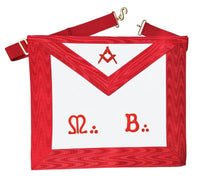
In 1887, a new revision led to the "Amiable" version of the French Rite, which saw the disappearance of any reference to God and to the immortality of the soul, in favor of ideas clearly influenced by positivism. The "Amiable" French Rite closely resembles the rituals of the Ancient Accepted Scottish Rite in use at the Grande Loge Symbolique Écossaise, a very distinctly republican, democratic, anti-clerical Masonic body devoted to free thought and even anarcho-syndicalism. Ritual elements previously unknown in the French Rite now appeared: passing under the blindfold, the Worshipful Master's flaming sword, the mourning battery, the chance to speak offered before closing the Work, the five stages of the Companion's journeys (the senses, the arts, the sciences, the benefactors of humanity, the glorification of work), the letters M B on the aprons…

It was in 1922, with the "Gérard" version, that the French Rite reached its lowest Masonic point. Nearly all Masonic symbolism was eliminated, along with the abandonment of Masonic regalia, lodge carpets, columns, candlesticks, and so on, and the ritual was reduced to simple moral statements about human fraternity and the effort needed to improve humanity through the study of sciences. It was in symbolic defiance against this ritual, which had nothing specifically Masonic left, that the last great version of the French Rite was born, the "Groussier" version of 1938. Because of the Second World War, this Rite was not finally published and generaligned with the Grand Orient of France only in 1955. With a few subsequent revisions, it still remains the reference Rite of the Grand Orient of France. The French "Groussier" Rite is often regarded by Freemasons from other Rites as a lesser Rite, a kind of minimum threshold below which Freemasonry would not even exist. However, this eminently respectable Rite intended, on the contrary, to restore certain symbolic and traditional values that were sorely lacking in the two previous versions. Although different from the 1785 Rite in its wording, it nonetheless carries the same spirit of openness and freedom.
Revival of the Traditional French Rite
A first attempt to reconnect with the ritual practices of eighteenth-century French Freemasonry, in a spirit of returning to the roots, emerged in the 1950s. By studying the French rituals of the eighteenth century and highlighting rites that had only recently been rediscovered, this historical research, carried out by a small group around René Guilly (also known by his pen name René Désaguliers, 1921-1992; art historian, journalist, museum curator, eminent Freemason and specialist in Freemasonry) created the Restored Modern French Rite, which is still in use today. Some refer to it as the Traditional French Rite, but this designation actually refers more to another organization which, in the 1980s, saw a Lodge of the Loge Nationale Française (a Masonic obedience founded in 1968 by René Guilly) restore, with some inevitable modifications, the French Rite of 1785, which had been published in 1801 under the title "Régulateur du Maçon." This Traditional French Rite, including its higher degrees, is now practiced within several Masonic obediences.
Other research carried out on the sources of the French Rite has led to different versions, each of which could claim the title of Traditional French Rite, such as the Philosophical French Rite, developed in the 1970s by the Lodge Tolérance of the Grand Orient of France, or the French Rite of Ancient Observance, created between 2015 and 2019 for an independent Lodge located in Bangkok.


I WANT TO RECEIVE NEWS AND EXCLUSIVES!
Keep up to date with new blog posts, news and Nos Colonnes promotions.
