



Why is geometry in Freemasonry the most useful science for the Mason?
From the very beginning, geometry in Freemasonry has accompanied the Mason’s gaze. It is present on Lodge Tracing Board, in the tools, in the figures that are traced and contemplated. It is often stated that geometry in Freemasonry is the most useful science for the Mason, without always pausing to consider what this formula truly means. Is it merely a survival from the operative past, or does it point to a deeper principle? If geometry in Freemasonry holds such a central place, it may be because it touches upon the very order of the world and the way in which man takes his place within it.
- 1. Masonry and Geometry in the Old Charges
- 2. From the Art of Building to the Art of Thinking
- 3. The Blazing Star and the Figure of Order
- 4. Why the Most Useful Science?
- 5. Conclusion – Measure and Inner Construction
- 6. FAQ – Geometry in Freemasonry
- 7. Podcast – Why Is Geometry at the Heart of Freemasonry?
Masonry and Geometry in the Old Charges
In the Old Charges, written in England from the end of the fourteenth century, Masonry is explicitly described as Geometry. The Regius Manuscript, generally dated to 1390, opens with the “statutes of the art of geometry according to Euclid.” The word is not used as a mere learned reference; it names the Art itself.

First page of the Regius Manuscript (c. 1390), one of the earliest known Old Charges, where Masonry is described as the “art of geometry according to Euclid.”
This equivalence may seem surprising today. Yet it was not a rhetorical exaggeration. In the Middle Ages, Geometry formed part of the Liberal Arts and held a recognised place within the structure of knowledge. To call Masonry “Geometry” was therefore to situate it immediately within a precise intellectual horizon.
But the significance of such a choice must be weighed carefully. To name an art is never neutral. By designating it as Geometry, the compilers of the Old Charges were not merely defining a technique; they were affirming a principle. Geometry evokes measure, proportion and intelligible order. It suggests that a structure stands not by chance, but through conformity to just relationships.
Thus, from its earliest written formulations, the Masonic tradition associates the Art with a science of measure. The Old Charges do not elaborate at length on this identification. They state it as something self-evident. To practise the Art is to practise Geometry. This textual datum, present from the earliest surviving expressions of the tradition, forms the starting point for a broader understanding of geometry in Freemasonry.
From the Art of Building to the Art of Thinking
If the Old Charges identify Masonry with Geometry, speculative Freemasonry does not merely preserve this equivalence as an inherited formula. It transforms it. The material building site gradually disappears, yet the logic that made it possible remains. What once ensured the stability of a structure becomes a principle of inner ordering.
In operative practice, Geometry guarantees the accuracy of the plan, the solidity of the foundations and the correctness of angles. An error in measurement compromises the whole. This rigour was not theoretical; it was visible in stone. The speculative translation consists precisely in recognising that this demand does not apply only to walls, but to the individual himself.
The square, the compasses and the rule thus change status. They are no longer tools of trade in the strict sense; they become instruments of reference. The square evokes rectitude, the compasses define a space, the rule traces a direction. Each reminds us that no construction can dispense with measure. And this measure is not arbitrary: it presupposes a stable relationship between elements.
Geometry in Freemasonry therefore ceases to be merely applied knowledge and becomes a method. It introduces the idea that thinking, judging and acting require just proportions. It suggests that excess, as much as deficiency, disturbs the whole. Where the builder once checked the verticality of a wall, the speculative Mason examines the coherence of his thought and the consistency of his conduct.
The distinction between operative and speculative thus appears less as an opposition than as a continuity. What was once an exacting standard in construction remains an exacting standard in reflection. The science of measure does not disappear; it shifts. Its primary object is no longer stone, yet it preserves the same logic of balance and proportion.
The Blazing Star and the Figure of Order
It is in the degree of Fellowcraft that the geometric dimension becomes explicit. The Blazing Star takes its place at the centre of the Lodge as a figure to be contemplated as much as understood. This pentagram is not a decorative motif. It is constructed according to the golden ratio, a particular proportion which, since antiquity, has been associated with harmony and balance.
Within the pentagon it contains, a new star may be traced; within each of its points, another pentagon appears, itself capable of generating a further star. At every level, the same relationships re-emerge. The figure displays an internal coherence that can unfold indefinitely.
Yet this figure does not impose itself through an explanatory discourse. It is not extensively commented upon; it is presented to the eye. Its pedagogy is silent. The Fellowcraft does not first receive a theory of proportion, but an image that calls for attention and reflection. Here Geometry acts without formal demonstration. It educates the gaze before it appeals to reasoning.
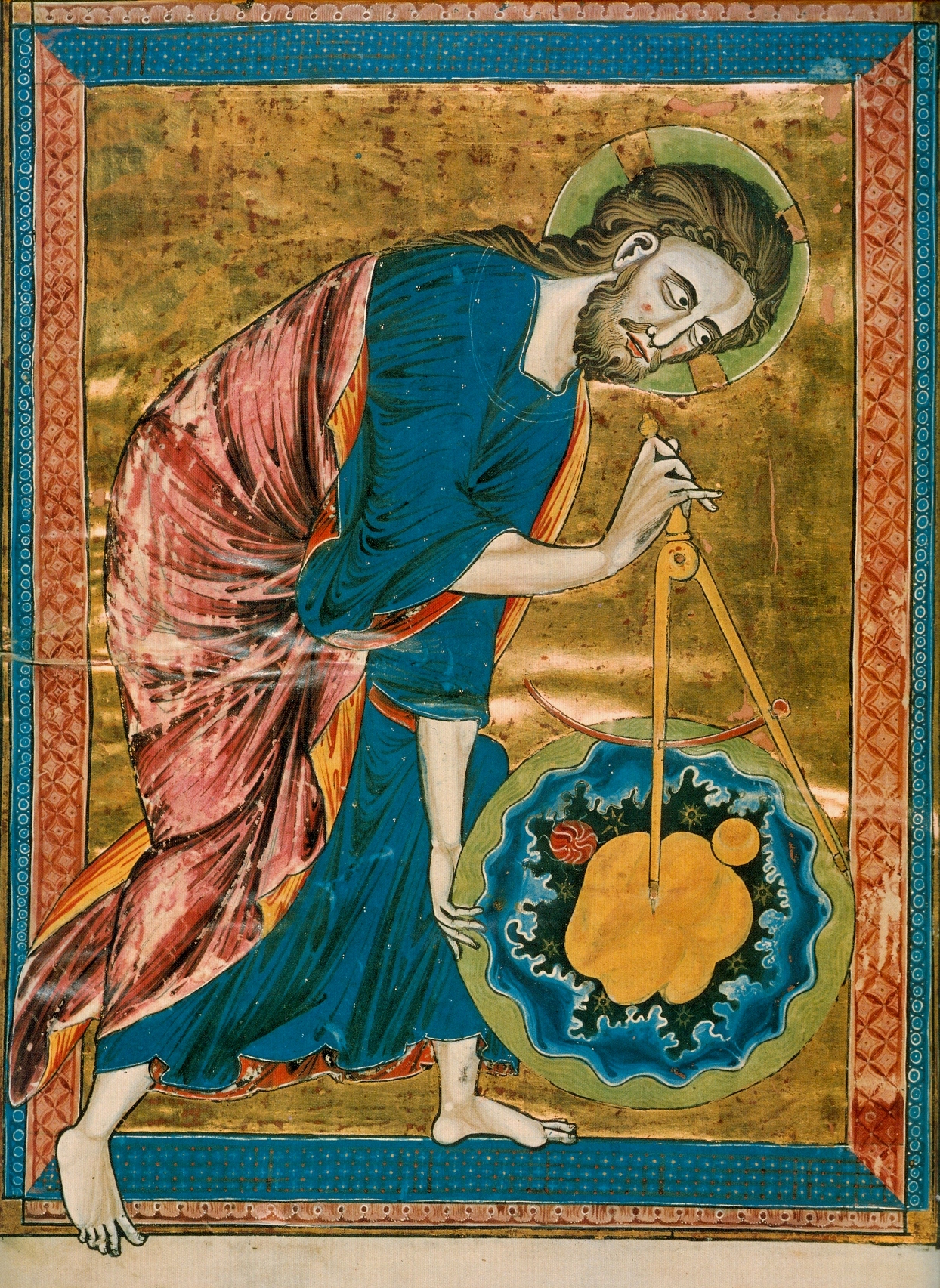
Medieval illumination (c. 1220–1230) depicting the Grand Geometer of the Universe drawing the world with compasses, symbol of order and measure.
At the centre of the Blazing Star, the letter G reinforces this interpretation. Among its possible meanings, that of the Grand Geometer of the Universe places emphasis on the intelligibility of the world. The universe is not chaos; it is structured, proportioned and measurable.
At this stage, geometry in Freemasonry no longer merely underpins an art of building or a method of thought. It becomes a key to understanding the cosmos itself.
Why the Most Useful Science?
To affirm that Geometry is the most useful science for the Mason does not primarily refer to practical usefulness. Medieval builders knew how to measure and draw long before this formula was repeated in ritual contexts. The usefulness in question belongs to another order. It concerns the solidity of what is constructed, whether visible or invisible.
Geometry teaches discernment. It imposes clarity of outline and precision of relationship. It reminds us that a structure stands through exactness, not approximation. This demand extends beyond the material sphere. It becomes an inner rule. Where everything might dissolve into vagueness, Geometry introduces clear lines.
In speculative Freemasonry, this discipline takes on a particular dimension. It does not aim at immediate efficiency, performance or speed. It aims at stability. A thought that respects no proportion loses its balance. A judgement that ignores measure either hardens or disperses. Geometry recalls that there is a point of equilibrium to be sought and maintained.
It is in this sense that it may be called the most useful. Not because it would be superior to other sciences, but because it provides a rule of coherence applicable to all. It teaches us not to confuse what is essential with what is secondary, not to yield to excess, and to situate action within an intelligible framework.
Geometry in Freemasonry thus remains a constant reference. It does not promise spectacular revelation. It offers a method of adjustment. Between the art of building and the art of thinking, it ensures a discreet continuity. What once guaranteed the stability of a structure becomes a principle of balance for the individual himself.
Conclusion – Measure and Inner Construction
Geometry in Freemasonry does not present itself as an additional theoretical discourse. It accompanies initiation from its earliest formulations and runs through the rituals without particular display. Yet it remains one of their most constant axes. It reminds us that every construction, whether material or inner, presupposes a principle of measure.
The Old Charges named it without hesitation. Speculative Freemasonry preserved the reference. Between stone and thought, there is no rupture but continuity. What once guaranteed the balance of a vault becomes a demand for inner equilibrium. The tool changes its object, not its logic.
To say that Geometry is the most useful science for the Mason does not mean that it dominates all other disciplines. It means that it offers a regulating principle. It invites the search for justness rather than excess, proportion rather than imbalance, coherence rather than arbitrariness. It reminds us that freedom is not the absence of structure, but inscription within an intelligible order.
In a world where speed and opinion tend to replace measure and examination, this reference retains a discreet relevance. Geometry in Freemasonry does not promise additional knowledge; it proposes a way of inhabiting the world with balance. What was once the science of tracing remains the science of adjustment.
Thus, the ritual affirmation is neither archaic nor decorative. It expresses a constant demand: to build solidly, to think with precision, to act with proportion. Every lasting work begins with a just measure. And that measure, ultimately, is learned not only on the building site, but in the patient work of the self upon itself.
By Ion Rajolescu, Editor-in-Chief of Nos Colonnes — serving a Masonic voice that is just, rigorous, and alive
From square to compasses, discover our Lodge tools collection and the symbols that translate geometry into practice.

1 Why is geometry in Freemasonry called the most useful science for the Mason?
Because it provides a principle of measure and proportion applicable both to material construction and to inner formation.
2 Do the Old Charges really identify Masonry with Geometry?
Yes. The Regius Manuscript dated 1390 explicitly refers to the “art of geometry according to Euclid” to describe Masonry.
3 What is the link between geometry in Freemasonry and the Liberal Arts?
In the Middle Ages, Geometry was part of the Liberal Arts. Identifying Masonry with Geometry placed it within a recognized intellectual framework.
4 Why is the Blazing Star associated with Geometry?
Because it is constructed according to precise ratios, notably the golden ratio, and expresses an order based on measure.
5 What does the letter G in the Blazing Star represent?
It can have several meanings, including Grand Geometer of the Universe, emphasizing the idea of an intelligible and structured cosmos.
6 Is geometry in Freemasonry purely symbolic?
No. It continues an operative tradition while becoming, in speculative Freemasonry, a method of thought and discernment.
7 How does geometry relate to speculative Freemasonry?
It is no longer applied to stone but to the individual, introducing coherence, proportion and balance into reflection and conduct.
8 Does the golden ratio have initiatic significance?
It illustrates harmony and internal coherence, serving more as a pedagogical symbol than a technical lesson.
9 Is Geometry still present in modern Masonic rituals?
Yes. References to Geometry and to the Grand Geometer of the Universe remain in many contemporary rituals.
10 Why is the notion of measure central in Freemasonry?
Because any lasting construction, whether material or inner, depends on just proportions and respected balance.
Read the full transcript of the podcast here for those who prefer reading or want more detail.
Podcast – Why Is Geometry at the Heart of Freemasonry?
There is a statement that we sometimes hear without really pausing to consider it.
Geometry is said to be the most useful science for the Mason.
At first glance, this may seem surprising. Why geometry? Why this science rather than another? And above all, what does such usefulness truly mean?
To understand this, we must return to the earliest known texts of the Masonic tradition. In the Old Charges, those ancient duties written in England from the end of the fourteenth century, Masonry is explicitly described as Geometry. The Regius Manuscript, generally dated to thirteen ninety, speaks of the “art of geometry according to Euclid.”
The word is not decorative. It names the Art itself.
In the Middle Ages, Geometry formed part of the Liberal Arts. It belonged to the noble disciplines that structured the intellect. To call Masonry “Geometry” was not merely to describe the craft of builders. It was to affirm that the craft rested upon a principle of measure, proportion and intelligible order.
This logic did not disappear with speculative Freemasonry. It shifted.
In operative practice, Geometry ensured the stability of a building. An error of measure endangered the whole structure. In speculative Freemasonry, stone gives way to the human being. Yet the principle remains the same. What once guaranteed the balance of a vault becomes a demand for inner balance.
The square, the compasses and the rule are no longer simply working tools. They become points of reference. They remind us that no construction endures without exactness.
Geometry thus ceases to be merely an applied skill and becomes a method. It introduces the idea that thinking, judging and acting require just proportions. That excess, as much as deficiency, disturbs the whole.
This dimension becomes particularly visible in the degree of Fellowcraft. The Blazing Star appears as a central figure. This pentagram is constructed according to the golden proportion, a ratio long associated with harmony and balance since antiquity.
Within the figure, the same relationships repeat themselves at different scales. It gives form to an order that unfolds without breaking. It does not argue. It shows. Its pedagogy is silent.
At the centre of the Star, the letter G introduces a further meaning. Interpreted as the Grand Geometer of the Universe, it points toward the idea that the universe itself is structured, proportioned and measurable.
One then understands that Geometry is not a simple technical survival from the past. It is a constant reference point.
To say that it is the most useful science for the Mason does not mean that it dominates all other disciplines. It means that it provides a regulating principle. It invites the search for balance rather than excess, proportion rather than imbalance, coherence rather than arbitrariness.
In a world where speed and opinion often replace measure and examination, this reference retains a quiet relevance.
Geometry does not promise spectacular revelation. It proposes a method of adjustment.
What once ensured the stability of a building becomes a principle of equilibrium for the individual.
And it is perhaps in this sense that Geometry remains, even today, at the very heart of Freemasonry.


I WANT TO RECEIVE NEWS AND EXCLUSIVES!
Keep up to date with new blog posts, news and Nos Colonnes promotions.
