







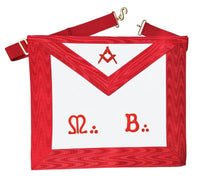
The Templar Cross: from Battlefield to Lodge
It unfolds across the white mantles of the ancient knights, on banners marked with the seal of the Temple, and even within the imagination of initiates. The Templar Cross carries the echo of a fervour that has defied time. Born amid the Crusades, it left the battlefield to find a quieter place within certain Masonic degrees. But what does the Templar Cross signify today? Is it merely a relic of the Middle Ages, or the emblem of an inner quest still alive? In its simple form and its vivid red, the Templar Cross joins courage, faith, and light.
- 1. Where Does the Templar Cross Come From?
- 2. What Place Does the Templar Cross Hold Among the Other Chivalric Orders?
- 3. The Templar Cross in Freemasonry
- 4. What Is the Universal Symbolic Meaning of the Cross?
- 5. Conclusion – What Does the Templar Cross Still Tell Us Today?
- 6. FAQ – The Templar Cross
- 7. Podcast – The Templar Cross: From Battlefield to Lodge
Where Does the Templar Cross Come From?
When Hugues de Payns and his companions founded in Jerusalem the Order of the Poor Knights of Christ and of the Temple of Solomon in 1118, their white mantles bore no emblem. Woven from coarse wool, this garment marked both their poverty and their new vocation as soldier-monks. Its whiteness recalled the moral purity demanded of the brethren, and the clarity of the purpose they served.
For nearly thirty years, the Knights of the Temple fought without a symbol. Only the crusaders wore coloured crosses sewn onto their tunics, each hue revealing their nation: red for the French, white for the English, green or black for the Germans. It was not until 1147, during the Second Crusade, that Pope Eugene III — a former Cistercian monk and disciple of Saint Bernard — granted the Templars the privilege of adding a red cross to their white mantles.
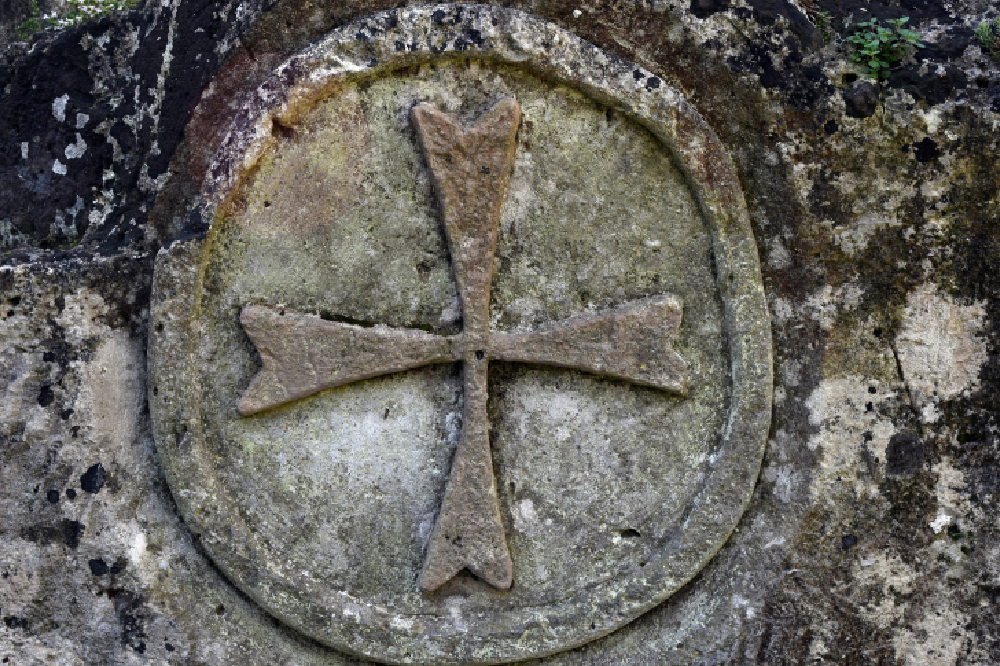
Templar Cross carved in stone — a silent witness to the faith and discipline of the Knights of the Temple
This papal act carried deep meaning. Red, the colour of fire and of blood, recalled the sacrifice of Christ as well as that of the brothers who fell in battle. The Templar Cross was therefore more than the emblem of an order; it embodied an ideal — to live and die in fidelity to the Temple and to the faith.
Medieval sources show, however, that the cross was not always identical. On the mantles, it was usually patty, its arms widening toward the ends. On some seals appear Greek crosses with equal arms, or occasionally crosses potent and crosses fleury in heraldic design. The Order imposed no strict rule in such matters, yet the red cross patty naturally prevailed as the image of the Temple — simple, strong, and instantly recognisable.
It was not an ornament but a vow. The red cross, stitched onto the white mantle, reminded each Knight of the Temple of his promise: to serve without reserve, to fight without hatred, and to die without fear.
What Place Does the Templar Cross Hold Among the Other Chivalric Orders?
The Order of the Temple was not alone in bearing the cross as a sign of belonging and obedience. From the twelfth century onward, several chivalric confraternities arose from the same spiritual and military fervour that animated the Crusades. Each adopted a distinctive form of the cross, reflecting its mission and its inner spirit.
The Hospitallers of Saint John of Jerusalem, founded even before the Templars, wore a white cross on a black mantle. At first simple and upright, it later became patty, and finally took the eight-pointed form established by the rule of 1496 — the Maltese Cross. Its whiteness symbolised charity and care for the sick, while the black mantle recalled humility in service.
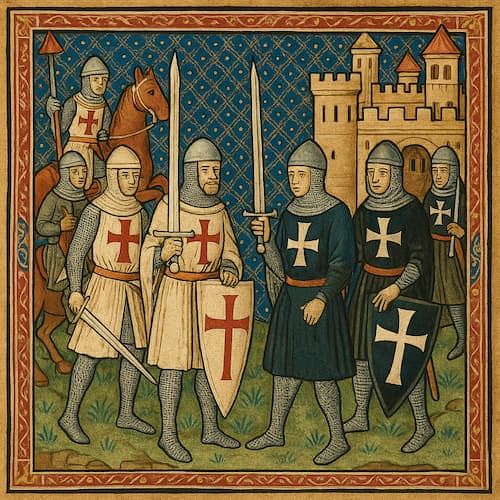
Templars and Hospitallers side by side — two brother orders, united by the cross yet divided by their calling
The Teutonic Knights, born from German crusaders, bore a black cross on a white habit. Their seals and banners display many variations, but the cross patty was by far the most common, while the cross potent was reserved for certain Grand Masters or heraldic depictions. This black cross expressed the discipline and austerity of a military order born in the cold of the North and faithful to a strict monastic rule.
By contrast, the red Templar Cross carried a wholly different breath. It belonged to an order dedicated to the defence of the Holy Land — more martial than hospitaller, more active than contemplative. Where the white of the Hospitallers spoke of mercy, and the black of the Teutonic Knights of order and rule, the red of the Temple proclaimed courage and the readiness for sacrifice.
Saint Bernard, in his De laude novae militiae, summed up this vocation: “The knight of Christ strikes with confidence and dies in peace.” Under this motto, the red cross did not signify rank, but a state of soul.
The Templar Cross in Freemasonry
The Templar Cross does not belong to the symbolism of the first three degrees of Freemasonry, which are centred on the art of building. Yet it reappears in the so-called “chivalric” systems that emerged in the eighteenth century, when several higher degrees sought to connect Freemasonry with the supposed heritage of the Order of the Temple.
The first of these systems was the Strict Templar Observance, founded in Germany around 1750 under the influence of Baron von Hund. It claimed direct descent from the vanished Order of the Temple. In its upper degrees, the red cross patty became the sign of a restored knighthood — a symbol of obedience to an ideal rather than submission to power.

Karl Gotthelf von Hund (1722 – 1776), founder of the Strict Templar Observance and a key figure in Freemasonry’s chivalric revival
From this lineage arose, in 1778, the Rectified Scottish Rite, developed in Lyon by Jean-Baptiste Willermoz. In this Rite, the red cross patty appears on the regalia of its two chivalric degrees: Squire Novice and Beneficent Knight of the Holy City. It reminds the Masonic knight of his spiritual and moral vocation — to serve truth, to aid his brother, and to defend light against error.
In the Anglo-Saxon world, this lineage continued through many systems attached to the Knights Templar, present throughout Britain and America. The red cross patty remains their principal emblem, a mark of honour and service. The Knights of Malta, closely linked yet distinct, wear the white Maltese Cross inherited from the Hospitaller Order of Saint John of Jerusalem.
The Ancient Accepted Scottish Rite also presents several symbolic variations. In the twenty-seventh degree, called Commander of the Temple, the black cross patty is the most widespread in Europe. In the United States, this degree often features a Grand Master’s Teutonic Cross: a black cross potent overlaid with a smaller golden cross, at the centre of which lies a golden escutcheon bearing the black Germanic eagle. In the thirtieth degree, that of Knight Kadosh, the red Maltese Cross on a black field evokes fidelity, justice, and steadfastness in trial.
In the thirty-first, thirty-second, and thirty-third degrees, a red cross patty or cross potent frequently appears on jewels and collars — a further reminder of the Templar lineage that the Ancient Accepted Scottish Rite implicitly claims.
What Is the Universal Symbolic Meaning of the Cross?
Long before Christianity, the cross was already one of humanity’s most essential signs. Carved in stone, drawn in sand, or traced upon wood, it expressed a single, complete idea — the order of the world. In its simplest form, two lines that meet, it joins earth and sky, the horizontal and the vertical, the finite and the infinite.
This structure gives it a universal meaning. The horizontal bar evokes the material world — the four cardinal points, the four elements. It refers to human experience, to the limits of the incarnate condition. The vertical bar, by contrast, links these realities to the principle that transcends them: spirit, light, permanence. Their intersection marks the centre, the place of balance and presence. Within the cross, all that expands finds its measure and orientation.
The Templar Cross belongs to this same symbolic lineage. Its patty arms, widening outward, suggest the diffusion of inner strength, the radiance of the centre spreading into the world. Its vivid red recalls fire, blood, and transformation — not violence, but the passage through trial. The Templar Cross therefore expresses not domination, but alignment: it joins action with faith, rigour with light.
This symbol finds a direct echo in Freemasonry. Like the cross, the mason’s tools — square, compasses, level, and plumb line — order space and remind one of the necessity of right measure. The upright man, arms outstretched, forms a living cross himself: four limbs extended toward the world and a centre seeking its axis. Thus the cross speaks as much of the cosmos as of the initiate; it invites him to unite the horizontal labour of work with the vertical aspiration of spirit.
Conclusion – What Does the Templar Cross Still Tell Us Today?
A symbol of faith, commitment, and balance, the Templar Cross reaches far beyond the boundaries of history. It no longer refers to a vanished order, but to an inner attitude — that of a man standing upright between earth and heaven, faithful to an axis greater than himself. Red on white, it reminds us that light is earned only through trial, and that no spiritual journey is genuine without discipline and courage.
In lodges as in minds, the Templar Cross endures as a point of reference — not to cling to an idealised past, but to continue, in the silence of inner work, the long labour of uprightness it has embodied for centuries.
By Ion Rajolescu, Editor-in-Chief of Nos Colonnes — in service of a Masonic voice that is just, rigorous, and alive.
Continue your journey into the Rectified Scottish Rite, and discover the regalia and jewels inspired by the chivalric legacy of the Temple.
Explore the Inner Order Collection – Rectified Scottish Rite.

1. What is the Templar Cross?
The Templar Cross is a red cross patty, whose arms widen towards the ends. It was worn on the white mantles of the Knights of the Temple from 1147 onwards, after Pope Eugene III granted them this distinction.
2. What does the red colour represent?
Red symbolised the blood shed in defence of the faith, but also spiritual ardour and charity. For the Templars, it was the colour of courage, sacrifice, and divine zeal.
3. What is the difference between a cross patty and a Maltese cross?
The cross patty, used by the Templars, has arms that broaden gradually without meeting in sharp points. The Maltese cross, used by the Hospitallers and later by the Knights of Malta, has eight points representing the Beatitudes.
4. Did the Templars always use the same cross?
Not exactly. Although the red cross patty is the best known, other forms appear on their seals and banners — Greek crosses, crosses fleury, or even crosses potent. The Order did not impose a single design.
5. Is the Templar Cross a Masonic symbol?
Not within the three Craft degrees of Freemasonry. However, it appears in several higher degrees — notably in the Rectified Scottish Rite and the Ancient and Accepted Scottish Rite — where it signifies chivalric and Templar inspiration.
6. Why does the Templar Cross still appear in Freemasonry?
Because it represents a moral and initiatory ideal rather than a historical lineage: courage, discipline, constancy, and self-mastery. It symbolises the inner struggle of the initiate rather than a vanished order.
7. What form of cross is found in higher Masonic degrees?
Depending on the rite, one may find red or black crosses patty, Maltese crosses, or crosses potent. In the 30th degree of the Ancient Accepted Scottish Rite (Knight Kadosh), the red Maltese cross on a black field is the most emblematic.
8. Are the Templar Cross and the Teutonic Cross identical?
No. The Teutonic Knights used a black cross patty, sometimes potent for the Grand Master. Both share a similar structure but differ in colour, origin, and meaning.
9. What is the role of the Templar Cross in modern culture?
It remains a powerful emblem of chivalry, courage, and spiritual commitment. Today it appears in Masonic regalia, jewellery, and banners, though often stripped of its original significance in popular culture.
10. What does the Templar Cross represent for the Freemason?
It expresses the union of vertical and horizontal — of spirit and matter. It invites the initiate to balance inner construction with action in the world: to build and to rise in the same movement.
Read the full transcript of the episode here for those who prefer reading or want more detail.
Podcast – The Templar Cross: From Battlefield to Lodge
Some symbols never seem to age. Among them, the Templar Cross holds a special place. Red on white, simple in form yet inexhaustible in meaning, it crosses the centuries like a thread stretched between history and spirit. It can be seen on the white mantles of medieval knights, on crusaders’ banners, and even on Masonic regalia, where it has become one of the most recognisable signs of inner chivalry. But where does this cross come from? And why, eight centuries after the fall of the Temple, does it still speak to those who seek the light?
When Hugues de Payns founded the Order of the Temple in Jerusalem in the year eleven hundred and eighteen, the first brothers wore no emblem. Their habit was of plain white wool, without ornament or distinction. That white said everything: monastic simplicity, purity, renunciation. The Templars were monks first, bound by the three traditional vows — poverty, chastity, and obedience. To these, they added a fourth: to protect pilgrims and defend the Holy Places with the sword. For nearly thirty years, they fought without a symbol. At that time, crusaders wore coloured crosses on their tunics to mark their origin — red for the French, white for the English, black for the Germans. It was only in the year eleven hundred and forty-seven that Pope Eugene the Third, a former Cistercian and disciple of Saint Bernard, granted them the right to sew a red cross upon their mantle. A visible sign, stitched over the heart, like a public vow to shed one’s blood in service of the faith. The red meant more than sacrifice; it expressed fervour, charity, and the fire of the Spirit. On the white cloak, the red cross was not an ornament but a reminder: to serve without reservation, to fight without hatred, to die without fear.
The shapes of this cross varied through time. On mantles it was most often a cross patty, its arms widening toward the ends. On seals it might appear as a Greek cross with equal branches, or a cross fleury ending in tiny lilies. In certain manuscripts, it became a cross potent, its arms finished in the form of the letter Tau. Whatever its variation, the Templar Cross embodied a single ideal: a faith upright, active, and ordered.
The Temple was not alone in bearing the cross. From the twelfth century onwards, other confraternities arose in the wake of the Crusades. The Hospitallers of Saint John of Jerusalem tended to pilgrims and wore a white cross on a black mantle. That whiteness spoke of charity and compassion. Later, its eight-pointed form was fixed as the Maltese Cross, each point symbolising a Beatitude. The Teutonic Knights, descended from German crusaders, bore a black cross on a white habit. Their symbol, austere and architectural, reflected discipline and obedience. Some Grand Masters adopted a cross potent bearing the black imperial eagle, but the black cross patty remained the most widespread. Among this heraldic mosaic, the red cross of the Temple stood apart: where the Hospitallers’ white meant mercy, and the Teutonic black meant rule, the Templar red proclaimed ardour — courage, fidelity, and faith unto death. Saint Bernard said it best in his De laude novae militiae: “The knight of Christ strikes with safety and dies in peace.”
The Order vanished, but the symbol endured. Centuries later it would reappear in the higher degrees of Freemasonry. The first three degrees — Entered Apprentice, Fellowcraft, and Master Mason — belong to the world of builders. But in the eighteenth century, several systems turned their gaze toward chivalric ideals. The Strict Templar Observance, born in Germany around seventeen fifty, claimed direct descent from the ancient Temple. In its higher ranks, the red cross patty became again a sign of fidelity to an inner ideal rather than temporal power. Out of that lineage grew the Rectified Scottish Rite. In Lyon, in seventeen seventy-eight, Willermoz created a Rite where knighthood was no longer a military function but a spiritual path. In its two highest degrees — Squire Novice and Beneficent Knight of the Holy City — the red cross patty adorns the regalia, standing for beneficence, truth, and pure action.
In the Anglo-Saxon world, the same heritage took other forms. The Knights Templar retained the red cross patty as their principal emblem, while the Knights of Malta, connected yet distinct, bore the white Maltese Cross inherited from the Hospitallers. The Ancient Accepted Scottish Rite also displays various forms of the cross. In the twenty-seventh degree, Commander of the Temple, the black cross patty is most common in Europe. In the United States, one sometimes finds the cross potent of the Teutonic Grand Master: black, overlaid with a smaller golden cross and the black Germanic eagle. In the thirtieth degree, Knight Kadosh, the red Maltese Cross on a black field is emblematic. In the thirty-first, thirty-second, and thirty-third degrees, red crosses patty or crosses potent frequently appear on jewels and sashes, discreet echoes of the Templar legacy.
But the cross itself transcends chivalry and Masonry. It is one of humanity’s oldest symbols. Long before Christianity, it appeared on stone, wood, and clay — wherever man sought to represent order in the cosmos. The horizontal bar evokes the earth, space, and the four directions. The vertical bar joins heaven and earth. Their intersection marks the centre — the meeting point between visible and invisible. The cross both divides and unites; it measures and relates.
The Templar Cross fits within this same geometry. Its widening arms express light expanding from a centre. Its red speaks of fire that purifies, of blood that gives life. It does not proclaim violence but transformation. In Freemasonry, the Templar Cross converses naturally with the square, the compasses, the level, and the plumb line — all instruments of balance and inner architecture.
In this sense, the Templar Cross does not belong to the past. It continues to inspire those who seek to unite action and faith, reason and hope. It teaches that the true battle is no longer fought outside but within: self-conquest, mastery of desire, and fidelity to the inner axis. Red on white, it unites fire and light. On black, in the higher degrees, it becomes the sign of fulfilment — the flame that burns without consuming. From battlefield to lodge, the Templar Cross keeps its original meaning: not a mark of power, but a call to stand upright. For nine centuries it has taught the same lesson — that man’s true victory is inward, and that to stand between earth and heaven is already to serve.


I WANT TO RECEIVE NEWS AND EXCLUSIVES!
Keep up to date with new blog posts, news and Nos Colonnes promotions.
