



Women in Freemasonry: History, Resistance and Recognition
Women in Freemasonry remains a subject that continues to generate debate, tension, and misunderstanding. For some, the presence of women in Lodge appears self-evident in the name of equality; for others, it is seen as a rupture with an allegedly immutable tradition. But what does this opposition truly rest upon? Is the question of women in Freemasonry a symbolic or initiatic issue, or merely the reflection of social conventions inherited from a particular historical context? By tracing the history of women in Freemasonry, from early refusals to the emergence of female and mixed forms, this article seeks to shift the perspective: not to arbitrate an ideological debate, but to understand what, within Masonic practice, long resisted change — and what eventually evolved.
- 1. Is Freemasonry fundamentally based on the exclusion of women?
- 2. Symbolism, craft, and sexual difference
- 3. Fallacious arguments: feminine nature and tradition
- 4. Early female initiations: revealing exceptions
- 5. Adoption Freemasonry: controlled opening or deliberate distance?
- 6. From half-measures to initiatic equality
- 7. Female Freemasonry and the question of recognition today
- 8. Conclusion – Women in Freemasonry and initiatic recognition
- 9. FAQ – Women and Freemasonry: Key Points Explained
- 10. Podcast – Women in Freemasonry: from exclusion to recognition
Is Freemasonry fundamentally based on the exclusion of women?
The tradition inherited from early English speculative Freemasonry is unequivocal: women have no place in Lodge. This principle, established as a criterion of regularity by the United Grand Lodge of England, remains one of the defining markers of so-called regular Obediences, which refuse recognition to any Lodge or Obedience that initiates women. Institutionally, the position is clear. But does it suffice to conclude that Freemasonry is, in essence, hostile to women?
The question deserves to be reframed. A rule may reflect less an initiatic foundation than a social context. Freemasonry took shape within societies in which the exclusion of women from public, political, and intellectual life was largely taken for granted. Should this exclusion therefore be read as an immutable symbolic principle, or as the inheritance of conventions specific to a given time? In other words, does the refusal of women proceed from a Masonic necessity, or from a social conformity that Freemasonry, like other institutions, long reproduced without questioning it?
Symbolism, craft, and sexual difference
Opponents of women’s presence in Lodge often invoke Masonic symbolism to justify their exclusion. Freemasonry, they argue, is rooted in a language drawn from a historically male craft, that of the mason, and can therefore address only men. The argument may appear coherent at first glance, yet it withstands neither symbolic nor historical examination.
Masonic symbolism is in fact largely structured around paired opposites that are meant to be held in tension and ultimately reconciled. Sun and Moon, the black and white squares of the mosaic pavement, the opposing Columns: far from excluding polarity, Freemasonry makes it one of the driving forces of initiatic work. The Mason is invited to recognise this duality within himself, to traverse it and to bring it into balance. It would therefore be paradoxical if sexual difference — the most immediately perceptible form of human duality — were to constitute an absolute limit where all other oppositions are called to be worked through.

Illustration from The Book of the City of Ladies by Christine de Pizan (1405), depicting women symbolically building and raising a fortified city.
As for the argument of the craft itself, it rests on an oversimplified view of history. While building trades were indeed predominantly male, women were never entirely absent from them. Medieval sources attest to the presence of women practising the mason’s craft, in some cases even reaching positions of mastery. The notion of a symbolism intrinsically reserved for men thus appears less as an initiatic necessity than as a later projection, designed to legitimise an exclusion that was already socially established.
Fallacious arguments: feminine nature and tradition
When symbolic arguments fail to convince, another line of reasoning is sometimes advanced, more subtle but no less problematic. Women, it is said, are naturally initiated. Their sensitivity, their relationship to life, birth, and death would make them spontaneously receptive to what Masonic initiation seeks to awaken in men. They would therefore have nothing to gain from initiation in Lodge. Presented as a compliment, this argument in fact functions as a polite form of exclusion. It denies women the right to a conscious, structured, and transmitted initiatic path, while confining them to an alleged essence that would exempt them from any work.
Appeals to historical tradition prove no more robust. It is often claimed that speculative Freemasonry has never admitted women, as though such exclusion reflected an immemorial consensus. In reality, this unanimity is largely reconstructed after the fact. It reflects above all the desire, in the eighteenth century, to stabilise a Masonic identity aligned with prevailing social norms. Tradition, in this sense, appears less as an initiatic inheritance than as a retrospective justification. What is presented as immutable frequently owes more to habit than to necessity.
Early female initiations: revealing exceptions
If one adheres to a strictly normative reading of Masonic history, the presence of women in Lodge would appear as an absolute impossibility. Yet certain episodes disrupt this overly smooth narrative. They are rare, marginal, sometimes surrounded by a degree of legend, but their very existence is enough to call the nature of the prohibition into question.
The earliest case is that of Elisabeth Aldworth, in Ireland, in 1712. Having observed the work of a Lodge held in her family home, she was discovered by the Brethren. According to the account that has come down to us, she was given a stark choice: initiation or death. She chose initiation and remained a member of the Lodge until her death. Whether the story was later embellished is of secondary importance. What matters is that it was preserved and transmitted. It indicates that, despite prevailing norms, the initiation of a woman was not perceived as an absolute impossibility, even within an Anglo-Saxon context generally hostile to any such transgression.
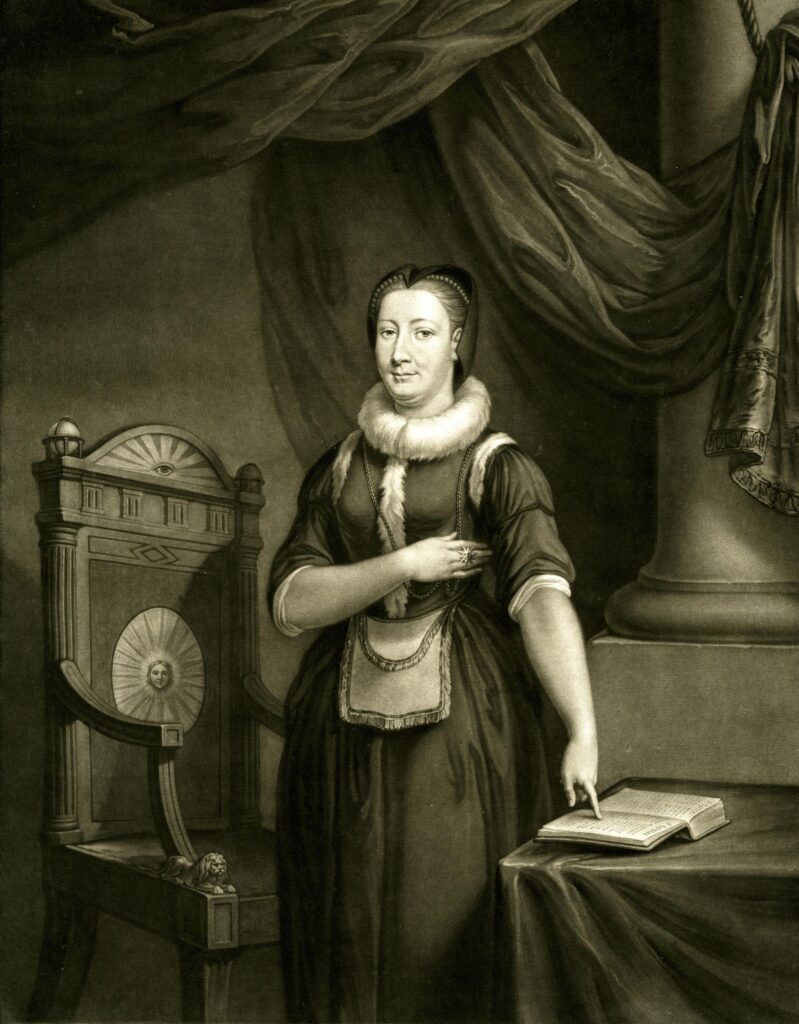
Portrait of Elisabeth Aldworth, initiated in 1712 in Ireland, depicted wearing a Masonic apron.
A few decades later, another example reinforces this reading. Jean-Baptiste Willermoz had his sister, Claudine-Thérèse Provensal, initiated within the Order of the Knights Elect Coëns of the Universe founded by Martinès de Pasqually, where she attained its highest degree, Réau-Croix. This was not a collective movement, but a deliberate decision, revealing a clear conviction: nothing within the initiatic structure itself rendered such an initiation inconceivable.
These cases cannot be taken as models. They remain exceptions. Yet they are illuminating. They show that the exclusion of women was not grounded in symbolic or ritual impossibility, but in social, moral, and cultural equilibria that were deemed preferable not to disturb. In this sense, these exceptions are not accidents of history: they reveal, by contrast, the true nature of the rule.
Adoption Freemasonry: controlled opening or deliberate distance?
Apart from these isolated cases, the first attempt at a broader opening to women did not take the form of full initiation, but of a compromise. It emerged within eighteenth-century French Freemasonry, in a cultural context markedly different from that of England. Whereas the British world favoured the strictly male model of the private club, France witnessed the flourishing of literary salons, often hosted by women, where philosophers, writers, and scholars met in a mixed sociability shaped by conversation and refinement. In such a setting, the complete exclusion of women from Masonic practices became increasingly difficult to sustain.
It was within this context that Adoption Freemasonry took shape. From the 1740s onwards, specific rituals were devised to allow women to take part in Masonic work designed expressly for them. These were not the rituals of speculative Freemasonry in the strict sense, but simplified moral and symbolic ceremonies, placing greater emphasis on virtues than on initiatic progression. The very structure of these Lodges betrayed their ambiguous status: always attached to a male Lodge, they remained under supervision, their work presided over by a double college associating Sisters with Officers drawn from the “proper” Lodge.
The official recognition of Adoption Lodges by the Grand Orient of France in 1774 did nothing to alter this dependency. Adoption thus constituted a limited form of opening, socially acceptable yet initiatically incomplete. Women were admitted not as fully engaged subjects of an autonomous Masonic path, but as participants in a derivative practice, carefully circumscribed. Under the appearance of inclusion, Adoption Freemasonry maintained a distance that once again reveals that the obstacle was not symbolic in nature, but lay in a social balance that one was still unwilling to disrupt.
From half-measures to initiatic equality
Adoption Freemasonry and the various para-Masonic structures open to women shared a common feature: none of them fundamentally challenged the principle of an implicit hierarchy between the sexes. They offered a form of participation that was supervised and sometimes socially valued, yet without recognising women as fully initiatic subjects. Equality was neither sought nor envisaged.
The break occurred in an entirely different context, that of late nineteenth-century France. Women’s demands no longer arose from mondain sociability, but from political and civic struggle. Claims for equal rights entered the public sphere, and Freemasonry could not remain untouched by these developments. It was in this climate that, in 1882, a Lodge of the Grande Loge Symbolique Écossaise initiated Maria Deraismes. The event caused an immediate scandal and swift disciplinary reaction: the Lodge was suspended, and only reinstated on the express condition that Maria Deraismes’s name be removed from its rolls.
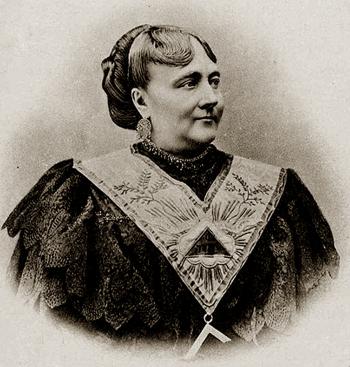
Portrait of Maria Deraismes, initiated in 1882, depicted wearing the collar of a Worshipful Master.
The story might have ended there. But in 1893, Maria Deraismes, with the support of Georges Martin, took a decisive step by initiating sixteen women and founding a new Obedience explicitly based on mixity. With Le Droit Humain, the initiation of women ceased to be a tolerance or an exception: it became a principle. Men and women were received on a strictly equal footing, according to the same rites and the same requirements. For the first time, initiatic equality was no longer a social concession, but a foundational choice, consciously and openly affirmed.
Female Freemasonry and the question of recognition today
The creation of mixed Obediences was not the only response to the question of women’s initiation. In France, another path emerged: that of an exclusively female Freemasonry, practising the same rites as men. In 1907, the Grande Loge de France sought to respond in its own way to women’s demands by reviving Adoption Lodges in a renewed form. From this movement arose, after the interruption caused by the Second World War, the Union Maçonnique Féminine de France, founded in 1945, which in 1952 took the name Grande Loge Féminine de France. It gradually abandoned the Adoption Rite in favour of the Ancient Accepted Scottish Rite, later followed by the French Rite and the Rectified Scottish Rite.
An autonomous female Freemasonry, fully initiatic in nature, thus came into being. It no longer presented itself as an adaptation or a concession, but as a complete and self-assumed practice, comparable in every ritual respect to that of male Obediences. This model soon spread beyond France, notably to Switzerland, Belgium, Italy, Portugal, Spain, and several countries in Latin America. At the same time, other mixed Obediences were created, often emerging from Le Droit Humain, while certain structures adopted more flexible models, allowing each Lodge to choose whether it wished to be male, female, or mixed.
Today, women may be initiated within a wide range of Lodges and Obediences belonging to liberal Freemasonry, whether mixed or exclusively female. Even historically male Obediences, such as the Grand Orient of France, have opened this possibility since 2010, without themselves becoming mixed as Obediences. The landscape has thus been profoundly transformed. And yet, a question remains unresolved. As long as certain Obediences, in the name of regularity or a fixed conception of tradition, refuse any recognition of Sisters and of the Lodges that initiate them, initiatic equality remains incomplete. What is at stake is no longer access to the Temple, but the recognition of those who already work within it.
Conclusion – Women in Freemasonry and initiatic recognition
The history of women in Freemasonry shows that their exclusion rested neither on symbolic impossibility nor on ritual necessity, but on social conventions long regarded as unquestionable. As these conventions were gradually challenged and overcome, female and mixed forms of Freemasonry established themselves as fully initiatic practices in their own right. The question that now arises is no longer that of legitimacy of presence, but of recognition. As long as that recognition remains partial, the debate on women in Freemasonry will remain open, not as a social demand, but as a genuinely Masonic issue.
By Ion Rajolescu, Editor-in-Chief of Nos Colonnes — serving a Masonic voice that is just, rigorous, and alive
Discover the regalia of the Grande Loge Féminine de France
Explore our collection of regalia designed for the Lodges and Sisters of the Grande Loge Féminine de France, created in accordance with ritual practice and initiatic standards.

1 Have women always been excluded from Freemasonry?
No. While exclusion was the norm in British speculative Freemasonry, documented exceptions appear as early as the early eighteenth century, showing that this was not an absolute initiatic impossibility but an institutional and social choice.
2 Is the exclusion of women based on Masonic symbolism?
Nothing in Masonic symbolism requires the exclusion of women. On the contrary, Freemasonry is built on the interplay and reconciliation of opposites, including symbolic dualities.
3 Does the building trade justify an exclusively male Freemasonry?
No. Although building trades were predominantly male, women were never entirely absent from them. The argument of the craft alone cannot justify initiatic exclusion.
4 What is Adoption Freemasonry?
It refers to female Lodges that emerged in eighteenth-century France, attached to male Lodges. They practiced specific rituals but remained under male supervision and were not fully autonomous.
5 Can Adoption Lodges be considered truly initiatic?
From an initiatic standpoint, Adoption Freemasonry represents a half-measure. It allowed symbolic participation but did not recognize full initiatic equality.
6 When did mixed Freemasonry emerge?
Mixed Freemasonry emerged in France at the end of the nineteenth century, with the initiation of Maria Deraismes in 1882 and the founding of Le Droit Humain in 1893, which explicitly affirmed initiatic equality between men and women.
7 Does an exclusively female Freemasonry exist?
Yes. The Grande Loge Féminine de France, founded in 1952, practices the same rites as male Obediences, including the Ancient Accepted Scottish Rite, and represents a fully autonomous female Freemasonry.
8 Are women widely admitted into Freemasonry today?
Yes, within many mixed and female Obediences, as well as within some historically male Obediences belonging to liberal Freemasonry. However, so-called regular Obediences continue to refuse their admission.
9 Why does recognition remain a central issue?
Because initiation alone does not guarantee full Masonic legitimacy. As long as certain Obediences refuse recognition to Sisters and to Lodges that initiate them, equality remains incomplete.
10 Is the debate on women in Freemasonry settled?
No. It has shifted. The issue is no longer access to initiation, but mutual recognition between Obediences — a profoundly Masonic question that remains unresolved.
Read the full transcript of the podcast here for those who prefer reading or want more detail.
Podcast – Women in Freemasonry: from exclusion to recognition
The question of women in Freemasonry continues to provoke debate and tension. It is often framed in terms of equality versus tradition, as if it were merely an ideological confrontation. But this framing is misleading. The real issue is not one of opinion, but of initiatic foundations.
Modern speculative Freemasonry took shape in a world where the exclusion of women from public life was taken for granted. That exclusion was later elevated to a rule, and then to a tradition. Yet a rule is not necessarily a principle, and a tradition is not always initiatically grounded.
Nothing in Masonic symbolism requires the exclusion of women. Freemasonry works with duality, with the tension of opposites, and with their resolution. Sun and Moon, black and white, opposing Columns: the symbolic language consistently points toward complementarity rather than closure.
History itself fractures the narrative of absolute impossibility. As early as seventeen twelve, in Ireland, Elisabeth Aldworth was received as a Mason. Later, Jean-Baptiste Willermoz had his sister Claudine-Thérèse Provensal initiated within the Order of the Élus Coëns of the Universe founded by Martinès de Pasqually, where she attained the degree of Réau-Croix. These cases are rare, but they suffice to show that the prohibition was not of an initiatic nature.
In the eighteenth century, Adoption Freemasonry offered a controlled opening. Women were admitted, but within supervised structures, without real autonomy. A half-measure: socially acceptable, but initiatically incomplete.
The rupture came at the end of the nineteenth century. In eighteen eighty-two, Maria Deraismes was initiated. In eighteen ninety-three, together with Georges Martin, she founded a form of Freemasonry explicitly based on mixity and initiatic equality. For the first time, the initiation of women became an affirmed principle.
In the twentieth century, another path emerged with the creation of an exclusively female Freemasonry, autonomous and practicing the same rites as men. Women were no longer invited, tolerated, or supervised; they worked there in full responsibility.
Today, access to initiation is no longer the core issue. The question has shifted. It is now one of recognition. Can one be fully Masonic when entire segments of Freemasonry still refuse to recognize that status? The debate is no longer social. It is profoundly Masonic.


JE VEUX RECEVOIR LES ACTUALITÉS ET EXCLUSIVITÉS !
Restez au courant des nouveaux articles de blog, des nouveautés et promotions Nos Colonnes.
